


If you've looked into lasers to remove a tattoo, you've probably heard of PicoWay Laser. There's a reason it's frequently mentioned as a tattoo removal device.
Reasons vary, such as when the shape and color have faded over time, or when you're unhappy with it and want to remove it quickly. Whatever the case, we've compiled information that's good to know before you start.
From Nanoseconds to Picoseconds
In the past, Q-switched nanosecond-based devices were primarily considered. Recently, picosecond lasers, which emit light in a shorter time, are widely used. This is in units of one trillionth of a second.
As the pulse shortens, thermal damage to the skin is reduced, and pigment ink can be broken down into finer particles. The types of PicoWay Laser have also diversified accordingly.

Wavelengths are chosen according to color and intensity
As perceptions of tattoos have become more flexible, the areas where they are etched have diversified, and the colors used have become much more vibrant. PicoWay Laser tattoo removal is performed with various wavelengths, allowing for the combination of wavelengths according to color, such as red, green, and blue, and also according to intensity.
Device configurations are detailed in R-Zero Pico-Frectat Tattoo Removal, and other methods are summarized in Nd:YAG Tattoo Removal.
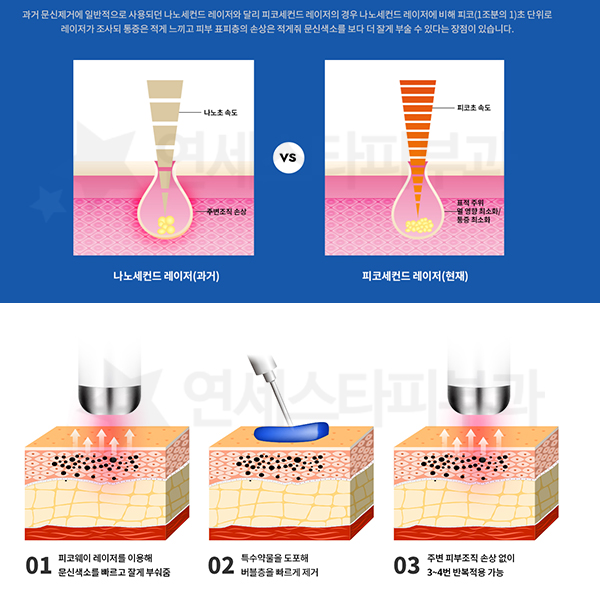
Two things that make decisions difficult
Pain is often cited as a reason why people hesitate to decide on tattoo removal laser treatment. Since it's a procedure that needs to be performed consistently over a long period, people tend to prefer methods with less pain and devices with supporting performance.
Another factor is repetition. Since it's a process involving multiple laser stimulations, it's important to receive treatment from experienced medical staff to minimize side effects like scarring.
The role of the Pinhole Technique
Along with equipment that enhances safety, to reduce the likelihood of scarring, the treatment method should also be considered. One such method is the Pinhole Technique.
By combining CO2 laser to create microscopic holes in the treated area, the skin's regenerative capacity is enhanced. Adding this process can help reduce potential side effects like scarring that may occur during tattoo removal.
The Pinhole Technique is a well-established method in clinical practice, even used for treating various scars.
Detailed principles can be found in the Pinhole for Burn & Surgical Scar guide.
| Process | Role |
|---|---|
| PicoWay Laser | Breaks down and decomposes pigment into fine particles |
| Wavelength combination | Adjustment according to color and intensity |
| Pinhole Technique | Activates regeneration through microscopic holes |
| Pinhole Technique | Prevents side effects such as scarring |

What to consider before the equipment
While equipment is important, there are factors that need to be checked before starting.
- Tattoo color
- Tattoo shape
- Tattoo size
- Skin type
Since these factors need to be considered comprehensively, we recommend consulting thoroughly with a clinic experienced in tattoo removal to create a plan that suits you. The treatment flow is available in the Tattoo Removal Treatment Guide.


Authored and Medically Reviewed by Chief Director Lee Sang-joo (Dermatologist) Board-certified Dermatologist · Graduated from Yonsei University College of Medicine · Completed residency in Dermatology at Severance Hospital Currently Adjunct Professor, Department of Dermatology, Yonsei University College of Medicine · Author of Medical Skincare, Skin Barrier View Medical Staff Profile
First published 2025-10-27 · Last reviewed 2026-07-29
This article contains general medical information and is not a substitute for individual diagnosis and treatment. Results and recovery may vary by individual.