


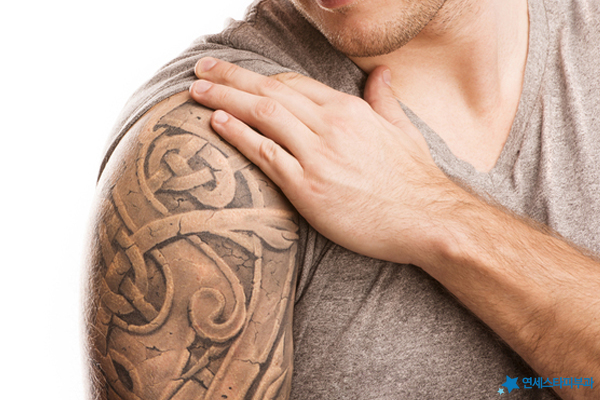
As the biting cold gradually eases and days lengthen, there are signs of a seasonal change. When clothes become lighter, you might feel anxious about whether a tattoo on a naturally exposed area like the shoulder can be removed within your desired timeframe.
Why the color doesn't disappear all at once
Laser tattoo removal works by breaking down pigment particles with a laser and expelling them.
It is not removed all at once, but gradually fades and disappears sequentially.
Therefore, it is advisable to start promptly before summer, when shoulder exposure increases.

How painful is the shoulder area?
Many people worry about how severe the pain will be, as the laser needs to be applied repeatedly to the skin. These days, tattoos are placed on various body parts, and there are slight differences in the intensity of pain felt depending on the area, not just the skin's nature.
If performed safely by an experienced clinic, removal can be more comfortable. Individual differences in pain perception may exist.

What to consider for darker and more varied colors
If the tattoo on your shoulder has various colors or is distinct and dark, it may take longer and be more challenging to remove. In such cases, the following items should be checked before making a decision:
| Item to check | Content |
|---|---|
| Equipment | Whether advanced laser equipment is used |
| Anesthesia | Whether safe anesthesia methods are available to reduce pain |
| Skill | Whether an efficient removal method is employed |
The use of picosecond devices, which can break down pigments much faster than conventional nanosecond lasers, is increasing. PicoWay has four wavelengths that can be used with a single device, making it easy to customize for various colored tattoos.
Method for quickly removing bubbles
Generally, after one laser application, white bubbles appear on the treated area. These bubbles obstruct laser penetration, making it difficult to perform consecutive treatments.
- The R0 method quickly removes these bubbles with a special solution.
- It prepares the treated area for consecutive laser applications.
- Consequently, it helps reduce the overall treatment time.
Details of this method can be found in the R-Zero Pico-Frectat Tattoo Removal guide, and information on other types of equipment can be found in Nd:YAG Tattoo Removal.

Instead of increasing intensity, we plan
It is advisable to understand that removing a shoulder tattoo with a laser is a process that takes some time and to proceed with the goal of gradual improvement. Forcibly increasing laser intensity or shortening treatment intervals can lead to severe skin irritation and side effects such as scarring or pigmentation.
A plan that considers both the tattoo and the skin
A process of comprehensively assessing the condition of the tattoo and skin, developing a treatment plan, and proceeding meticulously is necessary. The sequence and consultation flow are summarized in the Tattoo Removal Treatment Guide, and if you are curious about what is possible within the remaining period, you can ask via Chat now.
Authored and medically reviewed by Representative Director Dr. Kang Jin-moon (Dermatologist) Graduated from Yonsei University College of Medicine · Resident in Dermatology at Severance Hospital Currently, Adjunct Professor at Yonsei University College of Medicine, Department of Dermatology · Member of the Korean Society for Aesthetic and Dermatologic Surgery View Medical Staff Profile
First published 2026-02-25 · Last reviewed 2026-07-29
This article contains general medical information and does not substitute for individual diagnosis and treatment. Results and recovery may vary individually.