


The clavicle is often cited as an area where tattoo removal can be particularly painful. If you've been delaying removal due to pain, understanding why it feels more painful and what can alleviate that discomfort may help you make a decision.

Three Conditions That Lead to Greater Pain
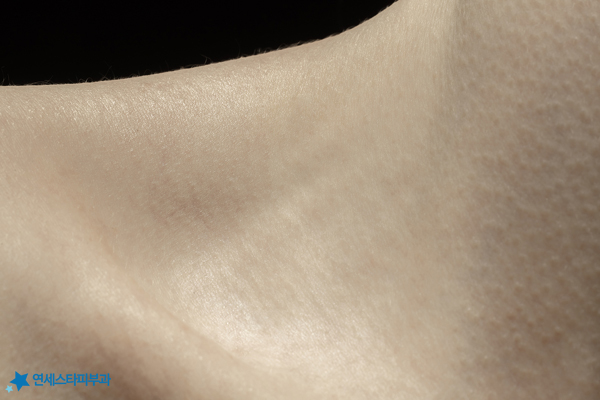
The clavicle is a prime location where strong pain can be felt during laser procedures. The reasons can be summarized into three main points:
- The subcutaneous tissue is thin, and there is almost no fat layer, so the bone is felt directly. Stimulation of pain receptors occurs more directly even before the laser energy is delivered deep into the skin.
- The area around the clavicle has a dense distribution of sensory nerves. Even small stimuli can transmit a stronger sensation of foreignness, stinging, and tingling.
- Skin tension changes with every movement of the shoulders and arms. This can make the area more sensitive to external stimuli, leading to a greater momentary pain during the procedure.
While Pain Cannot Be Completely Eliminated
It is not possible to make the procedure completely painless. However, the degree of relief can vary depending on how the hospital utilizes anesthesia methods, equipment, and treatment protocols.
Even when receiving treatment on the same area, the perceived discomfort can be significantly reduced depending on the skin characteristics, the method of progression, and the experience of the practitioner.
What to Consider When Choosing Anesthesia Methods
When undergoing laser tattoo removal, various methods can be considered, from cryo-anesthesia and topical anesthesia to nitrous oxide and conscious sedation. While these play a positive role in reducing pain, it is advisable to make a careful decision as they can affect your health.
| Method | Key Features Discussed Here |
|---|---|
| Cryo-anesthesia | One of the options used to reduce pain |
| Topical Anesthetic Cream | One of the options used to reduce pain |
| Nitrous Oxide | A method that allows for minimal impact on daily life immediately after the procedure |
| Conscious sedation | Reduces pain, but health implications should be checked before deciding |
| Cooling | Administers cold air during the procedure to alleviate pain in real-time |
For highly sensitive areas like the clavicle, using nitrous oxide anesthesia can make the procedure much smoother. Adding real-time cooling, which delivers cold air deep into the lesioned skin, helps reduce discomfort throughout the treatment period.
If you have any questions, you can ask them via chat now.
The Impact of Pigment Fragmentation Speed on the Number of Sessions
Pico laser is a recent focus for treating various pigment issues. It can fragment pigment much faster than older nanosecond methods, allowing for safe application to the necessary areas.
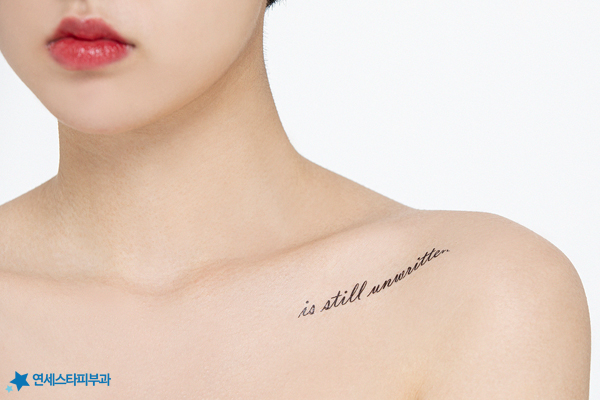
Due to the thin skin layer of the clavicle, tattoo ink is often situated relatively deep. Therefore, it is not uncommon for 5 to 10 or more repeated irradiations to be necessary.
Using equipment with good pigment-destroying power can lead to expected results without an excessive increase in the number of sessions.
As the intensity and frequency of laser stimulation decrease, the burden of pain also lessens. Equipment configurations are detailed in R-Zero Pico-Frectat Tattoo Removal, and other methods are summarized in Nd:YAG Tattoo Removal.

A Place with Pain Management, Equipment, and Experience
Due to the thin skin and numerous nerves in the clavicle area, pain can be felt relatively strongly. The perceived sensation may vary from person to person.
By effectively combining advancements in lasers with various methods such as cryo-anesthesia and nitrous oxide anesthesia, procedures often proceed more smoothly than expected. As it is a sensitive area, we recommend undergoing treatment at a place equipped with pain management, appropriate equipment, and extensive experience. The overall treatment flow can be found in the Tattoo Removal Treatment Guide.

Authored and Medically Reviewed by Representative Director Dr. Lee Sang-Joo (Dermatologist) Graduated from Yonsei University College of Medicine · Ph.D. in Medicine, Yonsei University Graduate School of Medicine Former Head of Dermatology, National Police Hospital · President of the Korean Dermatological Association in 2026 View Medical Staff Profile
First Published 2025-12-03 · Last Reviewed 2026-07-29
This article provides general medical information and does not substitute for individual diagnosis and treatment. Results and recovery progress may vary from person to person.