
![Causes of Depressed Facial Scars, Why Laser is Effective, and What Method You Need | [Yonsei Star Dermatology Sinchon]](/_next/image?url=https%3A%2F%2Fagqdgbuateknhwpocrgu.supabase.co%2Fstorage%2Fv1%2Fobject%2Fpublic%2Fsources%2Fbbf3bebe-45b6-4415-bd04-bda18b2cac0f%2Fblog-images%2F223819656835_00_975e9a3e50eb.jpg%3Ftype%3Dw966&w=3840&q=75)
Many people have experienced wounds from fingernail scratches or bumping into sharp objects that didn't heal cleanly, leaving depressed marks even after time. This is especially concerning if the mark is on the face. The first question that often comes to mind is: Why do some wounds heal cleanly, while others leave depressed marks? The key lies in how deep the damage has reached into the skin.
Why Do Some Wounds Become Scars?
It's not uncommon for our skin to get small wounds in daily life. Besides external injuries, marks can also remain after skin conditions like acne or chickenpox, or depressed facial scars can occur during the process of mole removal for cosmetic purposes.
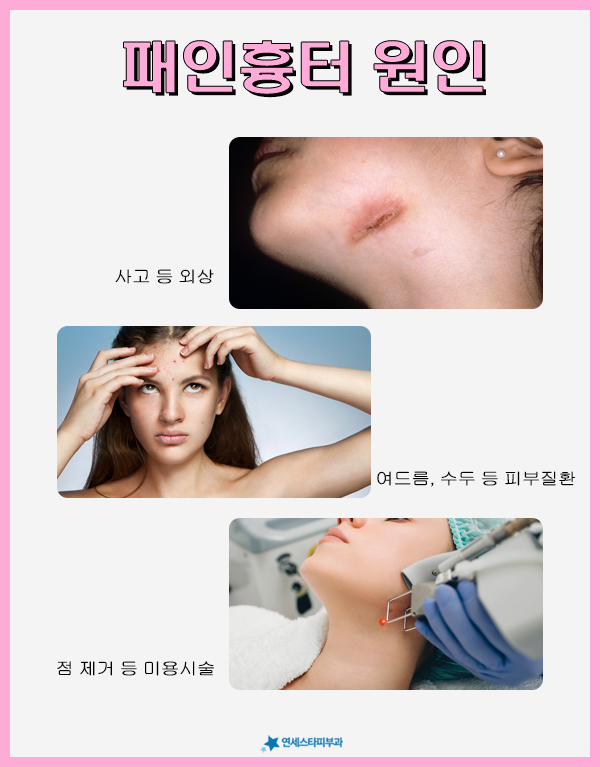
While these marks can arise through various paths, there's a common reason why they fail to fully recover and remain as depressed forms: the depth of the damage.
Depth of Damage Determines Recovery
When skin damage occurs, if the wound remains only in the area above the sebaceous glands, there's a high probability it will restore close to its original state. However, if the wound is created deeply below that, the likelihood of scarring increases.

The essence of a depressed scar is not a surface problem, but a state where collagen in the dermal layer has not been filled.
In the clinic, many people try to solve the problem by only looking at the epidermis and using ointments or cosmetics, but the actual problem lies in the deeper dermal layer.
Why Is Home Care Limited?

To treat depressed facial scars, it's important to address the problem in the dermal layer, where collagen is deficient and hasn't been filled, rather than just the visible epidermal layer. Since the treatment effect needs to reach deep skin layers that are not easily visible, it can be difficult to achieve satisfactory changes with home care methods alone, and even with consistent management, it's often hard to feel a significant difference.
Here are some points to check at the home care stage:
- Distinguish whether the mark is simple pigmentation or an actual depressed form.
- Manage to prevent further worsening with moisturizing and UV protection.
- Understand that epidermal exfoliation alone cannot fill dermal layer deficiencies.
- If changes are slow, seek diagnosis from medical professionals to confirm the depth of damage.
If you have any questions, feel free to ask through chat consultation regarding depressed acne scar treatment.
How Does Laser Treatment Work?

Laser treatment intentionally applies microscopic stimulation to the depressed area, inducing the skin to activate its own regeneration process. In this process, fibroblasts are stimulated to produce collagen to fill the deficient areas, and the mark can become fainter, with the skin filling up to resemble normal skin. However, the degree and speed of change may vary individually.
It is reported that combining skin boosters like Rejuran or Juvelook to aid collagen production can be more helpful for treating depressed facial scars.
Treatment Varies by Scar Type
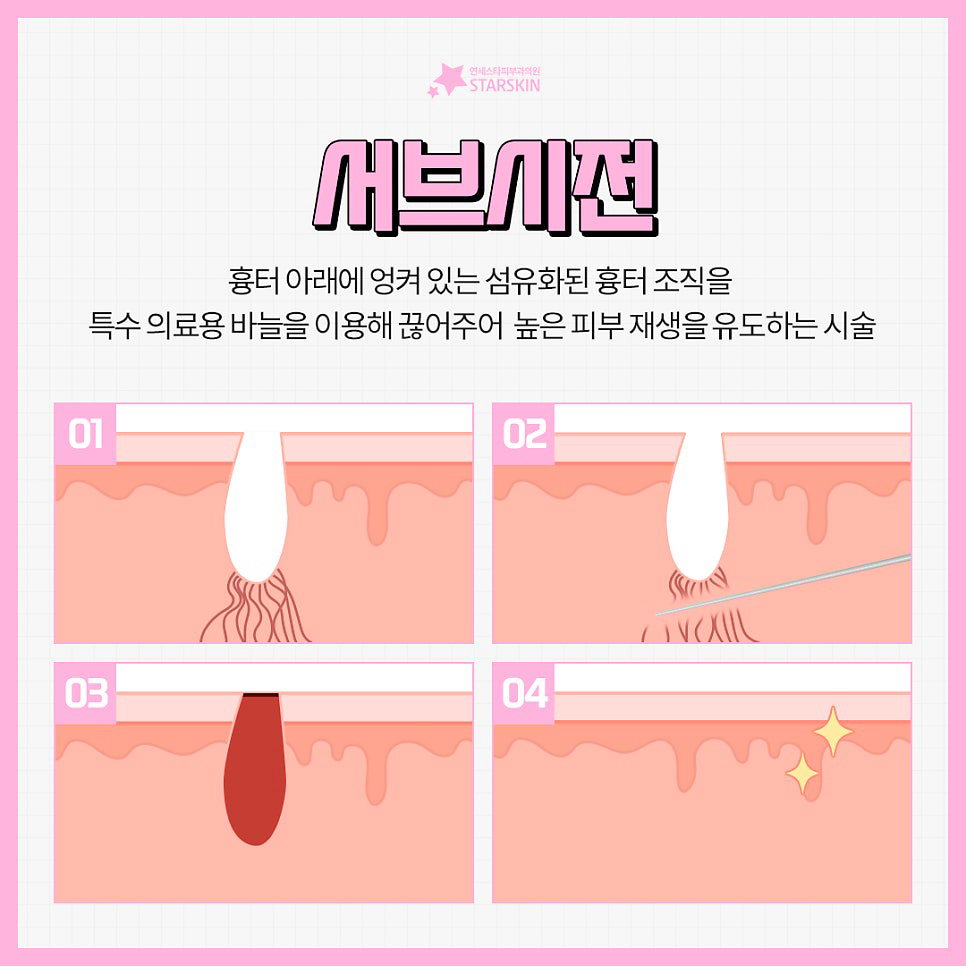
In some cases, other procedures may need to be applied in conjunction with laser treatment. Sometimes, fibrous bands within the skin pull the scar base downwards, creating a deeply indented shape. For such forms, the Subcision method is suitable. A medical needle is used to cut these fibrous bands, helping the depressed skin to rise again.
| Approach | Working Principle | Suitable Situation |
|---|---|---|
| Laser Treatment | Induces collagen regeneration with micro-stimulation | Rough surface and shallow depressed marks |
| Combined Skin Boosters | Supports collagen production environment | When dermal deficiency is present |
| Subcision | Cuts pulling fibrous bands | Deeply indented forms with a depressed base |
The appropriate method varies depending on the shape and depth of the scar, so it's difficult to treat all depressed scars uniformly with a single procedure.
How Consistently Should I Manage It?

If depressed facial scars have already formed, it's difficult to see dramatic improvement with just one or two treatments. However, if you consistently continue with the methods needed for you, based on the treatments explained above, improvement can be expected even for marks that appeared in childhood and remained into adulthood.
No one welcomes scars that don't disappear over time. If they are on the face, they are even more noticeable and, depending on their condition, can affect one's overall impression, so there's a strong desire to maintain a clean appearance. If you have similar concerns, it might be helpful to explore methods tailored to the shape, such as Premium Customized Acne Scar Care or Surgical Scar Revision.
💬 Consult NowDiagnosis First, Then Treatment

Even if they appear to be the same depressed scar, the necessary approach varies depending on the depth and shape of the damage. Therefore, the most important thing is a thorough diagnostic process to accurately assess the current condition. If the marks bother you, we recommend visiting a dermatology clinic to accurately confirm your condition and then decide on the appropriate direction for you.
Chief Director Lee Sang-Joo (MD, PhD, Yonsei University College of Medicine and Graduate School, completed dermatology residency at Severance Hospital, President of the Korean Dermatological Association) Chief Director Lee Sang-Joo's Profile First published 2025-04-02 / Last reviewed 2026-06-16
This content is for general information purposes only, and treatment results may vary individually. Please consult with medical professionals for an accurate diagnosis and treatment plan.