
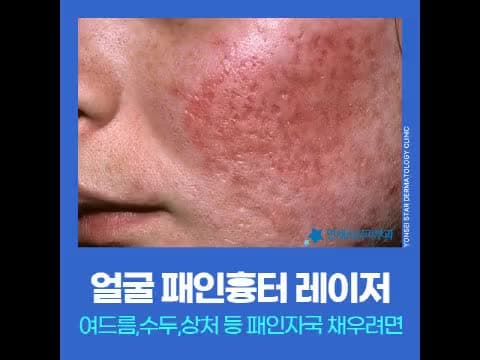
If you are concerned about depressed marks on your face that stand out under certain lighting or sunlight, let's first address why these marks do not fill in on their own.
Depressed scars have various origins: marks left by acne, traces from chickenpox or trauma, and even marks remaining after procedures. The commonality is that the dermal layer structure is damaged, making it difficult for the skin to fill in on its own over time. Therefore, an approach that actively stimulates skin regeneration from the outside is necessary.
Why Depressed Scars Don't Disappear on Their Own
Depressed scars are those where the collagen tissue in the dermis, the middle layer of the skin, is damaged and not repaired, leading to a hardened, sunken surface. If acne becomes severely inflamed or repeated squeezing occurs, the inflammation can extend to the dermal layer. If collagen is not sufficiently replenished during the healing process, depressed marks remain.
In particular, acne scars are often more challenging to treat than scars from single incidents like chickenpox or trauma, because damage accumulates from prolonged, repeated inflammation in the same area. Understanding the characteristics of specific types, such as atrophic acne scars, is the starting point.
How Regenerative Lasers Work
For depressed scars to fill in, new collagen must be generated in the dermal layer, and new skin must form around the damaged area. However, the skin's own regeneration has limitations when dealing with already hardened scar tissue.
Regenerative lasers create microscopic thermal stimulation zones in the dermal layer, prompting the skin to perceive this as damage and initiate a healing response. In this process, new collagen and elastic fibers are generated, and the sunken areas gradually rise, leading to a smoother surface. This is not achieved in a single session but through repeated stimulation and healing, resulting in gradual improvement.
What is Ultrapulse Alpha?
Among the regenerative lasers used for depressed facial scars, Ultrapulse Alpha uses a 10,600nm wavelength that is absorbed by water in the skin, precisely vaporizing damaged dermal tissue and inducing new collagen production and skin remodeling. A key feature is its ability to finely control treatment density and depth.
- The 10,600nm wavelength is absorbed by dermal tissue to induce a regenerative response.
- Treatment density and depth can be adjusted to match the scar condition.
- Scars with varying depths and shapes in different areas are approached with personalized designs.
If you're curious about the right treatment design for your scar, you can check your condition first. Consult via chat now
When Subcision is Beneficial
Some depressed scars, like rolling scars, involve fibrous tissue adhesions beneath the skin. In such cases, no matter how much the surface is regenerated, the pulling force from below prevents the skin from rising. Combining subcision can be helpful in these situations.
Subcision is a procedure that involves inserting a special needle into the boundary layer between the dermis and subcutaneous fat, without incising the skin surface, to directly sever the fibrous adhesion tissue that pulls the scar downwards. Once the adhesion is broken, new collagen is generated in that space, creating an environment for the sunken skin to rise.
Depressed scars are not filled by stimulating the surface alone. Only when dermal regeneration and the removal of underlying adhesions occur together can the skin truly have space to fill in.
Dividing the Roles of the Two Approaches
Regenerative lasers and subcision act on different areas. The table below clearly shows why these two methods work in conjunction.
| Approach | Area of Action | Primary Role |
|---|---|---|
| Regenerative Laser (Ultrapulse Alpha) | Dermal layer | Induces collagen regeneration with micro-thermal stimulation, helping the depressed area to rise |
| Subcision | Dermis-subcutaneous fat boundary | Directly severs fibrous adhesions pulling downwards, securing space for new collagen to fill |
| Combination | Simultaneous top and bottom | Regeneration from above, adhesion removal from below, creating conditions for skin to fill in |
Why Scar Treatment Designs Vary
In clinical practice, scars often differ in depth and shape even within the same face, requiring a customized, multi-faceted approach rather than a single method. Depending on the scar type, various methods may be combined, such as Multi-Laser Scar Treatment or Premium Customized Acne Scar Care.
Our Approach to Scar Treatment
Depressed scars often cannot be resolved by merely stimulating the surface. Collagen regeneration must be activated in the dermal layer, and if necessary, fibrous adhesions pulling from below must be released for the skin to fill in naturally. Stimulating dermal regeneration with Ultrapulse Alpha and combining it with subcision, depending on the condition, can be helpful.
Since the method varies depending on the type, depth, and extent of the scar, we recommend consulting thoroughly with a dermatologist to create a plan tailored to your scar. Consult via chat now
Sang-Joo Lee, Chief Director · Dermatologist
As the Chief Director of Yonsei Star Dermatology Sinchon, he has long specialized in pigment and scar treatments. He will serve as the President of the Korean Dermatological Association in 2026 and is also an adjunct professor at the Department of Dermatology, Yonsei University College of Medicine. You can find more about the medical team on Chief Director Sang-Joo Lee's profile.
First published 2026-06-23 · Last reviewed July 23, 2026
This article provides general medical information, and treatment methods and results may vary depending on individual skin conditions. Please consult with a dermatologist for an accurate diagnosis and treatment plan.