
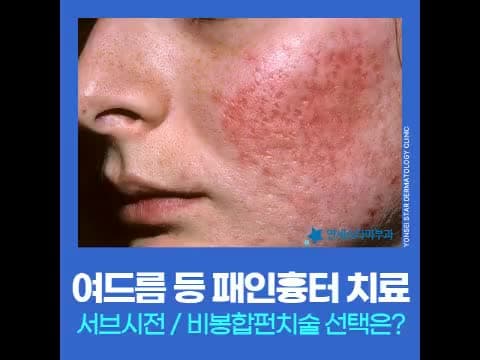
If your depressed acne scars remain even after multiple laser treatments, it's time to look at the deeper structure of the scar.
Depressed acne scars are not simply surface skin damage. Severe acne inflammation penetrates the dermal layer, destroying tissue, and during the healing process, collagen becomes abnormally entangled, forming fibrotic tissue. This tissue pulls the skin surface down like a thread, causing the scar to be much deeper than it appears on the surface.
Why Laser Alone Isn't Enough for Depressed Acne Scars
No matter how much the surface is regenerated with a laser, the pulling force from below prevents the skin from filling up. This is why combination treatments, which include surgical methods alongside laser, are more effective for scars deeper than 1-2mm than laser alone.
For depressed acne scars, regenerating the surface alone has limitations. The fibrotic tissue pulling from below must also be released to allow the skin to fill in.
First, Distinguish Scar Types
The first step in acne scar treatment is to accurately identify the shape of the scar. This is because the appropriate treatment method varies depending on the shape.
| Type | Shape | Characteristics |
|---|---|---|
| Icepick | Narrow and deep, like an ice pick | High treatment difficulty due to deep dermal damage |
| Boxcar | Clearly defined, flat-bottomed, rectangular depression | Suture-Free Punch is primarily applied to this type |
| Rolling | Wide depression with gently sloping edges | Often accompanied by fibrous adhesions beneath the skin |
In clinical practice, most acne scars are a mix of several types, so a single method is often insufficient.
What is Suture-Free Punch Excision?
Suture-Free Punch is an acne scar treatment that has been performed in the United States since the 1990s. It involves using a medical punch device to lift the depressed area to a normal height, then fixing the height with a special medication. In the past, punch techniques required sutures, which left suture marks. However, Suture-Free Punch uses a special medication for fixation without sutures, allowing for immediate return to daily life without a separate recovery period. New skin regenerates beneath the pulled area, and approximately one week after the procedure, the height becomes similar to the surrounding skin.
- Acne scar treatment method performed since the 1990s
- Primarily applied to 1-5mm boxcar-type depressed scars
- Fixed with special medication without sutures — immediate return to daily life without suture marks
- Approximately one week after the procedure, the height becomes similar to the surrounding skin
- Expect more balanced results when combined with laser treatment
Subcision, an Approach for Rolling Scars
Subcision is a procedure widely used for wide and deep rolling scars. It involves inserting a special medical needle into the boundary between the dermis and subcutaneous fat to directly cut the fibrotic tissue that pulls the skin down. When the fibrous tissue is severed, blood accumulates in that space, forming a hematoma. This hematoma supports the depressed area, matching its height. Approximately one month after the procedure, new skin cells and collagen are generated, and the depressed area gradually fills in.
| Category | Suture-Free Punch | Subcision |
|---|---|---|
| Primary Target | Boxcar type with clear boundaries | Wide and deep rolling type |
| Method | Lifted with punch and fixed with medication | Fibrous adhesions cut with special needle |
| Recovery Flow | Height similar after approx. 1 week | Fills in over approx. 1 month after hematoma formation |
| Note | No surface incision | Bruising within 1-2 weeks is a normal reaction |
Since the surface is not incised, it is possible to return to daily life immediately after the procedure. Bruising that appears within 1-2 weeks after the procedure is part of the process where the hematoma fills the scar, so it is important not to touch it arbitrarily. If you are curious about which type your scar is closer to, you can consult with scar photos via chat.
Combined Shockwave Laser — Simultaneous Top-Down Approach
Combining shockwave laser with subcision can help reduce the burden of skin irritation and enhance treatment effectiveness. Shockwave lasers like Veluti transmit laser energy deep into the skin by converting it into shockwaves through a special patch containing black diamond particles, a mechanical stimulation method that does not directly apply heat to the skin surface. Thanks to this, it can be a relatively less burdensome approach for those who were concerned about redness or pigmentation after traditional Fraxel or CO₂ lasers, or those with thin or sensitive skin. It relaxes hardened scar tissue and stimulates collagen regeneration, so when applied with subcision, a synergy can be expected, approaching the scar simultaneously from above and below.
Why a Combination Tailored to Scar Type is Important
Depressed acne scars often have limitations with treatments that only stimulate the surface. By addressing the structural causes of scars with Suture-Free Punch and subcision, and combining them with laser and shockwave treatments, a simultaneous top-down approach is possible. If the types are complexly mixed, a plan combining various methods, such as Premium Customized Acne Scar Care or Acne Scar Triple Repair, can be established through consultation. We recommend carefully assessing your skin condition and scar type before creating a customized plan. If you're unsure where to start, you can also leave your scar condition via chat for a consultation.
Author · Dr. Sang-Joo Lee, Chief Director View Profile As a board-certified dermatologist, Dr. Lee Sang-Joo leads Yonsei Star Dermatology Sinchon and will serve as the president of the Korean Association of Dermatologists in 2026. He is also an adjunct professor at the Department of Dermatology, Yonsei University College of Medicine, and has extensive experience in scar and pigment treatment. (First published 2026-07-21 · Last reviewed 2026-07-23)
This article provides general medical information about acne scars, and the procedures and outcomes may vary depending on the type and depth of the scar and skin condition. Please consult with a board-certified dermatologist for an accurate diagnosis and treatment plan.