
![[Yonsei Star Dermatology Sinchon] TPC Program for Enlarged Pores / Sinchon Dermatology](/_next/image?url=https%3A%2F%2Fagqdgbuateknhwpocrgu.supabase.co%2Fstorage%2Fv1%2Fobject%2Fpublic%2Fsources%2Fbbf3bebe-45b6-4415-bd04-bda18b2cac0f%2Fblog-images%2F222784370174_00_799cc550afd4.jpg%3Ftype%3Dw1&w=3840&q=75)
Have you ever looked closely in the mirror and noticed that the pores on your nose and cheeks were particularly prominent? The biggest concern with pores is that once they enlarge, they don't easily shrink back. To put it simply, it's difficult to reverse enlarged pores with cosmetics or home care alone; a medical approach that addresses both sebum control and collagen elasticity restoration is needed.
Why do pores, once enlarged, not shrink back?
Pores are channels that release sebum and waste products from the skin. After puberty, as sebaceous glands enlarge and sebum secretion increases, pores rapidly widen. For the same reason, pores tend to open up easily in summer when sebum secretion increases.
The problem is elasticity. For enlarged pores to shrink back, there must be a force that tightens them, which means elasticity around the pores. However, when collagen in the skin decreases, this elasticity drops, and pores become fixed in an enlarged state. This is why pore concerns often appear alongside fine lines and sagging skin, not just pores themselves.

Why do pores get larger in summer?
When temperatures rise, sebum secretion becomes more active, and elasticity around the pores relatively decreases. This is a time when pores can easily remain stretched due to a mixture of sweat and sebum. If pore care is delayed during this period, the enlarged state can become fixed, so it's advisable to focus on both sebum control and elasticity restoration.
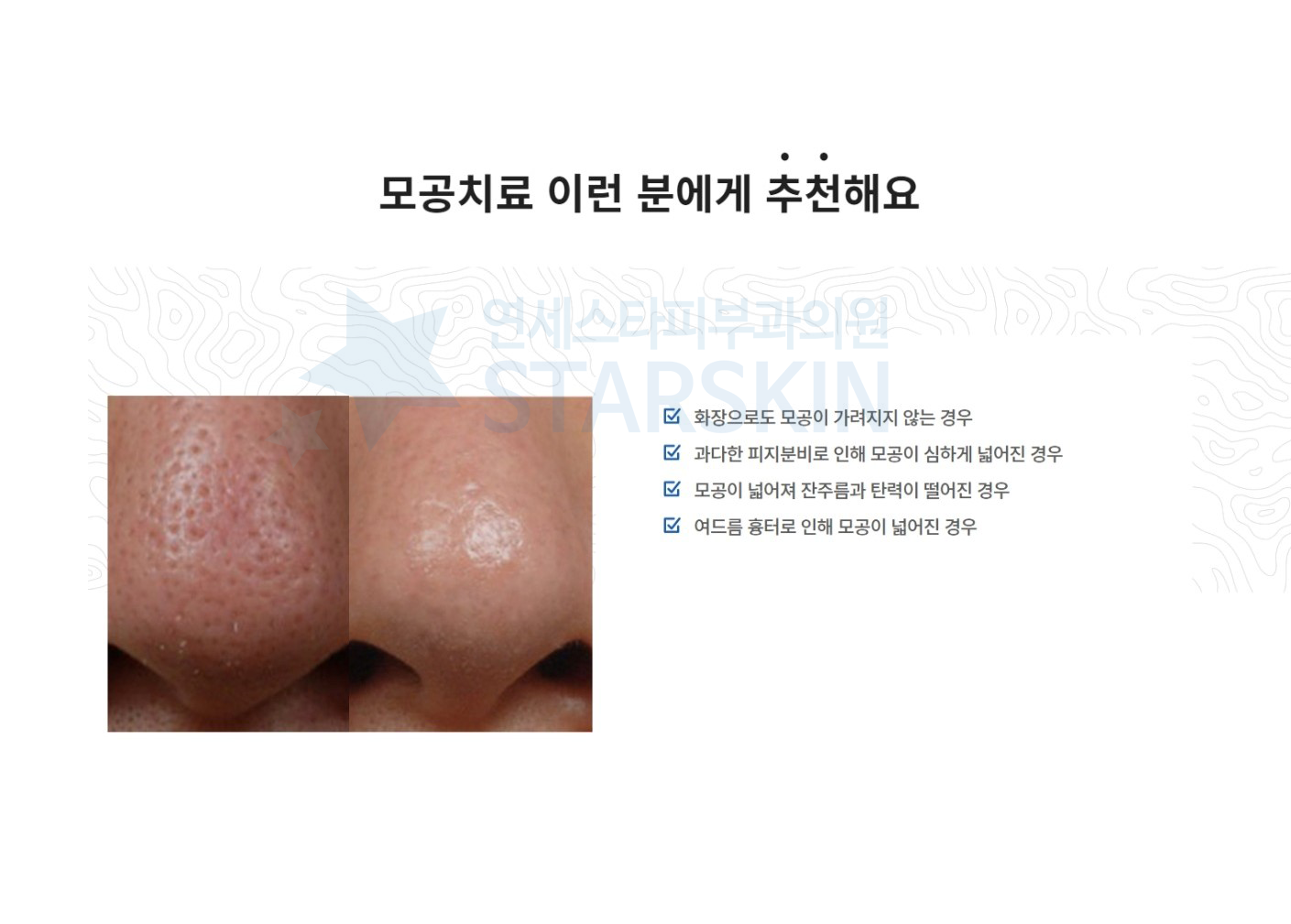
Consider treatment for these types of pores
In the clinic, those who fall into the following categories might consider pore treatment:
- When pores are not well covered even with makeup
- When pores are severely enlarged due to excessive sebum secretion
- When pores are enlarged, accompanied by fine lines and reduced elasticity
- When pores are enlarged due to acne scars
If depressed marks remain along with acne marks, making pores prominent, it may be accompanied by acne scars, so it's better to evaluate the scars together rather than just the pores alone.
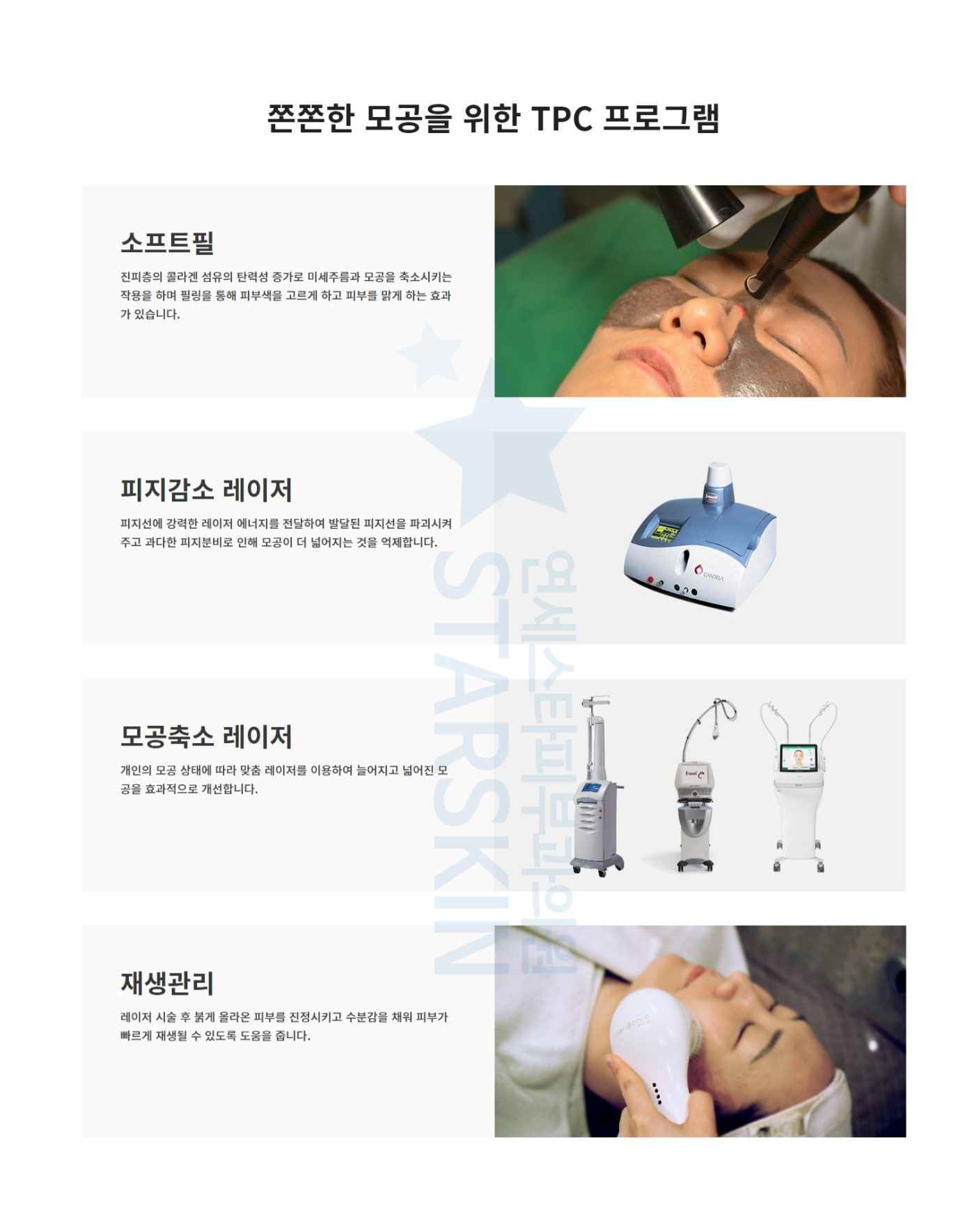
How is the TPC program structured?
Yonsei Star Dermatology Sinchon's TPC program addresses the various causes of enlarged pores by dividing them into stages. Rather than concluding with a single procedure, it's a method that separately handles keratin, sebum, elasticity, and regeneration.
| Stage | Goal | Mechanism |
|---|---|---|
| Soft Peel | Keratin management and skin tone | Increases the elasticity of collagen fibers in the dermis to reduce fine lines and pores, and evens skin tone through peeling |
| Sebaceous Gland Reduction Laser | Sebum secretion control | Delivers laser energy to developed sebaceous glands to reduce the cause of excessive secretion |
| Pore Reduction Laser | Improvement of enlarged pores | Improves enlarged pores with a laser tailored to the individual's pore condition |
| Regeneration Management Laser | Post-treatment calming | Calms reddened skin and replenishes moisture to aid rapid regeneration |
The core of this program is that it combines keratin removal, sebaceous gland stimulation, and pore elasticity enhancement into one flow.

If you're curious about which stage your pore condition falls into, you can check by inquiring about pore treatment consultation.
If pore concerns are accompanied by reduced elasticity
When pores appear with fine lines and sagging skin, sebum control alone may not be satisfactory. In this case, an approach that boosts skin elasticity itself is considered. This is why elasticity procedures like Thermage FLX or Ulthera Prime, and Water-Luminous Injection to supplement moisture and skin texture, are discussed alongside pore treatment.
It is reported that enlarged pores are often caused by a combination of factors, not a single cause, such as excessive sebum, collagen reduction, and reduced elasticity, thus requiring a complex approach tailored to the cause.
However, the appropriate combination may vary depending on skin type and pore condition, so there can be individual differences.

What to know after the procedure
As the procedure includes laser and peeling, temporary changes may appear immediately after the treatment. Knowing this in advance can prevent confusion during the recovery process.
- Temporary swelling or redness may occur.
- Light scabs or flaking may appear depending on the area.
- Recovery speed and reaction degree may vary individually.
- UV protection and moisturizing care can aid recovery.
These reactions usually subside over time, but the degree and duration vary from person to person.
If you're curious about the stage composition suitable for your pore condition and skin type, feel free to ask below.
💬 Consult NowIn summary
Enlarged pores are often caused by a combination of excessive sebum, collagen reduction, and reduced elasticity. Therefore, an approach that addresses keratin, sebum, elasticity, and regeneration in stages, rather than a single procedure, is reported to be helpful. The TPC program is structured to manage these causes step by step, so we recommend accurately checking your pore condition first.

Chief Director Lee Sang-joo (Yonsei University College of Medicine · Graduate School, Doctor of Medicine, Completed Dermatology Residency at Severance Hospital, President of the Korean Dermatological Association)
Chief Director Lee Sang-joo's Profile
First published 2022-06-22 / Last reviewed 2026-06-16
The degree and response of pore improvement may vary from person to person, and the appropriate treatment direction for you should be confirmed through consultation with medical staff.