
![[ Yonsei Star Dermatology Sinchon ] How to Remove Remaining Scar After Laser Lesion Removal / Sinchon Station Dermatology](/_next/image?url=https%3A%2F%2Fagqdgbuateknhwpocrgu.supabase.co%2Fstorage%2Fv1%2Fobject%2Fpublic%2Fsources%2Fbbf3bebe-45b6-4415-bd04-bda18b2cac0f%2Fblog-images%2F222988587827_00_5fa57993d078.png%3Ftype%3Dw966&w=3840&q=75)
Sometimes, after neatly removing a bothersome lesion with a laser, a new concern begins when the spot remains red and depressed, or new skin doesn't fill in well. Is it common for the spot where a lesion was removed to leave a mark for a long time? To conclude, most red marks immediately after lesion removal fade over time, but if there is no change after a certain period, it may have solidified into a scar.
Scars from lesion removal have different approaches for prevention and treatment after they have already formed. In this article, we will organize these two separately.
Reasons Why Scars Remain After Lesion Removal
Scars from lesion removal often result from the removal process and subsequent care, rather than occurring by chance. In the examination room, the following situations are frequently observed:
- When a deep-rooted lesion is removed forcefully in one go.
- When a regenerative band like DuoDERM is not maintained sufficiently after lesion removal and is removed prematurely.
- When the regenerative band is changed too frequently, not allowing new skin to settle.
- When the skin tissue is damaged by removing it deeper than necessary during the procedure.

As such, although lesion removal itself may seem simple, depth control and aftercare greatly influence the results. When undergoing Laser Lesion Removal, it is more helpful to approach it carefully according to the skin condition, rather than forcefully removing it deeply in one go, to reduce marks.
Distinguishing Between a Mark as a Scar or Still Recovering
Not all red marks immediately after lesion removal need to be definitively labeled as scars. Since skin regeneration speed varies from person to person, it can take anywhere from a short 1 month to a long 6 months for the area where the lesion was removed to fully recover.
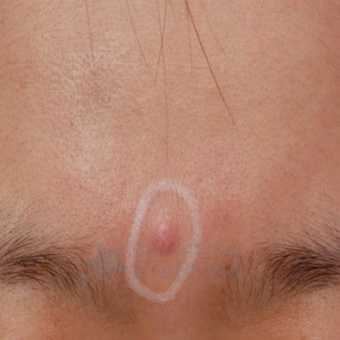
The problem arises when the mark remains unchanged even after sufficient time has passed. If the following conditions persist for more than a year after lesion removal, a scar can be suspected:
- If the mark is still deeply indented.
- If the redness around it does not subside.
- If it is white or hard and raised.
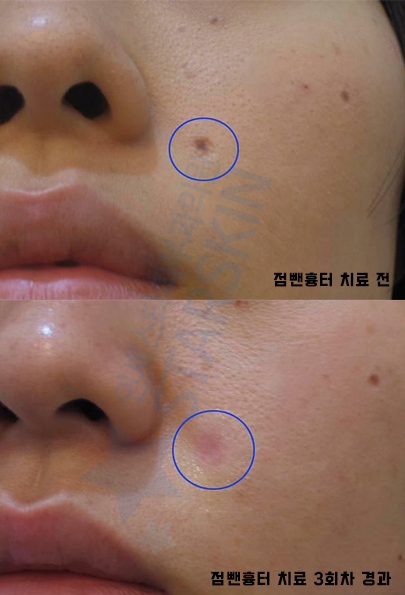
If the spot where a lesion was removed remains indented or raised for over a year, it is more realistic to consider it a scar and plan treatment, rather than waiting for natural recovery.
If it is difficult to determine which category your mark falls into, you can check your condition first by inquiring via chat consultation if you are curious about lesion removal scar treatment.
Two Types of Scars After Lesion Removal
Scars from lesion removal are broadly divided into raised and depressed forms, and the approach varies depending on the shape.
| Type | Appearance | Treatment Direction |
|---|---|---|
| Raised Scar | White or hard, raised | Injection treatment to break down collagen and lower the height |
| Depressed Scar | Indented with residual redness | Scar laser treatment to induce skin regeneration |

Raised Scars, Lowering Height with Injection Treatment
If collagen proliferates excessively due to skin damage during laser lesion removal, the area may become hard and raised. In such cases, Triamcinolone Scar Injection is performed to break down the overgrown collagen and reduce the height of the scar.
If the raised form shows characteristics of Keloid Scar or hypertrophic scar, injection treatment based on the same principle is applied, and the treatment interval is adjusted according to the nature and thickness of the scar.
Depressed Scars, Inducing Regeneration with Pinhole Technique
Red, depressed scars from lesion removal can be recovered with the Pinhole Technique, which creates microscopic holes in the scar area with a high-output scar laser to induce powerful skin regeneration. This method intentionally creates micro-damage to help new collagen fill in, and the intensity and frequency of Pinhole Alpha laser treatment are adjusted according to the depth and extent of the depression.
In addition to scars from lesion removal, there are depressed scars that are approached with a similar principle, so a treatment plan is established by considering the shape and depth of the mark together.
Summary of Aftercare to Reduce Scars
Care immediately after lesion removal greatly influences whether scars occur. It is good to remember the following points:
- Consistently maintain the regenerative band for at least one week after lesion removal.
- Do not change the band too frequently and allow new skin to settle.
- Pay attention to UV protection during the recovery period.
- If the mark shows no change for over a year, confirm with a medical examination rather than self-diagnosis.
The condition of the mark can vary individually, so even for the same lesion removal scar, the recovery pattern and suitable treatment may differ from person to person.
The dermatologists at Yonsei Star Dermatology Sinchon, with accumulated experience in scar treatment, will help you minimize scars from lesion removal and find ways to recover existing marks. Feel free to ask any questions through Lesion Removal Scar Treatment Consultation.

Representative Director Lee Sang-joo (MD, PhD, Yonsei University College of Medicine and Graduate School, completed dermatology residency at Severance Hospital, President of the Korean Dermatological Association) Representative Director Lee Sang-joo's Profile First published 2023-01-19 / Last reviewed 2026-06-16
This article contains general information about scars after lesion removal, and since the condition of the mark and suitable treatment vary individually, please confirm with a medical professional for an accurate diagnosis.