
![[Yonsei Star Dermatology Sinchon] How effective is laser treatment for stubborn nail fungus?](/_next/image?url=https%3A%2F%2Fagqdgbuateknhwpocrgu.supabase.co%2Fstorage%2Fv1%2Fobject%2Fpublic%2Fsources%2Fbbf3bebe-45b6-4415-bd04-bda18b2cac0f%2Fblog-images%2F222756749387_00_799cc550afd4.jpg%3Ftype%3Dw1&w=3840&q=75)
If your nails turn yellow, thicken, and become brittle, you might suspect nail fungus. The most common question we hear is, "I've used topical medications for a long time, but why isn't it getting better?" Nail fungus often shows slow improvement with typical external remedies alone because the fungal infection tends to establish itself deep within the nail.
In hot and humid summer environments, fungal infections can proliferate more easily, worsening symptoms. Many people hide their feet due to discolored and brittle toenails during seasons when bare feet are common. Today, we will explain the principles behind Yonsei Star Dermatology Sinchon's nail fungus laser treatment.
Why Does Nail Fungus Occur?
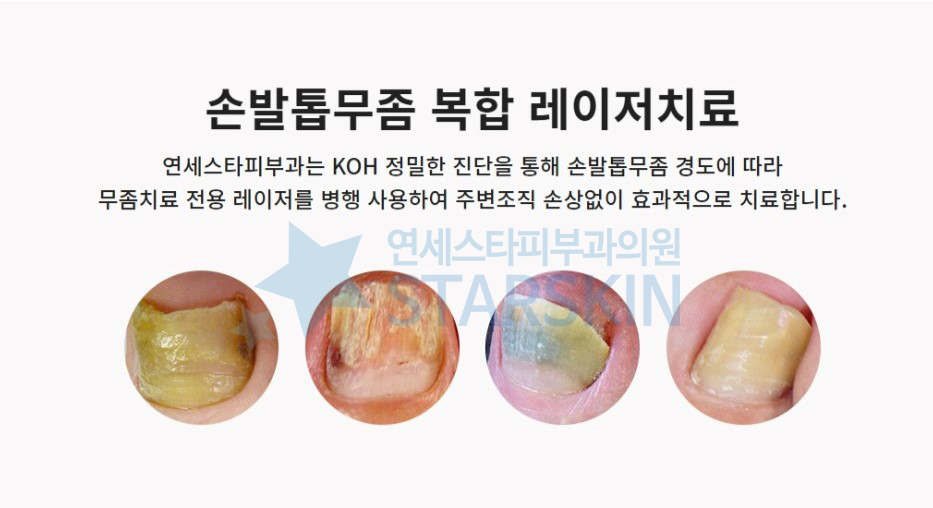
Nail fungus is caused by dermatophytes, a type of fungus. Dermatophytes, commonly found in the air, dust, and soil, can lie dormant on the skin around the nails and then penetrate the fingernails and toenails, causing the infection.

When the fungus settles deep within the nail, it can cause discoloration and thickening, and in severe cases, lead to crumbling or splitting. The hard keratinized structure of the nail itself makes it difficult for medication to reach deep areas, which is a factor that complicates treatment.
Why Previous Treatments Were Difficult
There's a reason why nail fungus treatment might have felt slow. In the clinic, we often see patients who are exhausted from long-term self-treatment with no visible changes. Existing treatment methods each have the following limitations:
- Topical medications are often difficult to absorb deep into the nail, making them less effective.
- Oral medications are effective, but long-term use can affect liver health, so caution is needed.
- Surgical removal of the nail or using medications to dissolve it is rarely used nowadays due to reported nail deformities and recurrence.
- If treatment is arbitrarily stopped midway, recurrence can occur due to remaining fungi.

It is known that due to the nature of nail fungus, where the fungi settle deep within the nail, approaches that only treat the surface have limitations.
Because of these limitations, laser treatment, which directly delivers energy to the affected area, is gaining attention as an alternative.
How Is Laser Treatment Different?

Yonsei Star Dermatology Sinchon performs laser treatment that directly irradiates thermal energy to the affected area under the nail, addressing the cause of the fungus. A characteristic of laser treatment is that it can be performed regardless of conditions such as pregnancy, breastfeeding, or liver health. This approach is also conceptually similar to Laser Lesion Removal, which treats fungal or viral skin lesions like nail fungus.
Laser treatment differs from existing methods by reducing the burden of oral medication and selectively targeting the area where the fungi are located.
If you are curious about nail fungus treatment, you can easily ask questions via chat about the laser treatment process.
PinPointe Laser
PinPointe Laser is a KFDA-approved device for nail fungus that selectively targets fungal cells by irradiating only the affected nail area with a laser, without irritating surrounding tissue. It is generally performed with almost no pain, making it less burdensome.
Another feature is its relatively simple procedure, taking about 10 minutes once a month. It is considered a less burdensome procedure as it may be covered by private health insurance. However, insurance coverage may vary depending on your enrolled product and terms, so it is advisable to check in advance.
OnychoLaser
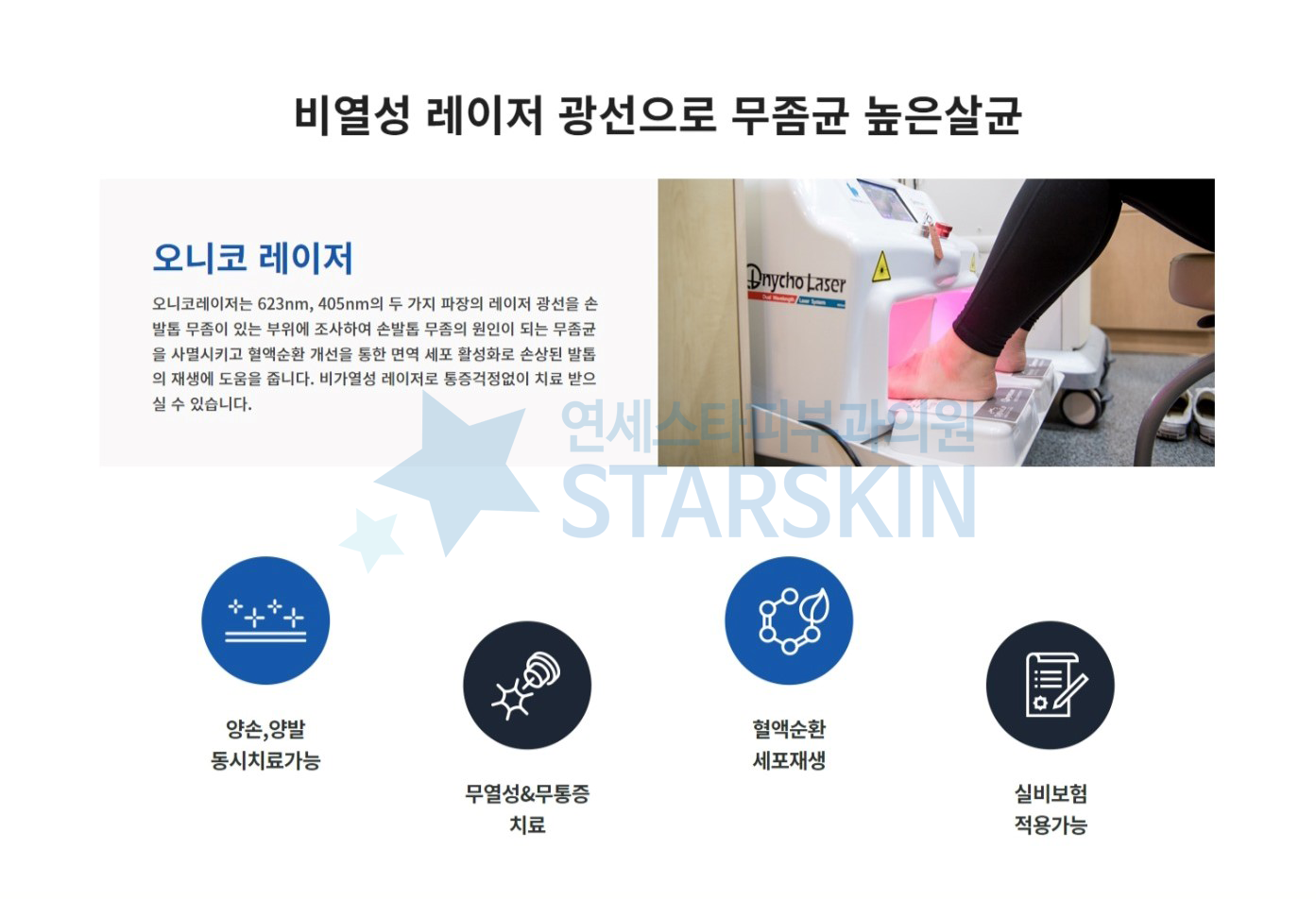
OnychoLaser is a method that treats the fungi causing nail fungus by irradiating the affected area with two wavelengths of laser light, 623nm and 405nm. It helps regenerate damaged nails by activating immune cells through improved blood circulation.
As a non-thermal laser, it can be treated with less concern about pain, and its advantages include private health insurance coverage and the ability to treat both hands and feet simultaneously. In terms of aiding blood circulation and tissue regeneration, it aligns with Hyperbaric Oxygen Chamber, which supports the recovery environment.
Comparison of the Two Lasers
| Category | PinPointe Laser | OnychoLaser |
|---|---|---|
| Method | Irradiates fungal area with thermal energy | Irradiates two wavelengths (623nm, 405nm) |
| Features | Less irritation to surrounding tissue, less pain | Non-thermal, aids blood circulation and regeneration |
| Procedure | Once a month, about 10 minutes | Both hands and feet can be treated simultaneously |
| Insurance | Private health insurance applicable (check terms) | Private health insurance applicable (check terms) |
The choice between the two lasers may vary depending on the patient's nail condition and the extent of the infection, so it is important to determine the direction based on a diagnosis.
Things to Know Before Treatment

Nail fungus takes time for new nails to grow, so consistent follow-up observation is needed rather than a one-time treatment. It is possible to confirm the nail condition through the diagnosis of 5 dermatology specialists experienced in nail fungus treatment and proceed in a way that minimizes damage to surrounding tissue.

Temporary swelling, redness, scabs, or flaking may appear depending on individual characteristics, so we recommend proceeding with treatment after sufficient consultation with the medical staff. If you are new to nail fungus treatment and feel overwhelmed, try chat consultation to find out about treatment suitable for your nail condition.
Chief Director Lee Sang-joo (MD, PhD, Yonsei University College of Medicine and Graduate School, Completed Dermatology Residency at Severance Hospital, President of the Korean Dermatological Association) Chief Director Lee Sang-joo's Profile First Published 2022-06-02 / Last Reviewed 2026-06-16
This content is for general information purposes only, and treatment effects and progress may vary individually. Please consult with medical staff for an accurate diagnosis and treatment plan.