
![[Yonsei Star Dermatology Sinchon] Effective Treatment for Severe Depressed Acne Scars / Sinchon Station Dermatology](/_next/image?url=https%3A%2F%2Fagqdgbuateknhwpocrgu.supabase.co%2Fstorage%2Fv1%2Fobject%2Fpublic%2Fsources%2Fbbf3bebe-45b6-4415-bd04-bda18b2cac0f%2Fblog-images%2F222793822757_00_799cc550afd4.jpg%3Ftype%3Dw1&w=3840&q=75)
When deep indentations remain on the face, they can't be covered with makeup, making it easy to feel self-conscious in front of the mirror. Many people wonder, "Why don't my acne scars disappear even after treatment?" Unlike pigment marks, depressed scars involve a deformation of the skin structure itself, making natural recovery difficult and requiring a different treatment approach.
The Process of Acne Becoming Scars
After acne causes inflammation, if blood flow increases in that area during the healing process, it can leave red marks. These red marks can turn into brown post-inflammatory hyperpigmentation over time, lasting for several months to several years.
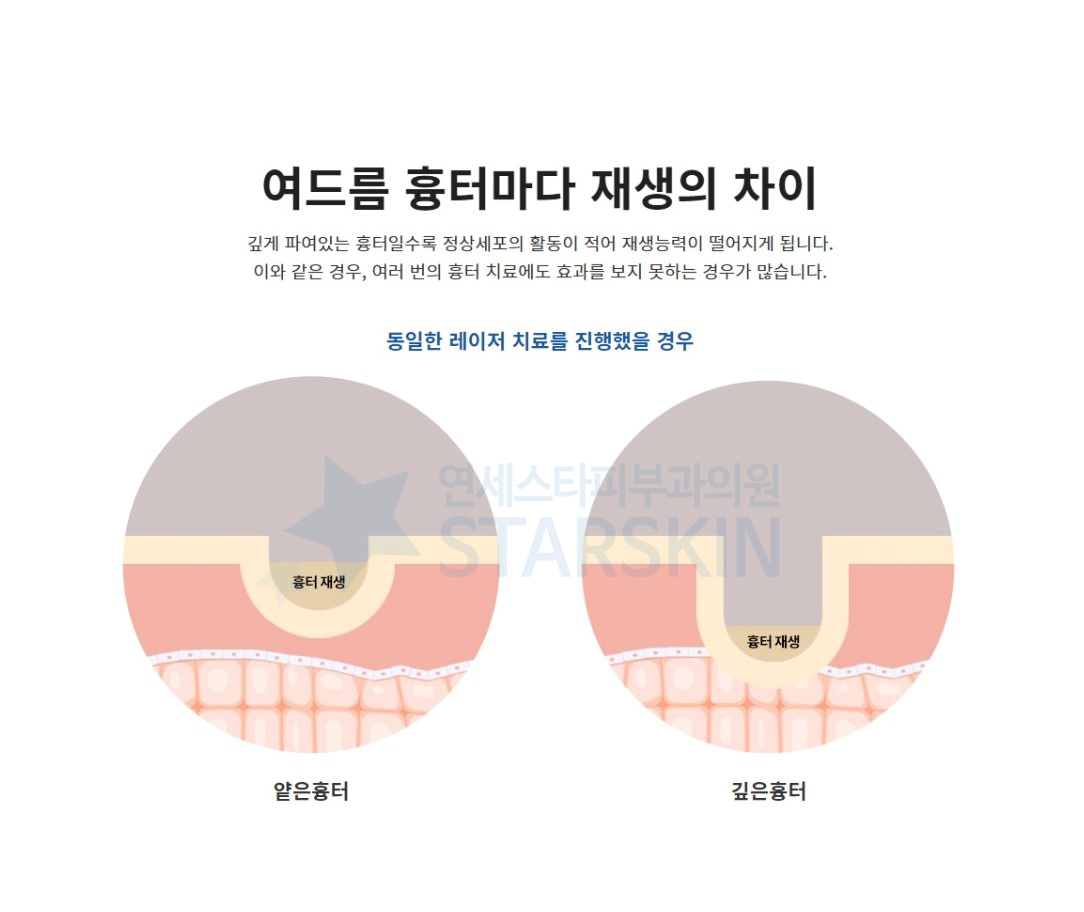
In cases of more severe inflammation, skin tissue deformation can lead to acne scars. These are divided into depressed scars and raised scars based on their shape. Depressed scars are characterized by a greater aesthetic burden compared to hyperpigmentation and the difficulty of expecting natural improvement.
It is reported that, unlike pigment marks, depressed acne scars involve a deformation of the skin structure, making it difficult for them to fill in on their own over time.
Reasons Why Depressed Scars Don't Heal Well Even with Treatment

Depressed acne scars, especially deeper ones, have less normal cell activity, leading to reduced regenerative capacity. Therefore, it's not uncommon for people to undergo multiple scar treatments without feeling an improvement. If the method applied isn't appropriate for the scar's depth and shape, it's easy to only treat the surface while the deeper parts remain untouched.
In the clinic, many patients who say, "I've tried everything, but nothing worked," often had cases where the depth of the problem wasn't adequately addressed. Thus, a stronger approach is needed for deep, firmly established scars.
Here are the factors we check when dealing with deep scars:
- Depth and area of the depressed scar
- Whether the scar shape is boxcar, rolling, or icepick type
- Degree of fibrosis where scar tissue pulls down the skin
- Regenerative capacity and skin texture of the surrounding skin
- Presence of accompanying hyperpigmentation or redness
The Approach of Complex Laser Dermabrasion

If scar tissue is large and deeply indented, strong thermal energy must be used to expect improvement. For very severe acne scars, Yonsei Star Dermatology Sinchon performs Deep Dermabrasion, which shaves off the skin to a consistent depth regardless of the scar's shape.
This approach aims to minimize damage while deeply shaving the skin to smooth the surface, complementing the shortcomings of traditional dermabrasion. If you are concerned about scars of this depth, it may be helpful to first understand the characteristics of depressed acne scars.
If you are unsure about the treatment direction, you can check your scar condition through chat consultation regarding depressed scars.
Depth-Controlled Laser and Regeneration Induction

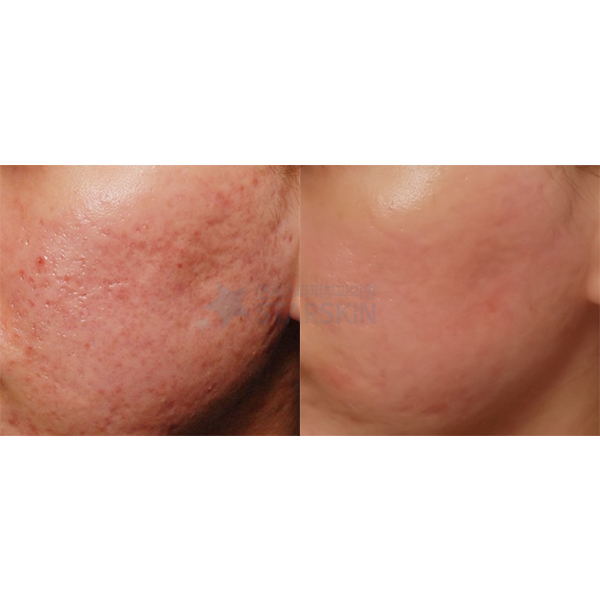
Complex laser dermabrasion uses the ProFractional laser, which can precisely control the depth of dermabrasion, to smooth both depressed scars and rough skin texture.
In addition, the Ultrapulse Encore laser, which is reported to have higher regenerative effects than Fraxel, is used to induce skin regeneration. This configuration aims to simultaneously refine the surface and boost deep regeneration.
Three-Dimensional Treatment with Dot Peeling and Subcision

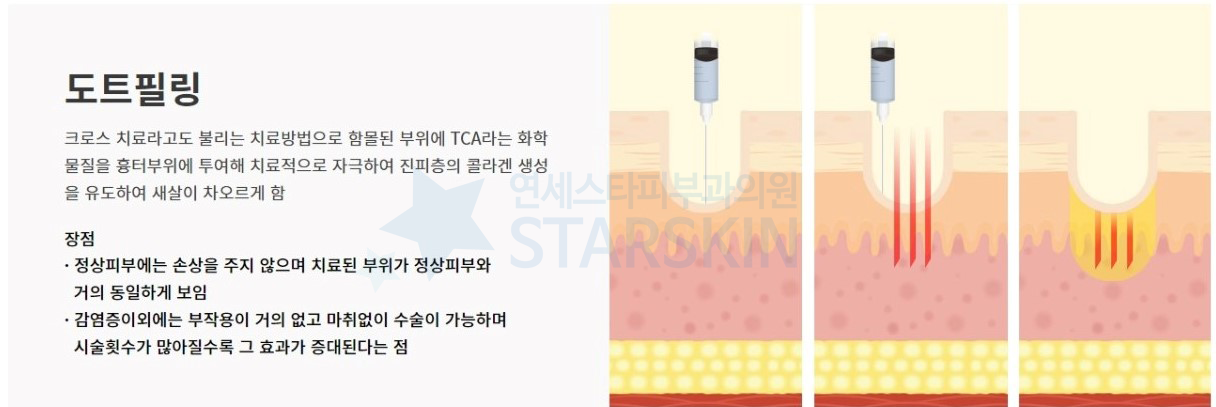
Dot Peeling, also known as CROSS treatment, involves applying a chemical substance called TCA to the depressed scar area to induce collagen production in the dermal layer and help new skin fill in.
Subcision is a treatment that uses a needle to break up fibrotic scar tissue that pulls the skin downwards, allowing the scar to fill in. It is reported to show good results particularly for rolling scars and is also applied to wide and deep lesions.
Since the appropriate method varies by scar type, the table below can help with understanding:
| Scar Type | Characteristics | Complementary Methods |
|---|---|---|
| Rolling | Gently sloping, broadly undulating depression | Subcision, Dermabrasion |
| Boxcar | Distinct, angular depression | Dermabrasion, Dot Peeling |
| Icepick | Narrow, deep, penetrating depression | Dot Peeling, Precise Dermabrasion |
As such, rather than relying on a single method, we approach by combining various treatments tailored to the diverse forms of acne scars.
Points to Consider in Post-Treatment Care

After regeneration-inducing treatments like dermabrasion, skin changes may occur during the recovery process, so it's advisable to take care of the following:
- Temporary swelling, redness, scabs, and flaking may occur, so do not forcibly remove them.
- Ensure sufficient UV protection to reduce the risk of hyperpigmentation.
- Maintain consistent moisturizing to support the regenerative environment.
- Consult with medical staff about the timing of additional treatments based on recovery progress.
Such scars often require a phased approach rather than a one-time treatment, so methods that adjust the composition according to the scar condition, such as Premium Customized Acne Scar Care, are commonly used.
Severe Scars: Check Before Giving Up

Even deep acne scars that haven't responded to other treatments can be expected to improve with combination therapy tailored to their depth and shape. Rather than giving up prematurely on deep scars, it's important to accurately assess your current condition first. If active acne is also present, acne management should be considered as well.
If you're curious about which combination is right for your scars, you can get a consultation immediately below.
💬 Get a consultation right nowChief Director Lee Sang-Joo (MD, PhD, Yonsei University College of Medicine and Graduate School, Completed Dermatology Residency at Severance Hospital, President of the Korean Dermatological Association) Chief Director Lee Sang-Joo's Profile First published 2022-06-29 / Last reviewed 2026-06-16
Treatment response and recovery patterns may vary by individual, so please determine an accurate diagnosis and treatment plan through sufficient consultation with medical staff.