
![[Yonsei Star Dermatology Sinchon] Checklist Before Keloid Scar Removal](/_next/image?url=https%3A%2F%2Fagqdgbuateknhwpocrgu.supabase.co%2Fstorage%2Fv1%2Fobject%2Fpublic%2Fsources%2Fbbf3bebe-45b6-4415-bd04-bda18b2cac0f%2Fblog-images%2F224126749119_00_027f40b98230.jpg%3Ftype%3Dw966&w=3840&q=75)
Many people worry about scars remaining after deep skin damage. Among scars, there's a type that swells larger than the original wound, which is a keloid scar. When patients first discover a scar, the first question they often ask is, "Is this just a regular scar, or is it a keloid?" To answer directly, it's difficult to distinguish between the two by appearance alone, and the treatment approach also differs, so it's important to confirm the condition in the early stages of its manifestation.
How do keloid scars differ from regular scars?
If there's a difference in skin tone and color from normal skin, or if it appears raised above the surface, it tends to be noticeable. If it's in a difficult-to-hide area, the concern naturally deepens. In some cases, due to constitutional reasons, the size of the scar may gradually increase.
This pattern is called a keloid scar. It's not a symptom that inevitably appears in everyone, but it has characteristics that make it difficult to erase, such as thickening or recurring after once subsiding.
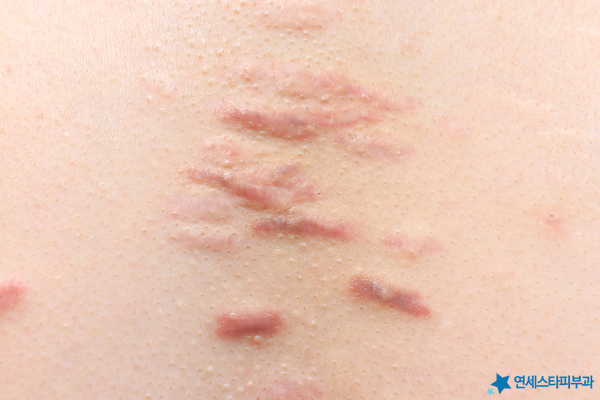
Why it's easy to confuse with hypertrophic scars
When a raised scar first appears, it's easy to confuse it with a common hypertrophic scar or a keloid. It's difficult to distinguish by appearance, and sometimes symptoms only appear much later after skin damage.
Before the problem manifests, it's difficult to clearly confirm whether one has a keloid-prone constitution. Therefore, preventing it in advance is also not easy. In the consultation room, individuals with the following skin characteristics tend to have a relatively higher chance of being keloid-prone:
- Skin easily swells when stimulated
- Recovery is slow even from small wounds
- Has a history of past scars growing larger than the wound area
- Has family members with similar scar patterns
It is reported that once keloids manifest, they can grow large enough to cause discomfort in daily life, so if a problem has already occurred, systematic treatment may be necessary.
If you have these characteristics, it's best to be careful not to get injured in the first place. If a scar has already formed, it's safer to get an accurate diagnosis and approach it step by step.

Advantages and limitations of injection-only treatment
Steroid injection therapy is considered a relatively quick way to reduce raised scars. This ingredient suppresses the further growth of keloid tissue, lowers its height, and helps alleviate pain or itching. It is still one of the widely used treatment methods.
However, the duration of its effect may not be long, leading to a possibility of recurrence, and it may require repeated injections. Therefore, satisfaction may be lower with this single method alone. More specific details on injection treatment can be found in Triamcinolone Scar Injection.
| Category | Injection Only | Injection and Laser Combination |
|---|---|---|
| Approach | Tissue growth suppression | Simultaneous tissue suppression and vascular control |
| Duration of effect | Relatively short | Reported to be relatively long-lasting |
| Recurrence tendency | Requires repeated treatments | Aims to reduce recurrence |
Why consider combination therapy
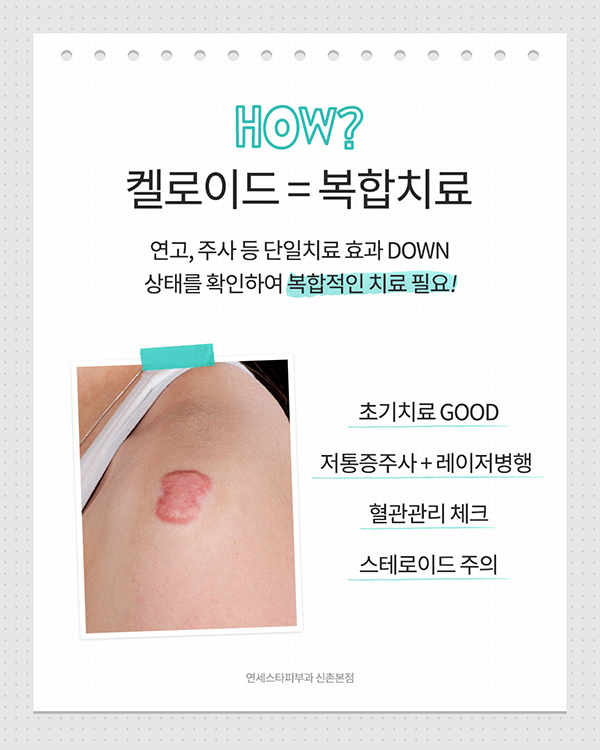
Combination therapy is considered to maintain the effect for a longer period. A typical approach involves combining injections and lasers. Scar areas often show excessive proliferation of blood vessels for rapid recovery.
To restore the skin closer to its original state, Vbeam Prima laser is used to control abnormally developed blood vessels. Since it addresses not only visible symptoms but also changes occurring within the skin, it is reported to reduce recurrence and maintain the improvement effect for longer.
If you have any questions during the process, you can easily check them by chatting with us about keloid scar treatment.
Things to know during treatment
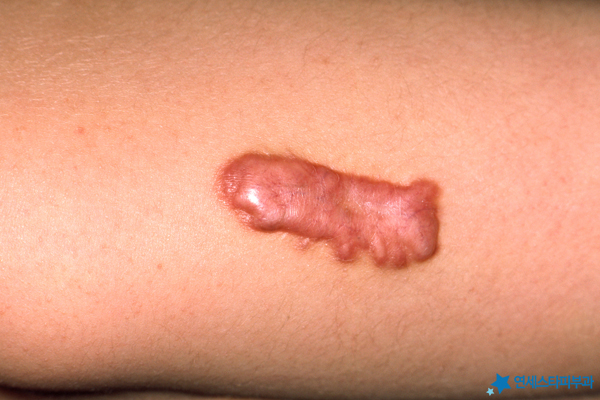
Occasionally, some individuals may feel that their scars have become darker during laser treatment. When improving all scars, not just keloids, they gradually fade through progressive stages of alleviation.
If treatment is stopped midway through this process, it may revert closer to its previous state, leading to lower satisfaction compared to the time and effort invested. Here are some helpful points to keep in mind when continuing treatment:
- Confirm your condition with the medical staff at regular intervals.
- Do not stop midway based on self-judgment.
- Avoid additional irritation or friction to the scar area.
- Understand that it is a gradual process, even if changes feel slow.
If you have similar concerns, the approach may vary depending on the type of scar, such as cosmetic surgery scars or surgical scars, so it's advisable to consult for a direction that suits your condition.

Things to check before treatment
Before deciding on keloid scar removal, checking the following in advance can make the consultation much smoother:
- When and how the scar formed
- Whether there's a history of past scars growing larger than the wound area
- Any previous history of injection or laser treatments
- Whether there are symptoms like pain or itching in the scar area
If the treatment direction requires deeper excision, Surgical Scar Revision may also be considered. If you're curious about what your condition falls under, we recommend checking through chat consultation about keloid treatment direction.


Chief Director Lee Sang-joo (Yonsei University College of Medicine, Ph.D. in Medicine, completed dermatology residency at Severance Hospital, President of the Korean Society for Dermatology) Chief Director Lee Sang-joo's Profile First published 2025-12-29 / Last reviewed 2026-06-16
Scar patterns and treatment responses may vary individually, and an accurate diagnosis and treatment plan are determined through face-to-face consultation with medical staff.