

Hello, this is Yonsei Star Dermatology Sinchon.
Scars remaining along the double eyelid incision line after double eyelid surgery are a concern for more people than one might think. If the surgery went well but you hesitate to look in the mirror because of the scar, the first question that comes to mind is likely, "Can this scar really be reduced with a laser?" To answer directly, it is an area where improvement is reported when treatments are combined according to the scar's condition and timing.
Why Double Eyelid Surgery Scars Are So Noticeable
Double eyelid surgery is now a very common procedure, performed by many people regardless of gender. However, the skin around the eyes is very thin and delicate, making it easily damaged and prone to scarring.
Especially when the surgery is performed using an incision method, there is a higher chance of noticeable marks remaining during the process of incising and suturing the skin. That's why many people carefully check the method suitable for them and the clinic's expertise from the very beginning when deciding on the surgery. However, even after going through this process, not a few people are still concerned about scars remaining on the double eyelid incision line.

Today, Yonsei Star Dermatology Sinchon, which has been performing scar treatments, will explain how we approach cosmetic scars and to what extent improvement can be expected with lasers.
Why Scars Become More Prominent Over Time
It can be upsetting if, after a successful surgery, an uneven scar forms on the double eyelid line. The redness may show no signs of disappearing, or while waiting for the swelling to subside, the scar may gradually turn white, becoming even more noticeable.

Along with double eyelid incision scars, the inner corner of the eye is another area of great concern. Many people undergo epicanthoplasty along with the double eyelid line to make their eyes look clearer and more defined. In such cases, a white, raised scar can form at the incised inner corner of the eye, making it particularly noticeable.
Scar shapes and colors are generally categorized as follows:
- Scars with prolonged redness (related to excessively developed blood vessels)
- Scars that turn white and lose color
- Hypertrophic scars that protrude along the line
- Adherent scars where the skin is pulled inward
Since the approach varies depending on the condition, the treatment direction for the same double eyelid scar cannot be identical.
| Scar Type | Commonly Considered Approach |
|---|---|
| Accompanied by redness | Combined vascular laser |
| White, depressed, or raised | Pinhole-type laser |
| Protruding hypertrophic | Combined laser and Triamcinolone Scar Injection |
| Skin adhesion | Combined Subcision |
The Core of Scar Treatment is Regenerative Power
There is a common core principle in erasing scars, whether they are from cosmetic surgery like double eyelid surgery or from everyday life. That is the skin's regenerative power.
Once a scar has formed, it is realistic to assume that general care, such as ointments or creams, has its limitations.
In the clinic, many patients say, "I've been applying ointment for a long time, but it's still the same." This is because scars are not just on the surface but are the result of abnormally rearranged collagen within the skin. Therefore, an approach that induces regeneration of the underlying tissue is necessary.
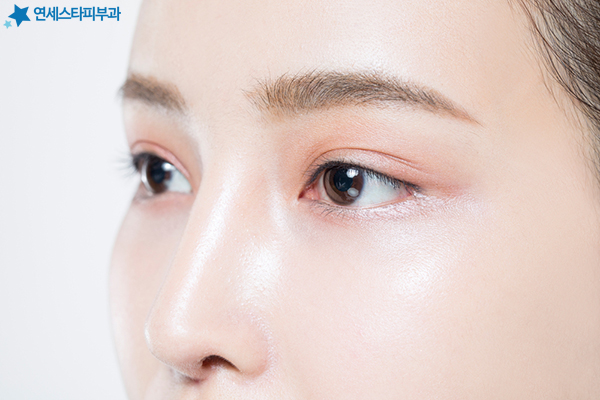
Lasers are a representative method for inducing such deep regeneration, and Pinhole Technique is one of them.
You can comfortably leave any questions you have via chat consultation regarding double eyelid scar treatment.
How Pinhole Technique Addresses Scars
Pinhole Technique is performed by creating very fine holes in the white double eyelid incision scar area with a laser such as Ultrapulse Encore. Through these tiny, barely visible holes, the Pinhole Technique helps to organize the collagen tissue clumped deep within the skin and induce regeneration, thereby improving it to a state similar to normal skin.

If the scar condition is not simple, we may consider the Pinhole Alpha method, which precisely controls the depth. Regardless of the method, it's better to understand it as a process of gradually getting closer to improvement over several sessions, rather than all scars disappearing at once. The effectiveness and recovery period may vary from person to person.
We Combine Treatments According to the Condition
Scars often require more than one method. If there is severe redness around the scar, vascular laser treatment is added to reduce excessively developed blood vessels. If the scar is particularly raised, Triamcinolone Scar Injection is performed together to gradually refine the condition.
If the skin has adhered after cosmetic surgery and a scar has formed, laser treatment alone may not yield satisfactory results. A process of cutting the fibrous bands that are pulling the skin is necessary; this is called Subcision. If the scar is deep and accompanied by structural changes, Surgical Scar Revision may also be considered.

Such combination treatments require knowledge and expertise in scars to select and combine appropriate methods, leading to highly satisfactory results.
Things to Check Before Scar Treatment
Organizing the following items in advance can make it easier to determine the direction of treatment:
- Time of surgery and when the scar appeared
- Current scar color (red or white) and whether it is raised
- History of ointments used or treatments received
- Presence of accompanying procedures such as epicanthoplasty
Scars often do not disappear on their own over time, so it is advisable to seek consultation when you feel that the changes have stopped.

If you no longer want to hesitate because of double eyelid incision scars and wish to achieve natural-looking eyes, start by checking your scar condition.
💬 Consult Now

Chief Director Lee Sang-ju (MD, PhD, Yonsei University College of Medicine and Graduate School, Dermatology Resident at Severance Hospital, President of the Korean Dermatological Association) Chief Director Lee Sang-ju's Profile First Published 2025-02-03 / Last Reviewed 2026-06-16
This article provides general information about scar treatment, and since scar patterns and treatment responses may vary for each individual, please consult with medical staff for an accurate diagnosis and treatment plan.