
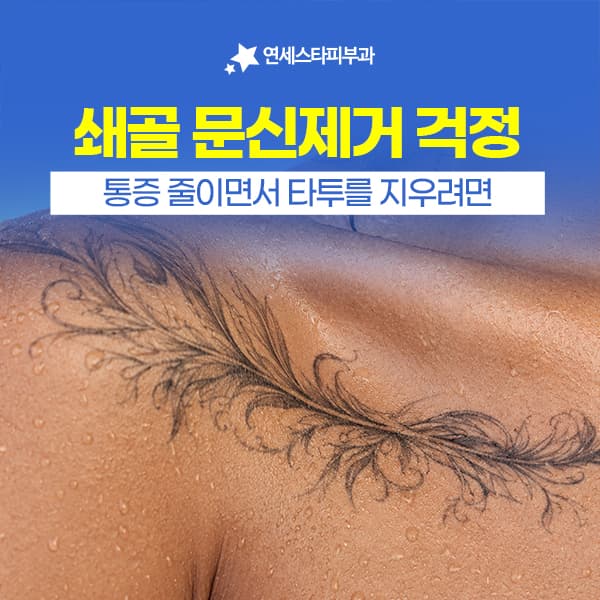
The collarbone is a prominent area of the body. Therefore, it is considered a good place to express individuality when getting a tattoo. However, more and more people are considering collarbone tattoo removal due to reasons such as seasons with increased exposure, changes in circumstances like employment and marriage, or faded designs over time.
The problem is that the collarbone is one of the areas of the body where laser procedures can cause strong pain.
Three Conditions That Make the Collarbone Sensitive to Pain
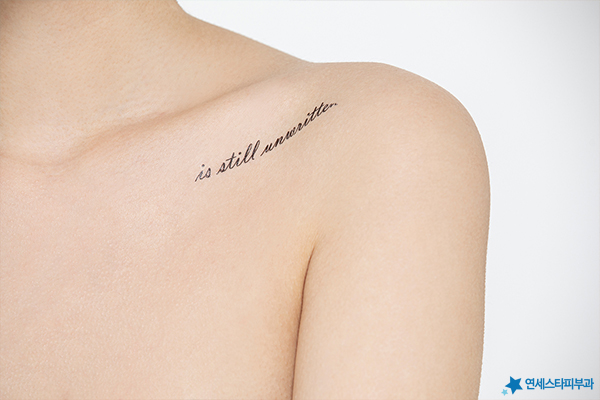
Due to its anatomical structure, the collarbone tends to experience pain more intensely than other areas. There are three main reasons for this:
- Thin skin and almost no fat layer The fat layer acts as a buffer for laser energy, but the collarbone has almost no such buffer, so pain receptors are stimulated more directly. As the skin layer is thin, tattoo ink is often located relatively deep, and repeated treatments, sometimes 5 to 10 or more sessions, may be necessary.
- Dense distribution of sensory nerves Even small stimuli are transmitted more intensely as a foreign sensation, stinging, and tingling. Even with the same laser output, it may feel more sensitive than other areas.
- Frequent movement The tension of the skin around the collarbone constantly changes with shoulder and arm movements. This can make it more sensitive to external stimuli, and momentary pain during the procedure may be felt more strongly.
How to Choose Anesthesia
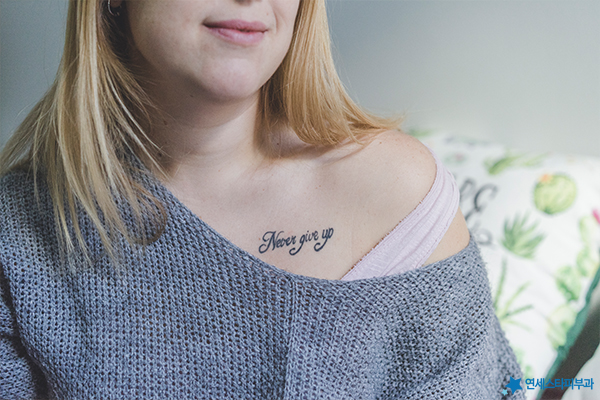
It is not possible to completely eliminate pain during collarbone tattoo removal. However, by choosing an anesthesia method that considers both the characteristics of the area and safety, discomfort can be significantly reduced. Since it is a process that requires steady, gradual removal, a plan that reduces the burden of each session is necessary.
| Method | Application Method | Use on the Collarbone |
|---|---|---|
| Topical Anesthetic Cream | Apply an appropriate amount for an appropriate time | A basic step to reduce discomfort during the procedure |
| Nitrous Oxide | Inhalation anesthesia | One of the highly satisfying methods for procedures on areas with strong pain |
| Cooling | Direct application of cold air to the lesion area | Cools the skin simultaneously with laser irradiation to relieve pain in real-time |
Cooling works by temporarily suppressing the nerve pathways that sense pain through cold stimulation. The fact that it can be applied continuously throughout the procedure is particularly helpful for sensitive areas like the collarbone. Using nitrous oxide and cooling together may be more effective in reducing discomfort during procedures on sensitive areas.
If you are curious about the anesthesia configuration, you can easily ask via Chat Inquiry Now.
To Repeat Irradiation Within One Session

When a general tattoo removal laser is irradiated, white bubbles form on the skin surface. If these bubbles remain, the laser light cannot properly penetrate the skin, making continuous irradiation difficult. A recovery period is required after one irradiation, which lengthens the overall treatment period.
R-Zero is a method that rapidly removes bubbles generated immediately after PicoWay Laser irradiation by applying a special medication.
Once the bubbles are removed, the laser penetration path is re-secured, allowing for repeated irradiation up to 4 times in one session.
However, the number of repeated irradiations and whether to apply them are determined by the medical staff based on skin condition and tattoo characteristics. There may be individual differences, and sufficient consultation before the procedure is necessary for safe progress. The equipment and technique configuration are summarized in the R-Zero Pico-Frectat Tattoo Removal Guide.
Shorter Pulse Width Means Shorter Time to Feel Pain
Among collarbone tattoo removal laser devices, PicoWay Laser is currently gaining attention. It delivers energy in picoseconds, which is one trillionth of a second, much shorter than the existing nanosecond method, breaking down pigment more finely.
PicoWay Laser flexibly responds to both black and color tattoos through various wavelengths. Because the pulse width is short, the time itself to feel pain is reduced. You can compare the wavelength configurations of different devices in the Nd:YAG Tattoo Removal Guide.
An Approach That Increases Efficiency Instead of Intensity

The collarbone has thin and sensitive skin. This is why it is important to proceed safely while minimizing unnecessary irritation. If the necessary pigment can be quickly destroyed, it can lead to a direction where the number of tattoo removal procedures does not excessively increase.
PicoWay Laser breaks down pigment particles more finely, and the R-Zero method removes bubbles, enabling repeated irradiation within the same session. The combination of these two methods is an approach that enhances treatment efficiency without excessively increasing laser intensity, making it useful for sensitive areas like the collarbone that require repeated treatments.
Things to Check Before Starting
The treatment results may vary depending on the color, depth, extent of the tattoo, and individual skin condition. We recommend consulting sufficiently with a specialized medical professional and planning before starting. The overall treatment flow can be found in the Tattoo Removal Treatment Guide.
Authored and Medically Reviewed by Chief Director Lee Sang-Joo (Dermatologist) Graduated from Yonsei University College of Medicine · Ph.D. in Medicine from Yonsei University Graduate School of Medicine · Resident in Dermatology at Severance Hospital Currently Adjunct Professor, Department of Dermatology, Yonsei University College of Medicine · President of the Korean Dermatological Association in 2026 View Medical Staff Introduction
First Published 2026-06-02 · Last Reviewed 2026-07-29
This article contains general medical information and does not substitute for individual diagnosis and treatment. Results and recovery progress may vary by individual.