

Scars on the wrist are not just a simple skin problem; they are marks that make you conscious of your daily attire and even your emotional state. It's not uncommon for people to regret self-harm after experiencing extreme stress, as the resulting marks become difficult to conceal over time. To answer the most frequently asked question first: self-inflicted wrist scars can be significantly lightened with laser treatment, but the effects appear over a long period, not in the short term.
Given the increasing number of people seeking scar treatment, this issue extends beyond individual concerns and touches everyone around us.
Why don't scars disappear on their own once formed?
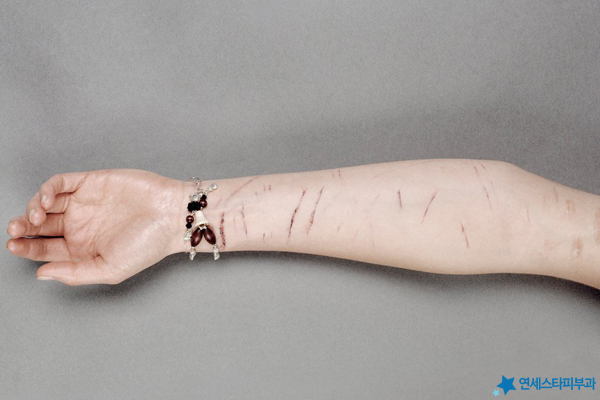
Once a scar is formed, natural improvement is very difficult. Therefore, the best way to maintain clear skin is to avoid damaging it in the first place. However, if scars remain on the wrist or arm after self-harm due to depression or other reasons, we will discuss how these can be improved.
Scars are reported to be marks left after deep skin damage, and once formed, they are difficult to return to their original state on their own.
Why are self-inflicted scars more challenging?
Wrist scars caused by accidents vary in shape and depth depending on the impact received. In contrast, self-inflicted wounds often involve repeated marks on the same area. This means the length and depth of the scars are likely to be inconsistent.

Therefore, before treatment, it is crucial to carefully examine the scar's condition and formulate a plan. If an area has a mix of marks with varying depths and widths, the approach must be adjusted accordingly. In a similar vein, for surgical scars, treatment directions are categorized based on the condition.
Another important point not to miss is to avoid creating new wounds in the same area during treatment. If additional wounds occur in the process of lightening wrist scars, the treatment period may lengthen, and the psychological burden can increase.
Laser selection varies depending on scar condition
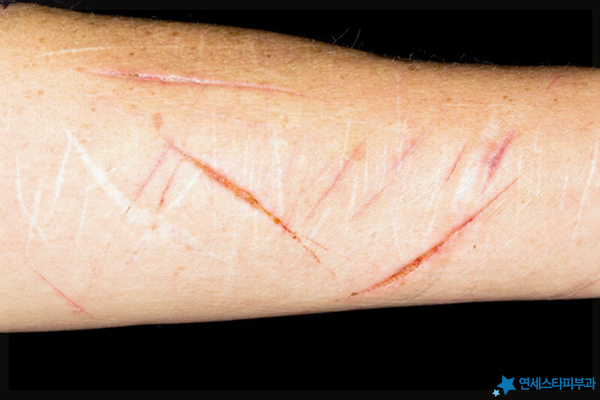
Recently, laser equipment capable of treating various scars, including wrist scars, has advanced, leading more people to consider treatment for old marks. The equipment used varies depending on the nature of the scar, and in the examination room, we often see a mix of conditions on one person's wrist, requiring a phased approach.
Here's a summary of the equipment utilized for different scar conditions:
| Scar Condition | Approach | Example Equipment |
|---|---|---|
| Depressed or thick texture | Enhance skin regeneration to improve texture and height | StarLux, Ultrapulse Alpha |
| Red marks | Alleviate redness to match skin tone | Vascular laser (Vbeam Prima) |
| Dull pigmentation | Reduce pigmentation to even out tone | PicoWay |
Red marks are approached similarly to facial redness management, and for severe pigmentation, the principles of Epidermal Pigment Removal are also considered. By using appropriate equipment for the situation, good outcomes can be expected for wrist scars, typically involving a combination of necessary devices applied progressively over 5 to 10 sessions.
For questions, inquire via chat consultation about laser scar treatment
How much improvement can be expected with laser treatment?

Laser treatment helps restore the skin to a cleaner state without creating additional scars. However, patient satisfaction may vary, and it can be challenging for a scar to disappear completely as if it never existed.
Therefore, the goal of treatment is not to eliminate the mark entirely, but to restore it to a natural state that is not easily noticeable in daily life. Surgical Scar Revision involving incision and suturing may also be considered, so it's best to determine the appropriate method for your scar during a consultation.
Here are some helpful points to consider when undergoing treatment:
- Accurately assess the current depth and extent of the scar before starting treatment.
- Be careful not to create additional wounds in the same area during treatment.
- Consistently perform basic care such as sun protection and moisturizing to aid recovery.
- Work together to create an environment that supports psychological stability.
- Accept gradual improvement rather than expecting significant changes all at once.
Especially for self-inflicted wounds, creating an environment that consistently supports psychological stability is as important as the treatment itself.
When do the effects appear, and how long does it take?
Many people considering wrist scar removal first ask, "How long will it take?"

The time it takes to lighten wrist scars to a barely noticeable extent, assuming 10 treatments at one-month intervals, is approximately one year. Including the recovery period, it takes about two years to confirm the final treatment outcome.
Therefore, scar treatment should be viewed as a long-term race, not a sprint. While it's important to assess the current state of the scar that needs treatment, the key is to continue treatment while being careful not to add new wounds or deepen existing ones.
Letting go of impatience is part of the treatment

Even if a scar is on a different part of the body, achieving satisfactory results usually takes a considerable amount of time. If you let go of impatience and don't give up midway, you can expect good improvement through lasers, so we recommend proceeding with a relaxed mindset. Since the type and location of scars vary from person to person, it helps to know in advance that there may be individual differences in results.

If you wish to confirm which treatment is suitable for your scar condition, please feel free to inquire.
💬 Chat for consultation now

Chief Director Lee Sang-joo (MD, PhD, Yonsei University College of Medicine & Graduate School, completed dermatology residency at Severance Hospital, President of the Korean Dermatological Association) Chief Director Lee Sang-joo's Profile First published 2025-10-14 / Last reviewed 2026-06-16
Treatment effects and recovery patterns may vary depending on the scar's condition or individual skin, so please confirm an accurate diagnosis and treatment plan through consultation with medical staff.