

Scars remaining on the face are a bothersome mark every time you look in the mirror. The first questions that usually come to mind are, "Will it get better if I start now, and how much will it cost?" To answer directly, it is reported that the earlier scar management begins after a scar forms, the greater the potential for improvement, and consequently, the shorter the treatment period and lower the cost burden.

How are Wounds and Scars Different?
Facial scars can result from various causes, including abrasions, burns, and surgical marks. Many people consider wounds and scars to be the same, but they are distinctly different.
Our skin undergoes a gradual healing process over time. A scar is the mark that remains as new skin fills in during this process. Therefore, facial scar treatment can be seen as the process of refining the marks that remain after a wound has stopped bleeding and healed.

In daily life, unexpected accidents can cause wounds, no matter how careful you are. The problem is how you manage the wound before a scar forms, and that facial scars can become prominent depending on constitutional factors. If skin damage is already deep and there's a high likelihood of scarring, it's advisable to start preventive care in the early stages.
Once a scar has settled, it is difficult to completely erase, so early intervention before the mark becomes deeply etched is reported to greatly influence the outcome.
Different Early Interventions by Cause
Facial scars come in various types and have multiple causes. Therefore, early intervention to prevent scars after a wound occurs also varies depending on the cause.
- Burns As damage is caused by heat, the priority is to cool the affected area as quickly as possible.
- Abrasions Foreign matter can enter the damaged area, so prompt cleaning of the wound is necessary.
- Surgical Marks The extent of the remaining mark can vary depending on the management after suturing.
- Golden Time As the scope of damage increases, so do the cost and duration, so it's crucial not to miss the period before a scar becomes deeply established.
Once a wound has healed and the discharge and scabs have disappeared, it's easy to assume, "It's healing well naturally." However, in the clinic, that very moment is often the ideal time to start treatment to reduce scar marks.

When is the Best Time to Start Scar Treatment?
Timewise, the period between 2 weeks and 2 months after a wound is generally considered the early stage. Even broadly speaking, starting treatment within 6 months of sustaining a wound can lead to rapid improvement in the early stages, and the associated costs can be utilized efficiently during this opportune time.
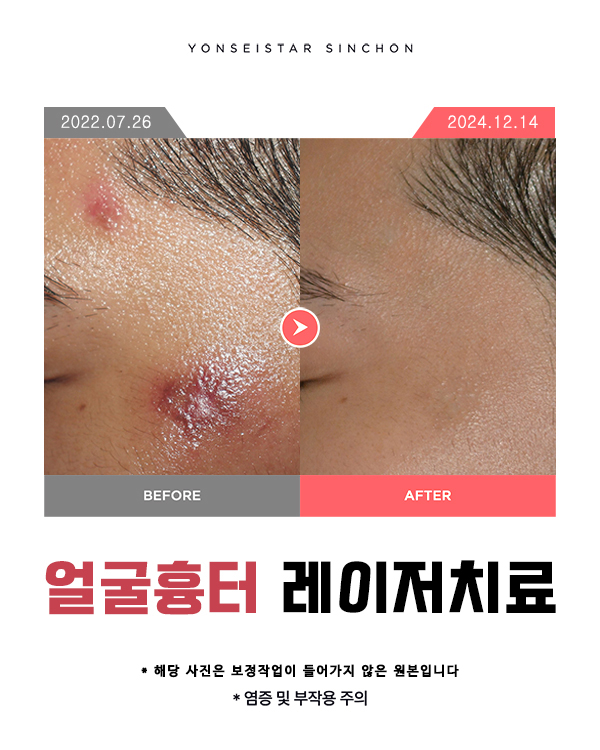
Especially the face is an area everyone is most concerned about to prevent scars. In the early stage, while redness still remains, vascular lasers like Vbeam Prima are used. We recommend not letting this period pass, as it's crucial for minimizing residual marks.
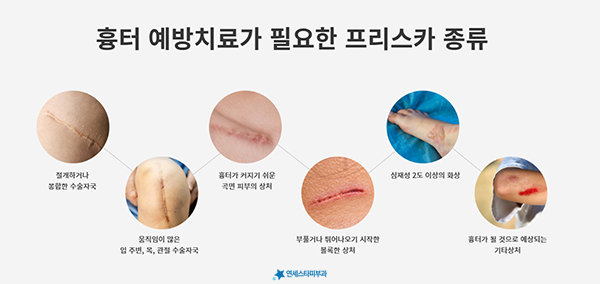
If the scar shows prominent redness, we refine the mark with an approach similar to V-beam Facial Redness Treatment or vascular laser treatment for red scars. For any questions, you can easily inquire through chat consultation regarding scar treatment timing.
What Treatment Methods Are Available?
The methods for treating scars are continuously increasing. Among them, laser treatment is widely used as a method that offers a good balance of safety, convenience, and improvement effects.
Home care, such as applying scar ointment, tends to show less noticeable changes. In contrast, laser treatment reports over 50% improvement, and sometimes other methods are used in conjunction depending on the scar's condition.
| Scar Condition | Concurrent Approaches to Consider |
|---|---|
| Early scars with residual redness | Vascular laser types |
| Scars with prominent raised appearance | Combined injection therapy |
| When aiming to accelerate overall regeneration | Combined skin boosters |
If the scar is prominently raised, Triamcinolone Scar Injection may be combined. If you want to boost overall regeneration, using skin boosters like Juvelook or Rejuran can also lead to positive outcomes. Since the depth and shape of scars vary for each individual, it is more accurate to determine the right combination through a consultation.

How to Use Costs Efficiently
Facial scar treatment is often performed meticulously because many people want to minimize visible marks as much as possible. Even with laser treatment, if the treated area becomes excessively raised or sunken, the treatment cost or duration may increase.
Some may worry that receiving multiple procedures together will increase the cost. However, please remember that proceeding as quickly and promptly as possible can ultimately shorten the overall treatment period and lead to satisfactory results.
- Consult immediately after the wound heals, before the scar deepens.
- Approach with methods appropriate for the red stage and the raised stage.
- Proceed systematically, observing changes in condition, rather than receiving all treatments at once.
- Do not rely solely on slow-acting home care; do not miss the opportune time.
If surgical marks or sutured scars are deeply entrenched, Laser + Revision Combination or Surgical Scar Revision can be considered together.

If You Missed the Early Stage
Even after the early stage has passed, treatment to lighten scars can still be performed, and it is not without effect. However, it is not uncommon for marks to remain, no matter how well they are refined. Therefore, if you are considering facial scar treatment, we recommend starting as early as possible.

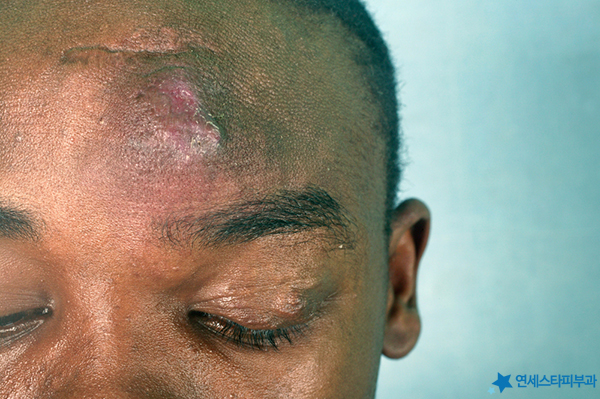
The type and depth of scars vary from person to person, and in cases like Keloid Scar where constitution plays a role, the approach itself may differ. Therefore, rather than there being one correct answer for a scar in the same area, it is safer to determine the direction after directly examining the condition.
If you are unsure which method is right for your scar, try chat consultation for scar types and treatment directions.

Chief Director Dr. Sang-Joo Lee (MD, PhD, Yonsei University College of Medicine and Graduate School, Completed Dermatology Residency at Severance Hospital, President of the Korean Dermatological Association) Chief Director Dr. Sang-Joo Lee's Profile First Published 2025-07-31 / Last Reviewed 2026-06-16
This content is for general information purposes only, and individual treatment results and progress may vary. Please consult with medical staff for an accurate diagnosis and treatment plan.