


As impulsive tattoos or old tattoos increasingly cause discomfort in employment and daily life, more people are seeking laser tattoo removal.
Among these, PicoWay Laser tattoo removal is garnering attention. Let's summarize why PicoWay Laser is chosen, what criteria to consider for equipment, and how to minimize scarring.
Two Categories Divided by Pulse Width
There are broadly two categories of tattoo removal lasers: nanosecond lasers and picosecond lasers. While existing lasers are not ineffective, the trend is rapidly shifting towards picosecond lasers due to the difference in pulse width.
Picoseconds are delivered 1,000 times faster than nanoseconds. This ultra-high-speed energy helps break down tattoo pigments in the skin into smaller particles, allowing for faster expulsion.
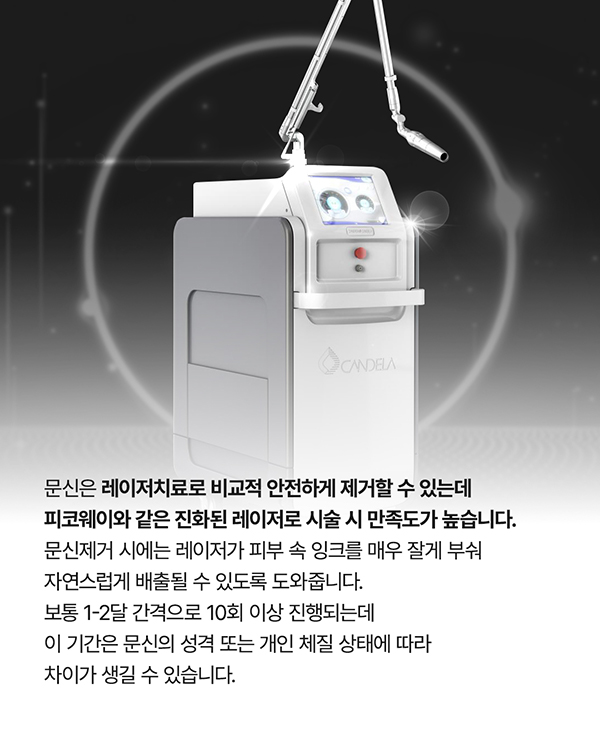
For Old and Amateur Tattoos
Even for tattoos with various colors, old tattoos, or amateur tattoos with irregularly distributed pigment, PicoWay Laser can provide more stable removal.

Three Things to Check Instead of the Name
As PicoWay Lasers have advanced, various versions such as PicoWay and PicoSure are available. PicoWay can effectively break down pigments in deeper areas.
It is important not to decide based solely on the equipment name, but to consult and confirm what wavelengths are used, at what output, and in what manner the treatment is performed.
- What wavelength is used?
- What output is delivered?
- What method is used for the treatment?
Information on equipment and treatment methods can be found in the R-Zero Pico-Frectat Tattoo Removal guide, and approaches for other types can be found in Nd:YAG Tattoo Removal.

The Disadvantage Caused by Bubbles
One of the biggest reasons for hesitating about tattoo removal is concern about scarring. The risk of scarring increases with tattoos that have a lot of pigment, those that have been layered multiple times, or large tattoos.
When a laser is applied, a bubbling phenomenon occurs where the skin swells white, and the laser beam is blocked by these bubbles, preventing it from penetrating. If excessive energy is applied at this time, tissue damage can deepen, potentially leaving scars.
Reasons for Using Two Techniques Together
| Technique | Method | Additional Benefit |
|---|---|---|
| R-Zero Technique | Quickly clears bubbles formed after the initial irradiation, allowing for multiple irradiations at once | Ensures removal speed through repeated irradiation within an optimal, non-excessive energy range |
| Pinhole Technique | Creates microscopic holes with a laser to help pigment particles exit the skin more easily | Can also be expected to have the effect of preventing scars in advance |
Combining these two techniques can reduce the risk of scarring compared to single treatments, while still achieving removal. However, the experience and skill of the practitioner significantly influence the results. The principle of the Pinhole Technique is summarized in the Pinhole for Burn & Surgical Scar treatment guide.

5 to 15+ Sessions, a Long-Term Process
Nowadays, tattoo removal treatments are available not only in dermatology clinics but also in various other places. However, tattoo removal is a more complex medical procedure than it might seem.
Laser tattoo removal is not a one or two-time procedure but a long-term process, typically requiring 5-15 or more sessions. When choosing a clinic initially, please carefully consider the equipment, techniques, and, most importantly, the expertise of the treating physician.
The overall process can be seen in the Tattoo Removal Treatment Guide, and if you are curious about how many sessions might be needed for your current tattoo condition, please contact us via chat now.

Authored and Medically Reviewed by Dr. Kang Jin-Moon, Chief Director (Dermatologist) Resident in Dermatology at Severance Hospital · Current Adjunct Professor, Department of Dermatology, Yonsei University College of Medicine Member of the Korean Dermatological Association · Author of "Medical Body Care" View Medical Staff Profile
First Published 2026-03-12 · Last Reviewed 2026-07-29
This article contains general medical information and does not substitute for individual diagnosis and treatment. Results and recovery may vary by individual.