
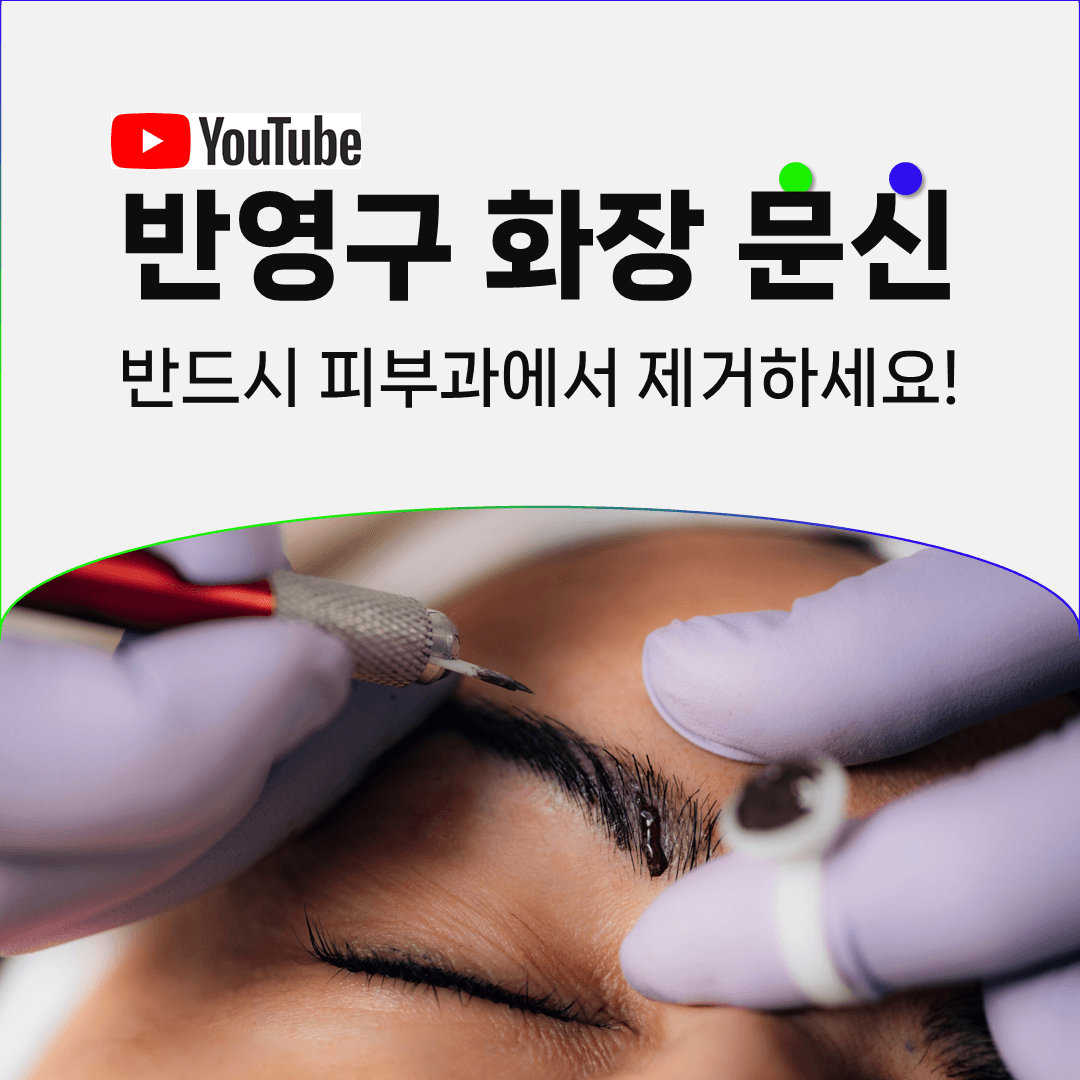
Eyeliner and eyebrow semi-permanent makeup are commonly seen. Perhaps because of this, many people think that removing them will also be simple.
In reality, that's not the case. We've summarized how semi-permanent makeup tattoos differ from regular tattoos and why their removal should be performed at a dermatology clinic.
If it remains for over a month, it's also a tattoo
If pigment is injected into the skin and lasts for more than a month, you can consider it a tattoo. Eyeliner and eyebrow semi-permanent makeup also fall into this category.
Because of the name 'semi-permanent,' it's easy to think of the pigment as disappearing on its own, but it's the same as a tattoo in that the pigment is located in the dermis.

Why is it more difficult when there's less ink?
Semi-permanent tattoos use less ink than regular tattoos. However, in practice, they are by no means easy to remove.
This is because various substances are mixed to create beautiful colors. As there are many colors, the laser response can vary, with some colors reacting strongly and others weakly, making semi-permanent makeup tattoo removal often quite challenging.

Both application and removal are illegal outside of a hospital
Applying semi-permanent makeup tattoos is illegal, and removing them outside of a hospital is also illegal.
Lasers can only be used by medical professionals. Tattoo removal performed in shops should be considered illegal.

How to treat pigment in the dermis
The ink for makeup tattoos is located in the dermis. In the past, methods for removing this included using chemicals to abrade the skin. However, this method had the disadvantage of causing many scars, so it is no longer used in hospitals. We understand that some shops illegally perform tattoo removal using such methods.
Currently, the most effective method for removing semi-permanent makeup tattoos or regular tattoos is laser treatment. It has become a standard treatment method due to its few side effects and excellent treatment results. If scar and blister management is also needed, you may refer to the Pinhole for Burn & Surgical Scar procedure guide.

Pain follows the amount of ink and the area
If there is a large amount of ink in the skin, the pain may be more severe. This is because pain occurs when the ink is broken down into small fragments for removal.
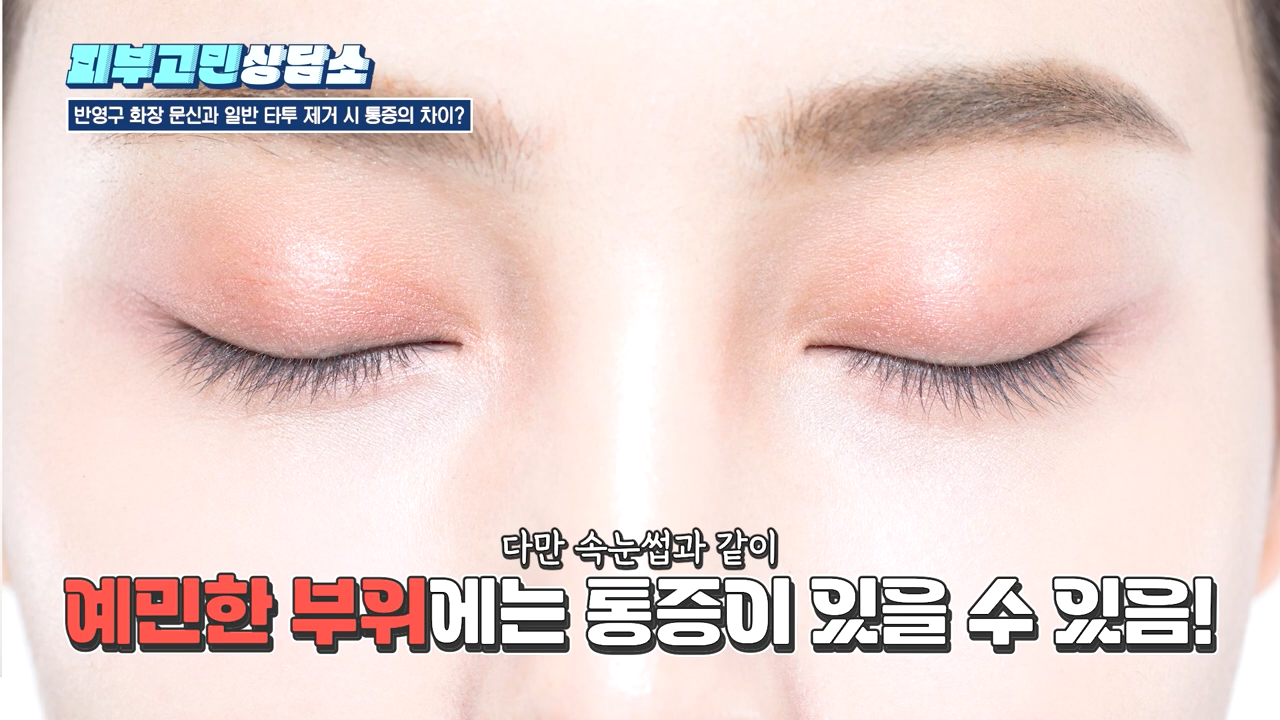
Semi-permanent makeup tattoos generally have less ink, so the pain is usually less than with regular tattoos. However, sensitive areas like the eyelashes may still experience pain. The perception of pain can vary from person to person.
If you have any questions, please contact us via chat now.

A structure that doesn't end in one session
Makeup tattoos require multiple sessions because the tattoo ink needs to be broken down into tiny fragments. Especially when the pigment is thick, layered from top to bottom, each layer must be removed one by one. Semi-permanent makeup tattoos, like regular tattoos, are performed over several sessions.
| Item | Conditions for Semi-Permanent Makeup Tattoos |
|---|---|
| Amount of ink | Less than regular tattoos |
| Pigment composition | Various substances mixed to create color |
| Laser reaction | Varies by color, some high, some low |
| Pain | Less than regular tattoos due to smaller ink amount |
| Sensitive areas | Eyelash area is prone to pain |
| Number of sessions | If layered, performed in multiple sessions |

The process changes with different equipment
To enhance effectiveness, it is advisable to use lasers with high therapeutic efficacy and minimal side effects. In the past, Q-switched Nd:YAG lasers were widely used for makeup tattoo removal, and recently, picosecond lasers have shown good results for tattoo removal.
- The method that has been standard since the past is summarized in Nd:YAG Tattoo Removal.
- Equipment that irradiates in picosecond units can be seen in R-Zero Pico-Frectat Tattoo Removal.
- The overall flow from consultation to recovery is in Tattoo Removal Treatment Guide.
The moment you consider removal
Even with the name 'semi-permanent,' situations can change over time.
- If residual marks remain
- If you are not satisfied with the color
- If you are not satisfied with the shape or form
In such cases, we recommend receiving treatment from a board-certified dermatologist. If you're curious about which method is right for you, please use Leave a consultation via chat.


Authored and medically reviewed by Chief Director Lee Sang-Joo (Board-certified dermatologist) Graduated from Yonsei University College of Medicine · Ph.D. in Medicine, Yonsei University Graduate School of Medicine · Resident in Dermatology, Severance Hospital Currently Adjunct Professor, Department of Dermatology, Yonsei University College of Medicine · President of the Korean Dermatological Association in 2026 View Medical Staff Profile
First published 2024-05-21 · Last reviewed 2026-07-29
This article contains general medical information and is not a substitute for individual diagnosis and treatment. Results and recovery progress may vary from person to person.