


Unlike the initial excitement, there comes a time when you want to remove a tattoo. We've summarized what has changed and how, focusing on PicoWay Laser, the most commonly heard name when looking for tattoo removal lasers in Sinchon.
Why the Shift from Nanoseconds to Picoseconds

In the past, tattoo removal lasers primarily used nanoseconds. While effective, it took a long time to break down pigment particles, and there was often significant thermal damage, which could be burdensome to the skin.
| Item | Nanosecond Laser | Picosecond Laser |
|---|---|---|
| Irradiation Time | Nanosecond unit | One quadrillionth of a second unit |
| Pigment Breakdown | Takes time to break down particles | Breaks down particles more finely |
| Surrounding Tissue | Relatively more thermal damage | Reported to have less thermal damage |
PicoWay Laser has a wavelength configuration that can handle even difficult-to-remove colors.
Summary of PicoWay Laser Features

- It finely breaks down pigment particles and expels them from the body, so removal progresses relatively quickly.
- It acts powerfully in a short time, reducing skin damage and, consequently, pain.
- It is applicable to black and white tattoos, as well as color tattoos such as red, yellow, and green.
- It is reported to cause less thermal damage to surrounding skin tissue, reducing the likelihood of scarring.
Equipment configurations are detailed in R-Zero Pico-Frectat Tattoo Removal, and methods using other wavelengths are summarized in Nd:YAG Tattoo Removal.
How Long Does It Take?
This is the most frequently asked question. Tattoo removal is a process that is difficult to achieve in a single session and takes quite some time.
The number of sessions required varies depending on the depth of the tattoo, the type of pigment, and its size, so it can take several months, and for some people, over a year. Generally, multiple sessions are received at intervals of 1 to 2 months, with usually 5 or more sessions being the basic application.
The number of sessions and duration may vary depending on the individual's skin and tattoo condition, so it is more accurate to determine this through consultation.
R-Zero Technique for Managing Bubbles
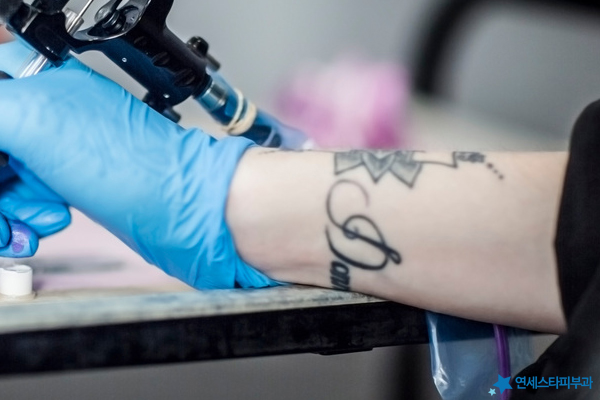
Generally, after laser treatment, a bubbling phenomenon occurs where the skin turns white. This used to require a long wait before the next laser treatment.
The R-Zero Technique involves applying a special substance that quickly alleviates the bubbling phenomenon, allowing up to four laser treatments in one session. If you've been concerned about long treatment periods, finding a clinic that applies this method may be helpful.
What Changes When Irradiating Multiple Times in One Session
Since multiple treatments are possible in one session, the overall number of treatment sessions can be reduced. This also shortens the total duration.
It is reported that the laser can penetrate deeper into the skin more effectively, improving the removal effect even for deeply embedded ink.
Auxiliary Devices to Reduce Pain
In addition to efficient equipment and techniques, low-pain methods such as cryo-anesthesia, which maintains an appropriate skin temperature during the procedure, and non-sedative nitrous oxide anesthesia, can make the experience more comfortable.
Post-treatment care is as important as the treatment itself. The overall treatment flow can be checked in Tattoo Removal Treatment Guide, and a personalized plan can be discussed by contacting us via chat now.

Authored and Medically Reviewed by Dr. Kang Jin-Moon, Chief Director (Board-Certified Dermatologist) Graduated from Yonsei University College of Medicine · Completed Dermatology Residency at Severance Hospital · Served as Professor at Bundang CHA Hospital Member of the Korean Society for Medical Lasers · Member of the Korean Dermatological Association View Medical Staff Profile
First Published 2025-09-22 · Last Reviewed 2026-07-29
This article contains general medical information and is not a substitute for individual diagnosis and treatment. Results and recovery progress may vary from person to person.