

Burn marks are not merely superficial issues where the skin darkens or remains red. Depending on their depth and extent, they can alter the skin's color, texture, and movement, leaving long-lasting effects. It's not uncommon for people to confuse a fresh burn with a developing scar, missing the optimal treatment window. To clarify, the entire process from the moment of the burn until the mark settles is considered a wound, and the final, lasting changes are understood as a scar.
Accidents often happen unexpectedly in daily life. Consequently, many individuals visit us late, having failed to manage their wounds properly in the initial stages. Marks are left as wounds heal, and because each person's skin type and regenerative capacity differ, the recovery outcomes can vary even from the same accident.
What's the Difference Between a Wound and a Burn Scar?
Many people wonder how to distinguish between a wound and a scar after a burn. In short, the entire process from the immediate burn to the settling of the mark is a wound, and the resulting lasting change is a scar.
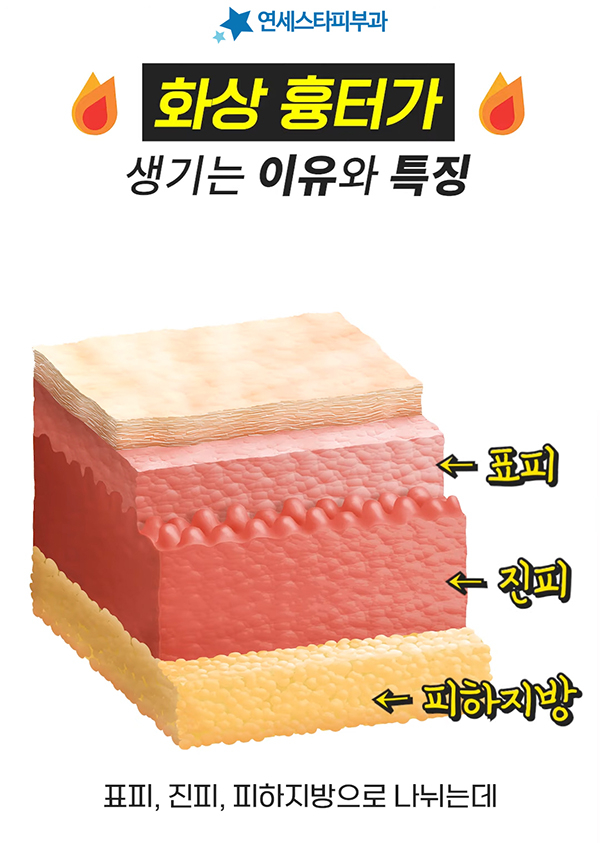
Looking at the skin structure, it is broadly divided into the epidermis, dermis, and subcutaneous fat. The depth of damage to these layers is key to determining the recovery pattern.

Why Does Dermal Layer Damage Leave Scars?
When damage extends deep into the dermal layer, skin appendages like sweat glands or hair follicles are destroyed. Abnormal collagen then fills this space, leading to changes in the skin's color, texture, and wrinkles.
The severity of a scar is determined by how deep and wide the wound is, as well as the temperature of the causative agent and the exposure time. Higher temperatures and longer exposure times can result in larger burn scars after healing.
It is known that deep damage beyond the dermal layer makes it difficult for the skin to restore its original structure on its own, and it becomes filled with abnormal collagen, forming a scar.
Areas with frequent movement, especially joints, around the mouth, or the neck, are typical examples. Mild damage, around 1st degree, tends to recover well with appropriate first aid. However, if the severity increases to 2nd degree or more, hypertrophic or contracture scars can form on the face, neck, and limb joints, leading to aesthetic changes and functional impairment.

Pay Attention if You See These Signs
If the damaged area does not improve and shows the following changes, it may progress to a hypertrophic scar, requiring attention:
- Persistent red pigmentation
- Continued stinging and itching sensations
- Color becoming redder over time
- The mark gradually thickening and rising
A prolonged wound healing period can be a sign of a severe burn or reduced skin regeneration capacity. However, the healing period itself is not a direct cause of scarring, and there can be individual differences. If you are concerned about a burn mark, it is better to have the progression of the burn scar accurately assessed by a professional rather than self-diagnosing.
For questions, inquire via chat consultation regarding burn scar treatment

Four Types of Burn Scars
Burn scars can broadly be categorized into four types. However, it's better to understand that the form changes depending on the extent of the damage, rather than there being fixed categories.
| Type | Key Characteristics |
|---|---|
| Hypertrophic Scar | Skin protrudes and appears reddish due to excessive collagen production (may turn white over time) |
| Pigmented Type | Skin color changes to brown or black due to excessive melanin production |
| Contracture Scar | Surrounding skin is pulled and joint movement is restricted due to collagen fiber contraction |
| Post-Graft Mark | Discoloration, pigmentation, and texture changes in the skin graft area |
The most common hypertrophic scar is a form where excessive collagen production occurs during the healing process, causing the skin to protrude and appear reddish. Over time, the red color may turn white.
The pigmented type shows the skin color changing to brown or black due to excessive melanin production during the recovery period. Increased synthesis in epidermal melanocytes and the migration of excessively produced cells to keratinocytes cause the skin to appear dark.
Contracture scars appear when the burn is severe and the damaged area is extensive. This phenomenon occurs as collagen fibers contract during the skin regeneration process, pulling the surrounding skin, which can alter the skin's shape and, in severe cases, restrict joint movement.
In severe burns, surgical skin grafting may be necessary to restore function. In such cases, discoloration, pigmentation, and texture changes in the grafted area can leave noticeable marks, causing stress.


What Can Be Expected from Treatment?
Restoring scars to their original skin condition is not easy. It is clear that even with careful, long-term management, complete disappearance is difficult. However, cases are reported where consistent treatment using appropriate laser devices such as Ultrapulse Encore, StarLux, and Vbeam, along with methods like Pinhole Technique, can lead to improvement sufficient for daily life.
In the clinic, we often find that even with the same burn, the approach needs to vary depending on the area, depth, and stage of progression. Therefore, establishing a direction before the mark sets is helpful. Methods such as Rejuran Skin Boosters to aid dermal regeneration or Mild Pinhole to refine depressions and thickness may be considered depending on the condition. We also tend to check if V-beam Facial Redness Treatment is accompanied by prolonged redness.
If you are curious about which type your burn mark resembles or which treatment is right for you, inquire via chat consultation for burn scar treatment

In this article, we summarized the criteria for distinguishing between wounds and scars after a burn, the forms scars can take, and the body areas where they commonly occur. Since initial management and timely treatment of burn marks can influence the subsequent course, we recommend consulting with medical staff to determine the best approach if you notice changes.
Chief Director Dr. Sang-Joo Lee (MD, PhD, Yonsei University College of Medicine and Graduate School; Completed Dermatology Residency at Severance Hospital; President of the Korean Dermatological Association) Chief Director Dr. Sang-Joo Lee's Profile First Published 2025-01-21 / Last Reviewed 2026-06-16
This content contains general medical information, and recovery patterns and treatment responses may vary individually. Therefore, accurate diagnosis and treatment plans should be determined through consultation with medical professionals.