

Many people want to remove their tattoos but hesitate due to concerns about scarring. The most common question is similar: "Will laser tattoo removal leave marks on my skin?" To answer directly, by adjusting the laser output and number of treatments to suit your skin condition, you can gradually lighten the tattoo with less burden.
Chief Director Lee Sang-joo of Yonsei Star Dermatology Sinchon summarized the clinical results of tattoo removal using the R-Zero Technique in Koreans and published the findings on tattoo removal duration and efficacy in the Journal of the Korean Laser Medical Association. In this article, we will sequentially examine the basic principles of laser tattoo removal, how the R-Zero Technique differs from conventional methods, and what results have been reported in Korean clinical studies.
What is the principle behind laser tattoo removal?

When a laser is applied to the tattooed area, the ink particles embedded in the skin are broken down into smaller fragments. These fragmented ink particles are then gradually expelled from the body by our immune cells through the bloodstream and lymphatic vessels. This process is repeated, causing the tattoo to fade over time.
In other words, it is not a treatment where all the ink disappears in a single session, but rather a treatment that involves multiple laser applications with time in between for the fragmented particles to be expelled. Therefore, tattoo removal often involves repeated treatments at regular intervals rather than in a short period.
Limitations of past 1st generation laser methods
In past 1st generation laser methods, when a laser was applied once to the tattooed area, the ink would break apart, and bubbles would rise to the surface of the treated area. These bubbles would interfere with further laser application, requiring a wait of about 20 minutes for the bubbles to disappear before continuing with the next application.
It was practically difficult to wait for the bubbles to disappear and then apply the laser multiple times to the same area within a single treatment session.
Due to the 20-minute waiting period, it was virtually impossible to apply the laser repeatedly to the same spot in one session. This also contributed to an increase in the total number of treatments and the overall duration.
How does the R-Zero Technique differ from conventional methods?
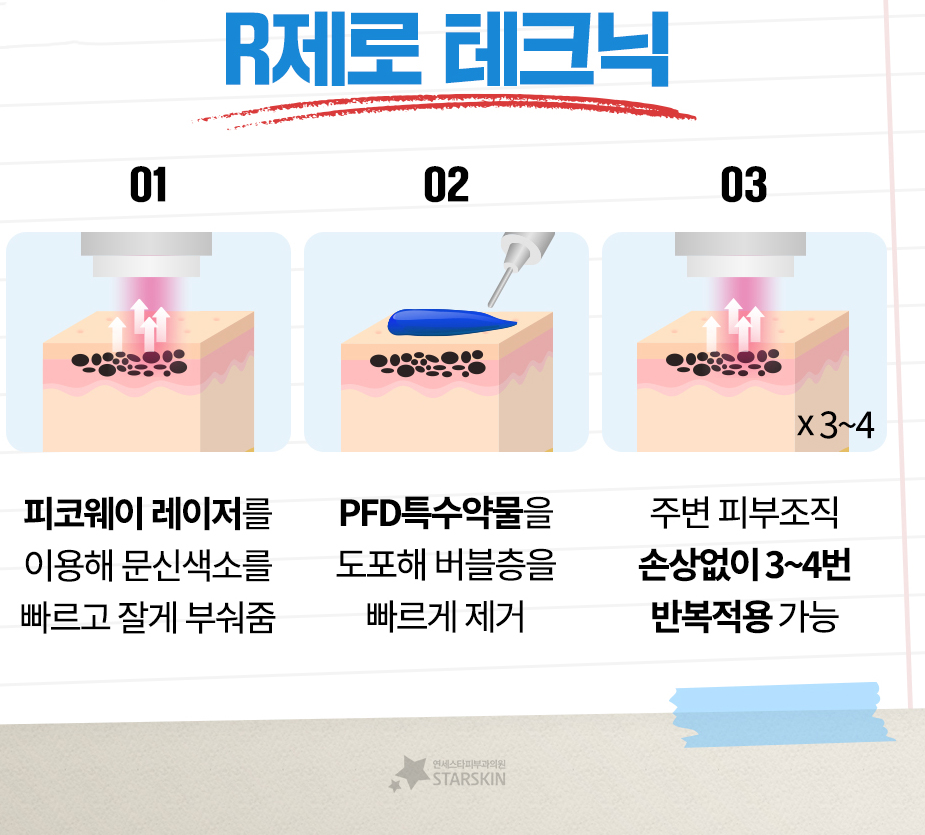
The R-Zero Technique involves applying a special medication, Perfluorodecalin (PFD), to the treated area to suppress bubbles. When this medication is applied, the bubbles that appear after laser application immediately subside.
When bubbles disappear quickly, additional laser applications can be performed immediately, allowing for multiple repetitions on the same area within a single treatment session. Compared to conventional methods, the differences can be summarized as follows:
| Category | 1st Generation Laser Method | R-Zero Technique |
|---|---|---|
| Bubble Management | Wait approximately 20 minutes for natural disappearance | Immediate suppression with special medication |
| Repeated Application | Difficult to repeat in one session | Multiple repetitions possible in one session |
| Treatment Flow | Increased number of sessions due to waiting time | Reported reduction in number of applications |
This ability to perform repeated applications can help reduce the number of treatment sessions required for tattoo removal. However, results may vary individually depending on the type and depth of the ink, and skin condition.
Yonsei Star Dermatology focuses on scar treatment, and thus performs tattoo removal while considering the burden on the skin. If you are curious about tattoo removal procedures, you can check the symptoms and treatment directions together at Learn about Laser Lesion Removal.
If you have any questions, please feel free to leave them via Chat consultation for tattoo removal procedures.
Why was a clinical study targeting Koreans necessary?

The R-Zero Technique was first developed in the United States, and there was a lack of clinical data specifically for Koreans. Since skin characteristics and ink reactions can vary by ethnicity and individual, it was necessary to confirm the results and safety when applied to Koreans.
Therefore, Chief Director Lee Sang-joo of Yonsei Star Dermatology Sinchon, along with domestic researchers, conducted a clinical study to confirm whether the R-Zero Technique reduced tattoo removal duration, and what its efficacy and safety were when applied to Koreans.
Reported Clinical Results
The clinical results were reported in the Journal of the Korean Laser Medical Association, considered a prestigious academic journal in Korea. Tattoo removal procedures using the R-Zero Technique were performed on Koreans with various types of tattoos, including black and white and colored tattoos, for a total of 4 sessions at 4-week intervals.
The reported results can be summarized as follows:
- Approximately 30% of participants observed more than 90% fading of their tattoos.
- The remaining approximately 70% also reported 70-90% fading.
- Applied to various tattoo types, including black and white and colored.
- Conducted with a repeated application method, 4 sessions at 4-week intervals.
In conclusion, the R-Zero Technique was confirmed to be a method that can help reduce tattoo removal duration in Koreans, with reported efficacy.
In clinical practice, even with the same number of treatments, the degree of fading can vary from person to person depending on the ink color, depth, and skin reaction. Therefore, it is good to understand that individual results may vary.
Considerations for safe procedures

At Yonsei Star Dermatology Sinchon, when performing tattoo removal, the laser output intensity and number of applications are adjusted based on the individual's skin condition. Rather than attempting to remove it all at once, the procedure considers the burden on the skin and the recovery process.
Yonsei Star Dermatology Sinchon, with over 20 years of clinical experience and expertise, has a team of dermatology specialists, and all treatments are conducted through 1:1 consultations and personalized care. If you are concerned about scars in addition to tattoos, Exploring Scar Treatment Directions or Learning about Burn Scar Management can also be helpful.
We have compiled important considerations when contemplating tattoo removal:
- Tattoo color (black and white, color) and the time elapsed since it was inked
- Skin condition of the tattooed area and presence of past scars
- Schedule that allows for treatment intervals and recovery time
- Ability to manage post-procedure care such as UV protection and moisturizing
Checking these items in advance can help in determining a suitable treatment plan during the consultation.

If you are curious about tattoo removal duration, the R-Zero Technique, and the number of treatments suitable for your skin, please feel free to inquire.
💬 Consult NowChief Director Lee Sang-joo (MD, PhD, Yonsei University College of Medicine and Graduate School, Completed Dermatology Residency at Severance Hospital, President of the Korean Dermatological Association) Chief Director Lee Sang-joo's Profile First Published 2023-09-13 / Last Reviewed 2026-06-16
Tattoo removal results and recovery patterns may vary depending on individual skin conditions, so please consult with medical staff for an accurate diagnosis and treatment plan.