
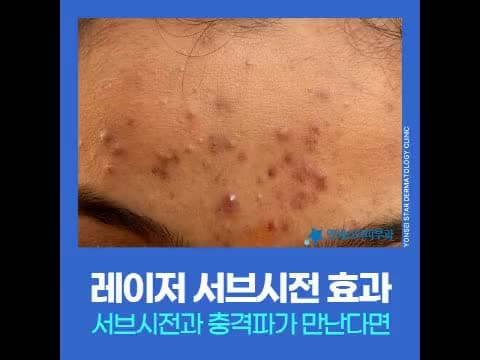
If the uneven marks left by acne bother you daily and cannot be covered by makeup, let's first look at why surface regeneration alone may not be enough.
Many people with thin or sensitive skin have delayed treatment because strong lasers felt too burdensome. In such cases, a less irritating approach involves combining laser shockwave therapy with subcision.
Why Acne Scars Become Depressed
When acne becomes severely inflamed or is improperly extracted, the inflammation can extend to the dermal layer. During this process, skin tissue is damaged, and if collagen regeneration occurs unevenly during recovery, depressed acne scars with sunken surfaces can remain.
Why Surface Regeneration Alone Is Insufficient
More importantly, there is fibrous tissue beneath the scar. If chronic acne inflammation recurs, string-like hardened fibrous tissue forms beneath the skin, pulling the skin downwards.
In this state, even if the surface is regenerated with a laser, there is a physical limit to how much the skin can rise due to the pulling force from below. This is precisely where surface regeneration alone falls short.
Laser Shockwave: A Less Burdensome Approach for Sensitive Skin
Laser shockwave therapy involves attaching a special patch containing black diamond particles to the treatment area and then applying laser energy. The particles in the patch convert the energy into shockwaves, delivering them deep into the skin. The key is to provide mechanical shockwave stimulation without directly applying heat to the surface.
When this stimulation reaches the deep layers of the skin, hardened scar tissue gently relaxes, and fibroblasts are stimulated, aiding in collagen regeneration. Activating microcirculation within the skin can also contribute to waste removal and blood circulation.
Shockwave therapy is particularly considered in the following cases:
- If you experienced redness or pigmentation after heat-based lasers like Fraxel.
- If strong lasers were burdensome due to thin or sensitive skin.
- If you are concerned about depressed scars along with reduced skin elasticity.
Laser Subcision: Severing the Pulling Force from Below
Laser Subcision is a procedure that directly severs the fibrous tissue pulling the scar downwards, without incising the skin surface. To reduce irritation during the treatment, a low-irritation shockwave laser is combined. When the fibrous tissue is severed, new collagen fills that space, creating an environment for the sunken skin to rise.
While the procedure itself is relatively short, it involves directly handling needles, so the practitioner's skill significantly impacts the results. Therefore, a careful approach through specialist consultation is necessary.
If you are curious about which combination is right for your scar, you can check your condition first. Consult via chat now
Understanding the Roles of the Two Procedures
In the clinic, we often see patients who experience redness after heat-based lasers like Fraxel. In such cases, understanding the distinct roles of these two procedures clarifies the reason for their combination.
| Category | Site of Action | Main Role |
|---|---|---|
| Laser Shockwave | Scar surface and upper layer | Reduces surface damage, relaxes hardened tissue, stimulates collagen regeneration and microcirculation |
| Subcision | Dermis beneath the scar | Directly severs pulling fibrous tissue, induces new collagen in the empty space |
| When combined | Simultaneous top and bottom | Top: relaxation and regeneration; Bottom: removal of pulling force to create space for skin to rise |
Above, the shockwave relaxes scar tissue and stimulates regeneration, while below, subcision severs the pulling force. These two directions work together to help fill depressed marks.
Combination Depends on Scar Type
The decision to combine these two procedures and their application order varies depending on the individual's scar type and skin condition. Therefore, it is safest to decide after a diagnosis by a dermatologist.
If you look beyond depressed scars to acne scars in general, or specific types like atrophic acne scars and red acne scars with remaining inflammation, the treatment plan becomes clearer. Along with managing the root cause, acne itself, for the scar stage, you can consider a customized approach like Premium Customized Acne Scar Care tailored to your condition.
Depressed acne scars often cannot be resolved with surface regeneration alone. The fibrous tissue pulling from below must also be released for the skin to naturally rise. We recommend consulting with a specialist to determine the appropriate procedure and sequence based on the scar's shape and depth, and your individual skin condition. Consult via chat now
Dr. Sang-Joo Lee · Dermatologist
Chief Director of Yonsei Star Dermatology Sinchon. A dermatologist with extensive experience in pigment and scar treatment, he is also an adjunct professor at the Department of Dermatology, Yonsei University College of Medicine, and will serve as the president of the Korean Dermatological Association in 2026. You can check his credentials on Dr. Sang-Joo Lee's Profile.
First published 2026-06-15 · Last reviewed July 23, 2026
This article provides general information, and the application methods and outcomes may vary depending on the scar type and skin condition. We recommend consulting with a specialist for a specific treatment plan.