

If depressed marks remain even after laser treatment
Depressed marks left by acne make skin texture rough and are difficult to conceal with makeup, causing long-term concern. To get straight to the point, there are often structural reasons hidden beneath the scar that prevent depressed scars from filling sufficiently with regenerative laser treatment alone.
Once a mark has become a scar, it does not flatten on its own over time. If you have undergone several regenerative laser treatments but your skin has not improved as much as expected, it may be necessary to consider other factors that cannot be resolved by surface regeneration alone.
How do depressed scars form?
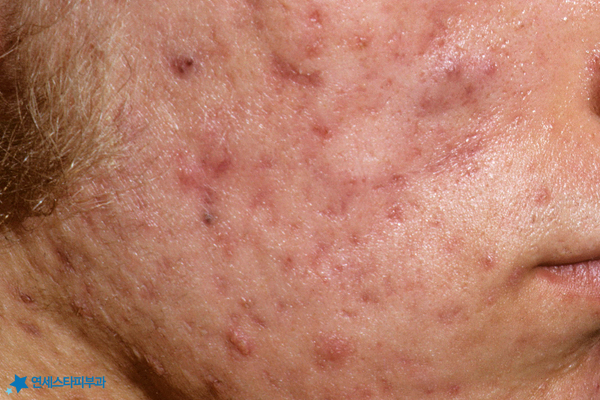
If acne becomes severely inflamed or is improperly extracted, the damage can extend to the dermal layer. During this process, skin tissue collapses, and if collagen regeneration does not occur evenly during recovery, the surface remains as a depressed mark. This is what we commonly refer to as depressed acne scars.
Even if they appear to be the same type of scar, their shape and depth vary from person to person. Therefore, rather than approaching all scars uniformly with a single treatment without diagnosis, it is important to first classify the scar's appearance. Detailed symptom explanations can also be found on the Depressed Acne Scars page.
Three types of depressed scars
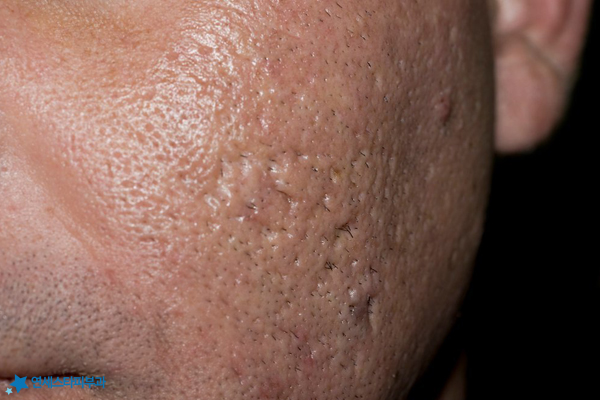
Depressed acne scars are broadly divided into three types based on their shape.
| Type | Shape and Characteristics |
|---|---|
| Icepick | Narrow and deep, as if pierced by an ice pick |
| Boxcar | Wide with relatively distinct, angular edges |
| Rolling | Indistinct boundaries, undulating like waves |
Since the appropriate treatment direction varies by type, it is advisable to determine the sequence and intensity based on an accurate diagnosis. Information on scars in general is organized on the Acne Scars page.
How does regenerative laser work?

CO2-based regenerative lasers, such as Ultrapulse Alpha, work by applying microscopic thermal stimulation to the skin to induce collagen regeneration, gradually filling in depressed surfaces. They play a role in refining the scar surface and creating an environment for new skin to grow.
However, there are cases where surface regeneration alone has limitations. Particularly with rolling depressed scars, fibrous tissue beneath the scar can pull the skin inward like a thread. In this state, even with a good laser regeneration response, there may be physical constraints on the skin rising sufficiently.
If there is still a pulling force from below, it can be difficult for the surface to rise sufficiently, no matter how much it regenerates. A significant number of scars that do not fill are reported to be associated with this structural cause.
Subcision, a treatment that addresses the cause of scar pulling
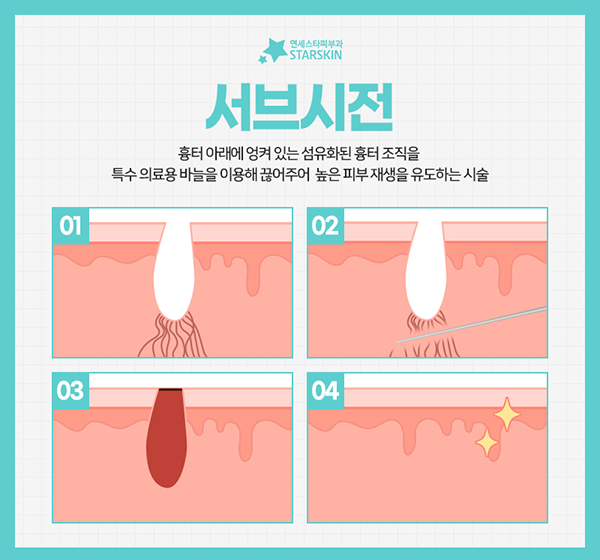
When the skin does not fill well, treatments that control the fibrous tissue beneath the scar can be helpful. Subcision is a representative method.
Subcision is a procedure that severs fibrous tissue beneath the skin with a specialized needle. Without incising or suturing the surface, a needle is inserted to separate the fibrous tissue that was pulling the scar downward. A space is created where the tissue was severed, and as this space naturally fills, new collagen forms, providing a foundation for the skin to rise. This is why subcision is so significant for deep depressed acne scars.
In clinical practice, I often explain that it is important to first address the pulling cause rather than repeatedly performing surface regeneration. Detailed information on the procedure and scar restoration can be found on the Surgical Scar Revision page.
💬 Consult NowThings to know before the procedure

Subcision is performed without surface incision and has a relatively short procedure time. However, it is good to understand the following points in advance:
- Temporary reactions such as bruising or swelling may occur.
- Results may vary depending on individual skin condition and scar type.
- As it is a needle-based procedure, the practitioner's skilled experience influences the outcome.
Considering these points, it can be helpful to check the scar treatment experience when choosing a dermatologist.
Reasons for combining laser and subcision
Acne scar treatment requires considerable time and consistency. Rather than sticking to a single procedure, a combined approach tailored to the scar type, depth, and current skin condition may be a better direction.
If the skin is pulled by fibrous tissue, a sequence can be considered where subcision first addresses the underlying cause, followed by regenerative lasers like Ultrapulse Alpha to promote surface regeneration. This structure allows the two procedures to complement each other's limitations by dividing their roles.
If accompanying symptoms are present, additional combinations may be made:
- If pigmentation is present, laser toning can be added.
- If redness remains, vascular lasers may be combined.
Such customized configurations, which address both the cause of the scar and accompanying symptoms, can lead to combined programs like Acne Scar Triple Repair or Premium Customized Acne Scar Care.
Ultimately, sequence and diagnosis are important
The shape and extent of scar damage vary from person to person. Therefore, the sequence and intensity of the approach are as crucial as the specific procedures chosen. If you have been frustrated by depressed scars that are difficult to improve, a diagnosis that also examines the underlying cause of the scar is the starting point.
💬 Consult NowChief Director Lee Sang-joo (MD, PhD, Yonsei University College of Medicine and Graduate School, completed dermatology residency at Severance Hospital, President of the Korean Dermatological Association)
Chief Director Lee Sang-joo's Profile
First published 2026-05-18 / Last reviewed 2026-06-16
This content is for general information purposes only, and results may vary depending on individual skin condition and scar type. Please consult a specialist for an accurate diagnosis and treatment plan.