
![Removing UV Tattoos Can Be Trickier Than You Think, So Be Careful [Yonsei Star Dermatology Sinchon]](/_next/image?url=https%3A%2F%2Fagqdgbuateknhwpocrgu.supabase.co%2Fstorage%2Fv1%2Fobject%2Fpublic%2Fsources%2Fbbf3bebe-45b6-4415-bd04-bda18b2cac0f%2Fblog-images%2F223906029209_00_3f0eb6b08832.jpg%3Ftype%3Dw966&w=3840&q=75)
UV tattoos, which glow subtly only in the dark or under UV light, are once again attracting attention. Inquiries from people hoping that "since they're not visible normally, the burden might be less" have increased, but what needs to be checked first and foremost is not the aesthetic appeal, but safety and the possibility of removal.
Invisible Tattoos: Why Are They Trending Again?
Many people nowadays get tattoos as a form of fashion and beauty. However, over time, the initial color may fade, or circumstances may change from when the tattoo was first applied, leading more people to consider removal. Getting a tattoo once takes time and money, but the effort involved in removing it is also considerable.
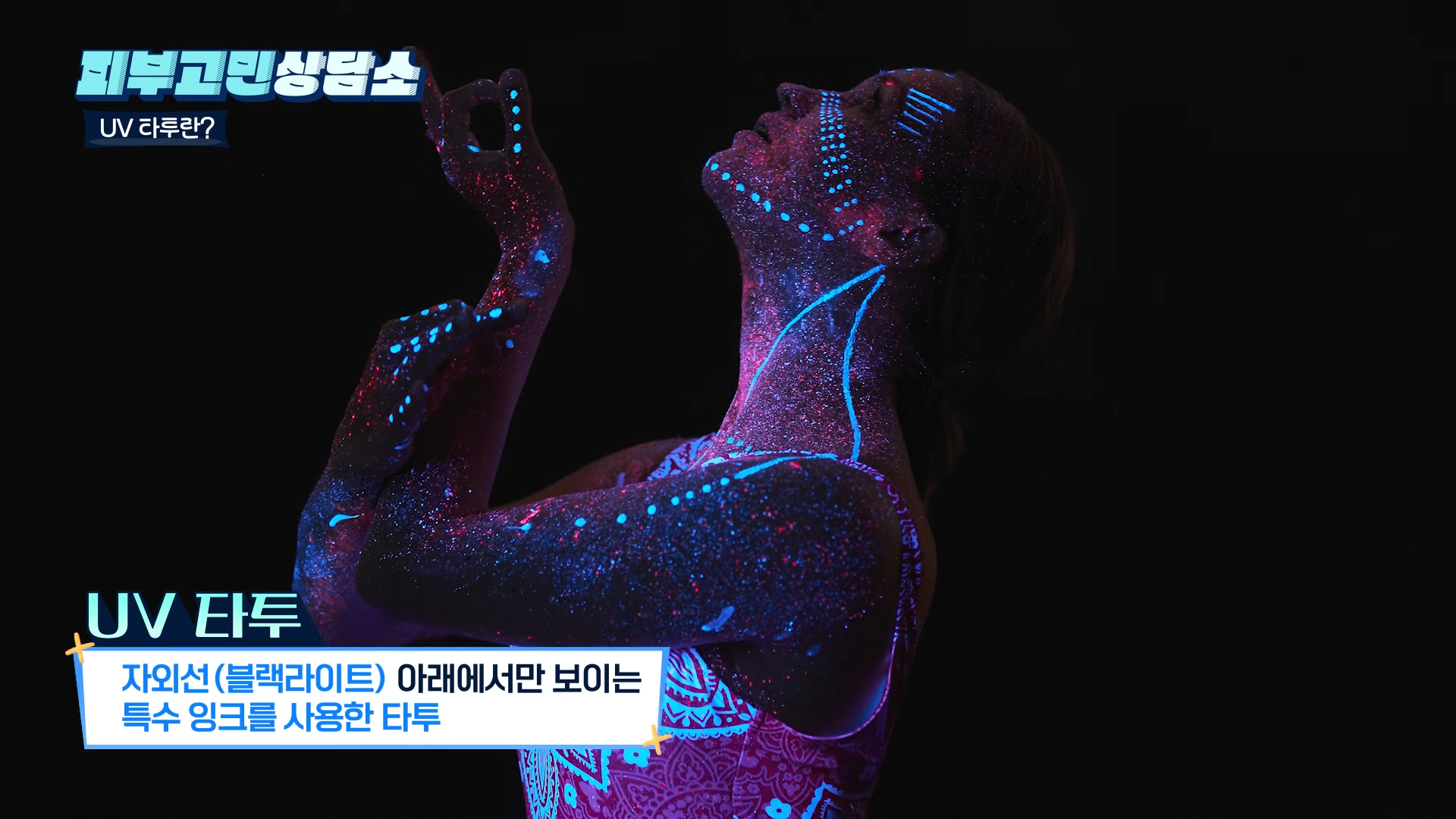

UV tattoos gained attention during the peak of club culture. They are usually almost invisible to the naked eye under sunlight, but in the dark or under UV light, they glow subtly, creating a special atmosphere. The reduced worry about tattoos being visible in daily life seems to be why they are gaining attention again.



However, the fact that they are not easily visible is a separate issue from their impact on the body. Let's carefully examine whether these tattoos irritate the skin and if there are difficulties in removing them later.
Is It Safe Just Because It's Not Visible?


Getting a tattoo involves injecting ink directly into the skin. Therefore, depending on the ink components, allergies, inflammation, or hyperpigmentation may occur. In particular, the fluorescent dyes used in UV tattoos are often not officially approved by the FDA (U.S. Food and Drug Administration) or MFDS (Korean Ministry of Food and Drug Safety), so it is important to note that their safety is not guaranteed.
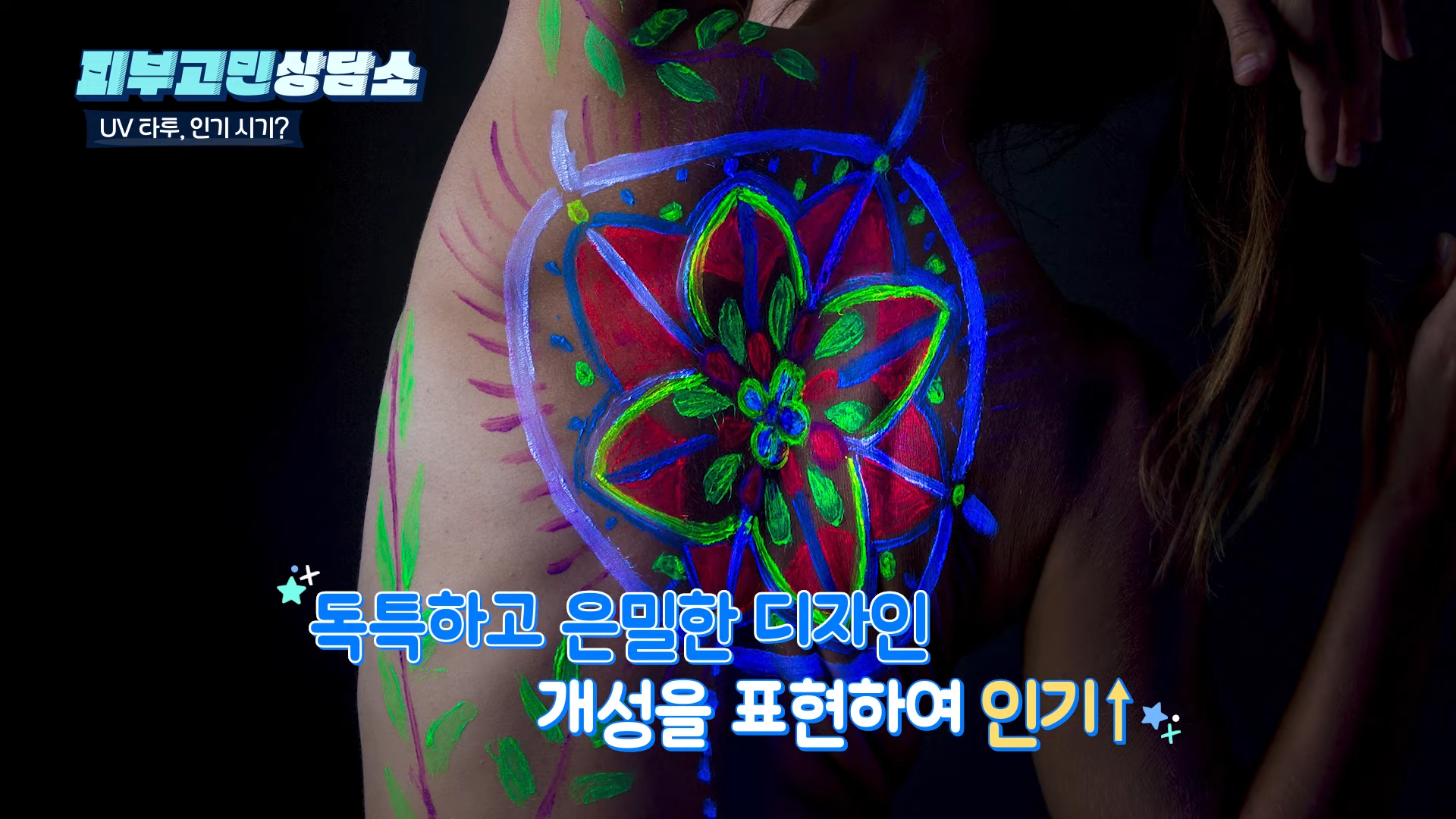

The fact that it's not visible does not mean it's harmless to the body. The key is what components the dye injected into the skin contains.
Even if it doesn't show on the surface, the dye clearly remains in the skin. It's also important to consider that because it's invisible, abnormal reactions might be noticed later.
Things to Check Before Getting a Tattoo


If you must proceed with a tattoo, we recommend carefully checking the following items before the procedure:
- Whether the dye used is an ingredient approved by the Ministry of Food and Drug Safety
- Whether there is a possibility of allergic or other adverse reactions when it comes into contact with the skin
- Whether the dye contains components that can be broken down by a laser later
- Whether the practitioner has sufficient experience and if the procedure is performed in a hygienic environment

If performed in a place without professional knowledge and experience, the risk of skin damage, such as infection, increases, and greater difficulties may be encountered during later removal.
If you have any questions about Laser Lesion Removal, including UV tattoos, you can easily check by contacting us via chat for tattoo removal.
UV Tattoo Removal Is More Difficult Than Regular Tattoos


UV tattoos are reported to be more difficult to remove than regular tattoos. As the number of cases that are difficult to remove even in hospitals continues to increase, it is essential to check the ink components and safety before getting a tattoo.


The factors determining the difficulty of removal are summarized in the table below:
| Category | Regular Tattoo | UV Tattoo |
|---|---|---|
| Dye Approval | Cases of using relatively verified inks exist | Frequent use of unapproved fluorescent dyes |
| Laser Response | Often reacts and breaks down | Reaction is inconsistent depending on components |
| Removal Prediction | Relatively easy to plan | Requires careful approach due to large case-by-case variation |


Removing tattoos made with unverified components can take longer and, in some cases, may leave scars. Therefore, sufficient consultation about RePott Laser treatment for tattoo removal is necessary before deciding on removal.
To Avoid Leaving Scars

In the clinic, we often see cases where rushing removal causes unnecessary burden on the skin. While UV tattoos can give a unique and attractive impression, it is difficult to conclude that they are safe just because they are not visible.


The safest method is to avoid getting tattoos if possible, but if you need to remove an existing tattoo, a treatment plan should be carefully established to avoid leaving scars. If you are concerned about scarring during the removal process, we recommend also looking into information about Surgical Scar Revision.
Double-Check Before Deciding

As this method is recently trending again, there is a growing atmosphere of people getting procedures out of curiosity. However, it is still reported that cleanly removing them can be difficult. Therefore, before the procedure, please reconsider, and if you wish to remove it, it is safer to establish a meticulous treatment plan to avoid scarring.
It requires careful consideration, as removal may take more effort than getting the tattoo itself. If you are considering tattoo removal, please consult with a dermatologist and proceed only after thoroughly checking your condition.

As this involves introducing foreign substances into your body, we emphasize once again the importance of thoroughly assessing safety before proceeding. If you are unsure about the timing and method of removal, it is better to check your condition first by contacting us via chat for UV tattoo removal rather than making a judgment alone.
Chief Director Lee Sang-joo (MD, PhD, Yonsei University College of Medicine and Graduate School, completed dermatology residency at Severance Hospital, President of the Korean Society for Dermatology) Chief Director Lee Sang-joo's Profile First published 2025-06-20 / Last reviewed 2026-06-16
This content is for general information purposes only, and individual results may vary depending on dye components and skin condition. Accurate diagnosis and treatment direction should be determined through consultation with medical staff.