


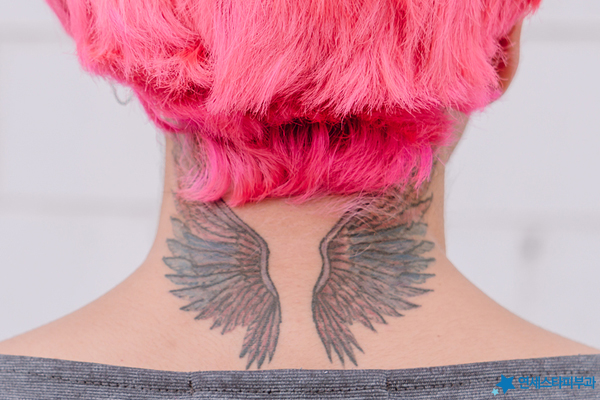
The neck is the most visible area. While the desire to remove a tattoo there is strong, it is also one of the most sensitive skin areas.

Four Conditions of Neck Skin
- The skin barrier is thin and has fewer sebaceous glands, leading to reduced regenerative capacity.
- As a frequently moving area, friction and wrinkles can occur, and recovery may be delayed.
- High sun exposure increases the risk of post-inflammatory hyperpigmentation and discoloration.
- Tattoo pigments often settle deeply.
An Area Where Intensity Cannot Be Arbitrarily Set
Even for the same tattoo, the neck is a tricky area where laser intensity should neither be arbitrarily increased nor too weakly applied.
It requires a dermatologist to meticulously analyze the neck's skin thickness, pigment depth, and color type, then perform the procedure with appropriate energy.

The Point Where a Short Pulse Width Becomes Advantageous
The neck is an area with a high risk of scarring. Therefore, a PicoWay Laser, which selectively destroys pigment with a short pulse width, is advantageous.
| Characteristic | Significance for the Neck |
|---|---|
| Picosecond high-output irradiation | Breaks down pigment more finely and reduces thermal damage to surrounding skin |
| Four wavelength operation | Responds to color tattoos like red or blue |
| Application to thin and sensitive areas | Can proceed with minimal skin damage |
You can compare the differences between devices in the R-Zero Pico-Frectat Tattoo Removal guide and Nd:YAG Tattoo Removal.
Overlapping Shots Without Waiting a Month
In conventional tattoo removal, after one laser shot, the next irradiation was only possible a month later.
With the R-Zero Technique, the story changes. By using a technique that quickly clears bubbles that interfere with additional irradiation, up to four overlapping irradiations are possible.
It is reported that the response is faster as the pigment is repeatedly targeted.
Less heat accumulates in the skin, which tends to lower the risk of blisters, scabs, and inflammation. This can accelerate the treatment progress in a short time, helping to reduce the total treatment period.

Adding Pinhole Technique in the Final Stage
Neck tattoos have a high probability of scarring during the removal process. This is because the skin is thin and recovery is slow. To compensate for this, the Pinhole Technique may be combined in the final stage.
The Pinhole Technique is a scar treatment method that creates very fine holes in the skin with a CO2 laser to induce regeneration. It has been used to improve various scars, including burns, and helps prevent residual scars or unevenness that may remain after removal, while restoring skin texture and elasticity. Detailed information can be found in the Pinhole for Burn & Surgical Scar treatment guide.

Early Stages are Fast, Later Stages are Slower
Pigment in the superficial layer fades relatively quickly. The remaining pigment is in deeper layers, so the response slows down, which is a normal progression.
This period is often the most exhausting. It is better to consistently continue the sessions rather than impatiently increasing the intensity. If it's too weak, changes will be minimal, and if it's too strong, the risk of blisters and scabs increases, so precise control is key.
If you are curious about the progress, please ask via Chat Now.

Adjusting Lifestyle to Prevent Pigmentation
The neck is particularly prone to scarring and pigmentation. Sun protection, reducing friction, and moisturizing care are essential throughout the recovery period.
The neck is a more challenging area for pigment treatment than general tattoos. Don't just think about erasing the pigment; also consider whether the stimulation is excessive, if precise irradiation is possible, and if post-treatment care is provided. You can check how the consultation is structured in the Tattoo Removal Treatment Guide.
Authored and Medically Reviewed by Chief Director Lee Sang-joo (Dermatologist) Ph.D. in Medicine, Yonsei University College of Medicine Graduate School · Resident in Dermatology, Severance Hospital · Former Professor of Dermatology, Youngdong Severance Hospital Author of Acne Bible, Medical Skincare, Skin Barrier View Medical Staff Profile
First Published 2025-12-09 · Last Reviewed 2026-07-29
This article contains general medical information and does not substitute for individual diagnosis and treatment. Results and recovery may vary by individual.