
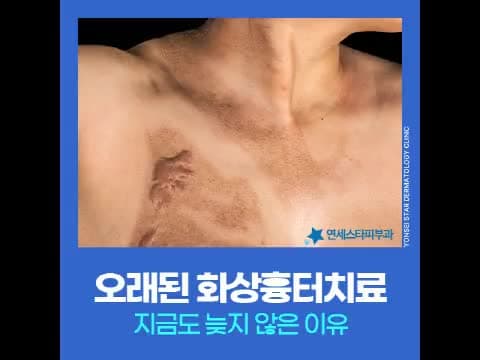
If you've spent years covering old burn scars with long sleeves, let's explore why it's not too late to start treatment now.
Some people, having sustained burns in childhood or scars from an accident decades ago, resign themselves to the belief that nothing can be done. To be clear, it's true that older scars are more challenging to treat, but they are not untreatable. With advancements in burn scar laser technology, including the Pinhole Technique, there are avenues for gradual improvement.
Why Burn Scars Don't Easily Disappear
When a burn occurs, layers of skin tissue, including the epidermis, dermis, hair follicles, and sweat glands, are destroyed by heat. During the subsequent healing process, if fibrous tissues like collagen are not properly rearranged, they can harden with altered color, texture, and shape. This is what forms a burn scar.
Four Types of Burn Scars
Burn scars do not appear in just one form. The approach to treatment varies depending on the type, so it's best to first identify which type your scar most closely resembles.
| Type | Characteristics |
|---|---|
| Hypertrophic Scar | Thick, raised form due to excessive collagen production |
| Contracture Scar | Scar tissue contracts, causing skin tightness or restricted movement |
| Atrophic Scar | Indented skin due to dermal damage |
| Pigment Changes | Scar area darkens or, conversely, becomes depigmented and white |
Is Treatment Truly Impossible If Delayed?
Burn scars are more amenable to treatment in their early, still-red stages, when skin regeneration is active. Starting appropriate treatment at this time can help reduce the progression to hypertrophic or contracture scars. In contrast, older burn scars have already hardened and clumped fibrous tissue, losing elasticity, which results in a lower regenerative response.
In such cases, natural recovery is difficult to expect without external regenerative stimulation from lasers. Even if management was not possible during the early scar stage, there are still options available to start now.
If you wish to identify the type of your burn scar, you can consult with us. Chat with us now
The Pinhole Technique Used for Old Burn Scars
The Pinhole Technique involves creating deep, dense, microscopic holes on the scar surface with a laser. As energy is delivered from the surface deep into the dermis, the long-tangled and clumped collagen fibrous tissue undergoes relaxation and rearrangement, inducing new regenerative responses. The essence of the Pinhole Technique is that this process, when repeated, gradually transforms the scar tissue into a softer and smoother state.
The procedure steps are as follows:
- Laser creates deep, dense micro-holes on the scar surface
- Energy is delivered from the epidermis deep into the dermis
- Clumped collagen fibrous tissue relaxes and rearranges
- Skin regeneration response is induced, gradually remodeling scar tissue
- Repeated treatments gradually make the scar softer and smoother
The Pinhole Technique is known as a method that can be used for scars that are difficult to access with conventional lasers, such as old burn scars, contracture scars, and hypertrophic scars.
Results Vary Depending on Equipment
The results of the Pinhole Technique can vary depending on the equipment used. One of the frequently used devices for burn scar laser treatment is a regenerative laser like Ultrapulse Alpha. The upgraded Ultrapulse Alpha is designed to deliver shorter, more precise pulses deeper into the dermal layer than previous devices.
When this characteristic is applied to the Pinhole Technique, the energy reaches deep into the hardened, old scar tissue, helping to induce fibrous tissue relaxation and regeneration. A notable feature is its ability to deliver high energy while minimizing thermal damage and discomfort to surrounding healthy tissue.
Why Results Differ Even with the Same Pinhole Technique
The Pinhole Technique is not simply about making holes with a laser. The expertise in designing the spacing, depth, and energy of the holes, based on a comprehensive assessment of the scar's depth, extent, shape, age, and individual skin response, directly influences the outcome.
In clinical practice, older burn scars tend to require more treatment sessions and longer treatment periods, but this does not mean that treatment is impossible. Burn scars vary in skin thickness and sensitivity across areas like the face, arms, and neck, and their forms are often complex mixtures. Therefore, more stable treatment can be expected when high-power equipment, skilled experience, and personalized design are combined.
When determining the treatment approach, we first diagnose the burn scar type, then consider options such as Multi-Laser Scar Treatment using multiple wavelengths or Surgical Scar Revision to directly address tissue, tailored to the condition. Hyperbaric Oxygen Chamber therapy, which supports the regenerative environment, may also be considered.
Post-Treatment Care for Burn Scars
- Scabs or erythema may appear after the procedure; do not remove them arbitrarily.
- Avoid direct sunlight and diligently use sunscreen.
- Keep the treated area clean and consistently maintain moisturizing care.
- During treatment, the scar may temporarily appear redder or more prominent; this is part of the regenerative response.
- If adverse reactions persist, consult your specialist immediately.
There is no need to give up on treating old burn scars. Since even the same procedure can yield different results depending on equipment performance and experience, we recommend consulting thoroughly with a dermatologist experienced in burn scar treatment before planning. Chat with us now
Chief Director Lee Sang-Joo · Dermatologist
Chief Director of Yonsei Star Dermatology Sinchon, a dermatologist with extensive experience in scar and pigment treatment. He is an adjunct professor at the Department of Dermatology, Yonsei University College of Medicine, and serves as the president of the Korean Dermatological Association in 2026. For more details on his background, please visit the Chief Director Lee Sang-Joo page.
First published 2026-06-11 · Last reviewed July 23, 2026
This article aims to provide general information about burn scars, and the treatment approach and progress may vary depending on the scar's condition and individual differences. Actual treatment should be decided after consultation with a specialist.