
![Laser Method for Safe Tattoo Removal Without Scarring [Yonsei Star Dermatology Sinchon]](/_next/image?url=https%3A%2F%2Fagqdgbuateknhwpocrgu.supabase.co%2Fstorage%2Fv1%2Fobject%2Fpublic%2Fsources%2Fbbf3bebe-45b6-4415-bd04-bda18b2cac0f%2Fblog-images%2F223984211838_00_b9395e915f4d.jpg%3Ftype%3Dw966&w=3840&q=75)
Past choices that lead to regret over time can happen to anyone. The first question people ask when considering tattoo removal is, "Will I be left with a scar?" To answer directly, it is reported that if the treatment is performed gradually without overdoing it and with careful attention to skin recovery, the risk of scarring can be reduced, and the tattoo can be safely removed.
While the perception of tattoos has changed significantly, a mark once etched is not a simple problem that can be erased quickly. Many people are troubled by tattoo marks remaining on their bodies after some time. The question of which laser and method to use remains a heavy task for many.
Why Does Tattoo Removal Lead to Scars?

Tattoos are etched into the skin in different forms depending on their size, type, and location. Therefore, the removal process is not uniform. The larger the area to be removed, and the deeper the ink components, density, and color remain in the skin, the more difficult the treatment and the higher the possibility of scarring.
Tattoo Removal is, simply put, the process of breaking down and eliminating pigments located in the dermis. When the pigment is fragmented by a laser, it is gradually expelled from the body through the lymphatic system, slowly fading. If the intensity is excessively increased or the skin is severely irritated during this process, the skin itself can be damaged before the pigment is removed, easily leading to scars or pigmentation.

In the clinic, many patients request continuous increases in intensity for faster results. It's natural to become impatient when changes feel slow, but that very moment is when laser-induced scars and pigmentation are most likely to occur.
First Check Situations That Increase Scar Risk
It is helpful to review in advance which conditions increase the likelihood of scarring before treatment. The following items are good to check during pre-treatment consultation:
- If the tattoo is a large, dark lettering type that needs to be removed
- If colors like blue or green, which are difficult for lasers to react to, are mixed in
- If the treatment is performed with excessively high intensity to finish in a short period
- If skin recovery is slow or there is a predisposition to scarring
- If pigmentation or irritation reactions have already appeared from previous treatments

The process of getting a tattoo itself is not easy. Removing it also requires repeated treatments and takes a long time. This is why many people hesitate to get treatment even if they don't like their tattoo, due to concerns about scarring.
Why Isn't It a One-Time Process and Becomes a Long-Term Battle?

Treatment duration varies greatly depending on the individual and their condition. If the tattoo is very large, contains vibrant colors, or is a dark lettering type, 10 or more sessions may be needed, sometimes extending over a year. Since it's a long-term process, receiving thorough treatment from the beginning and managing it well is advantageous for scar prevention.

Different laser reactions for each color are also a variable. Blue and green are particularly challenging, and skin recovery speed also varies from person to person, leading to differences in outcomes even with the same treatment. Therefore, an approach that is safe and proceeds in stages is recommended, rather than thinking of it as a quick, short-term process.
It is reported that a gradual treatment that monitors skin recovery rather than excessive intensity is key to reducing the risk of scarring.
The performance of the equipment used to remove tattoos also affects the results. It is advisable to find a place that uses lasers with verified safety and performance.
If you are concerned about pigmentation or scarring during the removal process, you can receive guidance tailored to your condition by inquiring via chat about the process of tattoo removal scarring and management directions.
Picosecond Lasers and Scar-Reducing Methods

Recently, picosecond lasers are often used for tattoo removal. This method delivers strong energy in an extremely short time, one trillionth of a second, and is gaining attention for its ability to break down ink in lesions while minimizing damage to surrounding skin. Such picosecond-level Laser Pigment Treatment is operated in a way that reduces the burden of scarring.
Among them, PicoWay is a superior version, and it is reported that it can be expected to provide relatively safe treatment along with its performance.
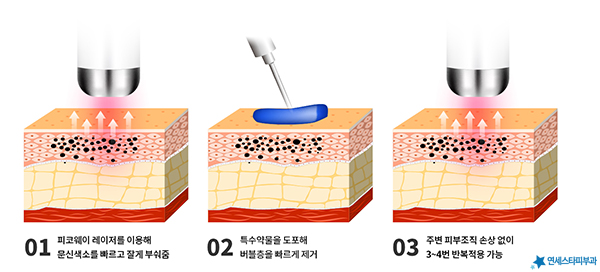
Along with this, there is a special technique called R-Zero. It is characterized by allowing up to 4 laser shots per session, improving the inconvenience of slow treatment speed where typically only one shot was possible at a time.
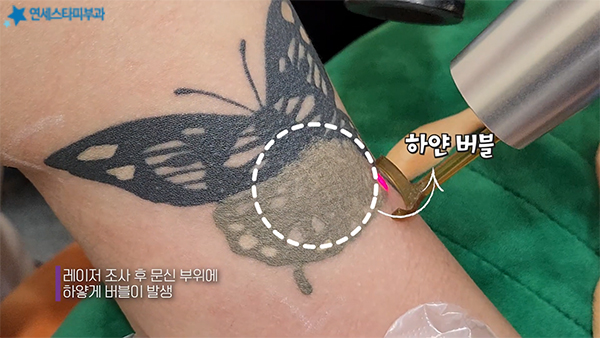

The factor that hinders multiple shots is the bubbling phenomenon. R-Zero quickly resolves this phenomenon, allowing multiple shots in a single session, and is evaluated as an efficient method in that the treatment effect can be felt relatively quickly.
Differences in Approach Based on Method and Pigment Type
The differences in treatment approach according to tattoo type and color are summarized in the table below:
| Category | Characteristics | Considerations for Treatment |
|---|---|---|
| Black monochrome tattoo | Relatively good laser response | May require fewer sessions, but varies with darkness |
| Color tattoo (blue, green) | Difficult color-specific response | Requires additional sessions and more delicate intensity control |
| Large, dark lettering | Wide area and deep color | May lead to 10+ sessions, long-term treatment |
If the pigment traces are deep or scars have already formed, treatment for the scar itself may be needed in addition to pigment removal. When depressed marks or hypertrophic changes are present, Surgical Scar Revision or Triamcinolone Scar Injection may be considered as appropriate for the condition.
Ultimately, the Practitioner's Judgment and Management Are Crucial

Even with excellent equipment and good methods, their effective utilization ultimately depends on the practitioner's skill. If the individual's skin characteristics and tattoo type are not precisely analyzed and a suitable treatment plan is not established before the procedure, additional side effects, including scarring, may occur.
It is not simply about firing a laser at the tattoo area; it is crucial to continue the treatment safely and flexibly, monitoring the results until the end. We recommend starting after a thorough consultation.
If you are curious about the treatment direction suitable for your tattoo type, color, and skin condition, we recommend checking before you begin.
💬 Consult NowChief Director Dr. Sang-Joo Lee (MD, PhD, Yonsei University College of Medicine and Graduate School, Completed Dermatology Residency at Severance Hospital, President of the Korean Dermatological Association) Chief Director Dr. Sang-Joo Lee's Profile First Published 2025-08-26 / Last Reviewed 2026-06-16
This content is for general information purposes only, and treatment outcomes may vary individually. Please confirm an accurate diagnosis and treatment plan through consultation with medical staff.