

When you see a firm, raised scar on your skin, you've probably wondered, "Is this a keloid, or just a thickened scar?" While these two types of scars may look similar, their underlying causes, progression, and treatment approaches differ, making accurate differentiation the first step.
In this article, we will systematically explain the differences between keloids and hypertrophic scars and how each is approached.
Hypertrophic Scars: Why They Form and How They Change
Hypertrophic scars are also known as hypertrophic scars. They form as a raised, rough, and thickened area of skin during the wound healing process.
They tend to appear when initial wound care was insufficient, or when the skin in frequently bending joint areas, such as knees or elbows, is repeatedly stretched during recovery.

Initially, they often appear reddish, making them easy to mistake for keloids. However, hypertrophic scars have several distinguishing characteristics:
- They do not continue to grow beyond the original wound boundary over time.
- They are a result of the wound healing process, not a constitutional issue, so anyone can develop them.
- They are usually almost painless.
- Recurrence is reported to be relatively rare.
For these reasons, improvement can be expected with appropriate treatment.
What Makes Keloids Different?
Keloids are largely influenced by constitutional factors. Therefore, they are often not recognized initially and are discovered later during the wound healing process.
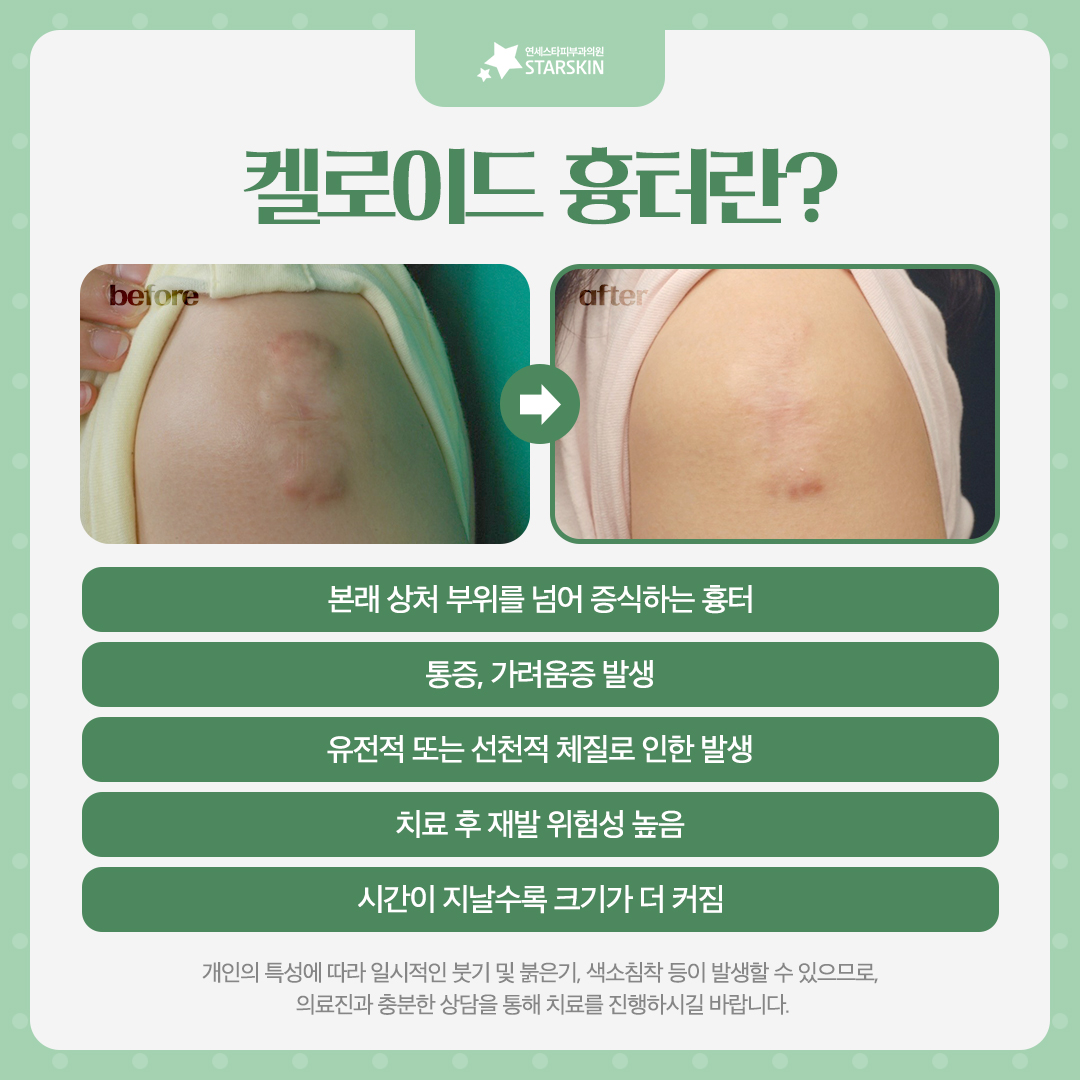
The most significant characteristic is that the scar tissue proliferates beyond the original wound boundary. This causes them to grow progressively larger, and unlike hypertrophic scars, keloids often cause itching or pain in the scar area.
Even if a raised scar subsides, it doesn't mean it's completely resolved. Due to underlying constitutional factors, there is a risk of recurrence, requiring consistent management.
Because of these characteristics, many people experience discomfort in their daily lives.
A Quick Look at the Differences Between the Two Scars
In the clinic, many people confuse these two types of scars. The key differences are summarized in the table below:
| Category | Hypertrophic Scar | Keloid |
|---|---|---|
| Main Cause | Wound healing process, site characteristics | Constitutional factors |
| Size Change | Does not exceed wound boundary | Proliferates beyond boundary |
| Pain/Itching | Almost none | Often accompanied |
| Recurrence Tendency | Rare | Relatively high |
As shown in the table, even though both are 'raised scars,' their progression differs, so an accurate diagnosis is more important than self-assessment.
If you're curious which type your scar is closer to, feel free to ask us via chat consultation about scar classification.
How Are Keloids Approached?

Our clinic provides keloid treatment focused on suppressing recurrence. We combine laser treatment that targets only the scar tissue with low-pain injection therapy to prevent excessive scar tissue formation, and we adjust the concentration of corticosteroid hormones appropriately to minimize side effects.

It is reported that performing only one of either injection therapy or laser therapy alone has a high possibility of keloid recurrence. Therefore, we recommend combining both treatments to reduce recurring discomfort. Triamcinolone Scar Injection, which acts directly on the scar area, is also utilized as one pillar of this combined treatment.
Customized Approach for Each Scar
Yonsei Star Dermatology Sinchon has over 20 years of experience in scar treatment. We have accumulated clinical experience with various scars, including keloids and hypertrophic scars, as well as acne scars, burn scars, and cosmetic surgery scars.
Even if scars appear similar, their causes and progression vary, so a personalized approach tailored to the symptoms is crucial.

Accurate Diagnosis Comes First
Today, we've looked at the differences between keloids and hypertrophic scars, and the treatment approaches offered at our clinic. While the two scars may look similar, their causes, progression, and management methods are different.
If you find it difficult to distinguish which type of raised scar you have, we recommend getting an accurate diagnosis before self-assessment. A clear diagnosis is essential for determining the appropriate treatment direction.
💬 Consult Now
Dr. Sang-Joo Lee, Chief Director (MD, PhD, Yonsei University College of Medicine and Graduate School; Dermatology Resident, Severance Hospital; President, Korean Dermatological Association) Dr. Sang-Joo Lee's Profile First Published 2023-12-06 / Last Reviewed 2026-06-16
Scar patterns and responses may vary by individual, so please confirm an accurate diagnosis and treatment plan through direct consultation with medical staff.