


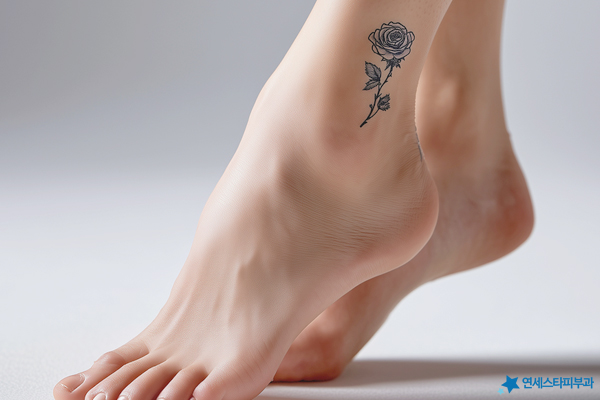
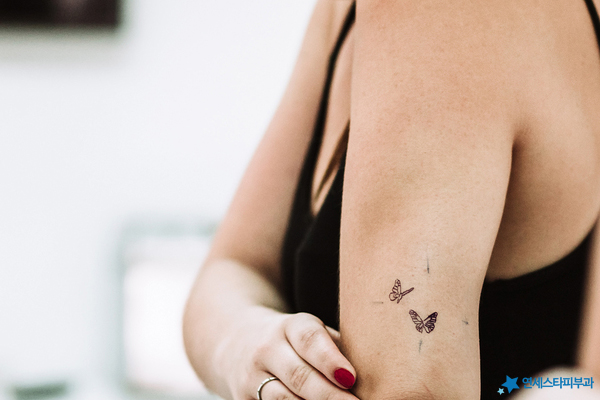
Small stars on the wrist, initials hidden behind the ear, mini designs wrapped around the ankle. Mini tattoos are a popular choice for many people because they can be applied without much burden. However, when they decide to remove them, they are often surprised, thinking that because it's small, it will disappear quickly.
Mini tattoo removal is not always simple just because of its small size. Let's go through the frequently asked questions from people considering small tattoo removal in order.
Small Does Not Mean Quick Removal
Small size does not always mean quick removal. The difficulty and number of treatment sessions depend more on the amount, depth, and color of the pigment than on the size.
Especially for mini tattoos, ink is often densely and sufficiently filled to achieve clear and vivid expression within a small area. The more pigment there is, the greater the total amount of particles the laser needs to break down, which may result in more treatment sessions than expected.
Depending on the ink density and pigment depth, mini tattoo removal may require more than 10 sessions.
The Process of the Body Expelling Laser-Broken Pigment
The principle of laser tattoo removal is simple. The laser finely breaks down pigment particles, and the body's immune cells absorb and expel these fragments in a repeated process.
Therefore, the greater the total amount of pigment, the more limited the amount that can be processed in a single session, and the more time immune cells need to sufficiently expel the fragments. This is why vivid and clear mini tattoos, despite their small size, may require more sessions.
Conversely, tattoos that are old and have faded significantly, or those with low ink density, may require relatively fewer sessions. The most accurate number of sessions can be confirmed through a specialist's diagnosis. The procedure is outlined in Tattoo Removal Treatment Guide.
Common Areas for Mini Tattoos
Mini tattoos are often placed in small, delicate areas on the periphery of the body.
- Fingers
- Wrists
- Collarbones
- Behind the ear
- Ankles
Coincidentally, these areas are also known to experience strong pain during laser tattoo removal. Even if the size is small, it is advisable to plan for pain management sufficiently if the tattoo is in such an area.
How Equipment and Techniques Work Together
| Element | Operating Principle | Use in Mini Tattoos |
|---|---|---|
| PicoWay Laser | Breaks down pigment particles finely with picosecond ultra-short pulse energy | Precisely targets narrow and dense pigment areas |
| PicoWay | Supports various wavelengths | Responds to colored mini tattoos |
| R-Zero Technique | Removes bubbles formed immediately after irradiation with a special medication, allowing up to 4 repeated irradiations in one session | Increases the amount of breakdown per visit without excessively increasing intensity |
PicoWay Laser helps reduce the recovery burden after treatment by minimizing thermal energy delivered to surrounding skin tissue. The repeated irradiation within a session using the R-Zero Technique can contribute to reducing the total number of treatment sessions. The combination of these two methods can be found in R-Zero Pico-Frectat Tattoo Removal Guide, and you can compare the differences between devices with the Nd:YAG Tattoo Removal Guide.
Why Scar Management is Considered Together

For mini tattoo removal, especially in areas with high ink density or sensitive skin, there is a possibility of scarring or pigmentation after the procedure. Therefore, it is important to proceed with laser treatment and scar management care together.
After the procedure, we recommend thorough moisturizing and sun protection as guided by the medical staff, and additional care for scar prevention if necessary. You can ask questions via Chat Now.
Even Small Procedures Are Medical Acts
Some people occasionally underestimate the importance of choosing a clinic just because the size is small. However, mini tattoo removal is also a medical act that applies energy directly to the skin.
In sensitive areas such as fingers, collarbones, and ankles, the discomfort during the procedure and the recovery status afterward can vary greatly depending on the practitioner's experience and equipment operation skills. Even for mini tattoo removal, it is advisable to consider the equipment, techniques to reduce pain burden, and the judgment of an experienced specialist.

Authored · Medically Reviewed by Representative Director Dr. Jinmoon Kang (Dermatologist) Graduated from Yonsei University College of Medicine · Resident in Dermatology at Severance Hospital · Former Professor at Bundang CHA Hospital Currently Adjunct Professor at Yonsei University College of Medicine, Department of Dermatology · Member of the Korean Dermatological Association and the Korean Society for Laser Medicine and Surgery View Medical Staff Profile
First Published 2026-06-26 · Last Reviewed 2026-07-29
This article contains general medical information and does not substitute for individual diagnosis and treatment. Results and recovery may vary by individual.