
![If you're concerned a raised scar might be a keloid, here's what to check first | [Yonsei Star Dermatology Sinchon]](/_next/image?url=https%3A%2F%2Fagqdgbuateknhwpocrgu.supabase.co%2Fstorage%2Fv1%2Fobject%2Fpublic%2Fsources%2Fbbf3bebe-45b6-4415-bd04-bda18b2cac0f%2Fblog-images%2F223838936729_00_08e74f944c85.jpg%3Ftype%3Dw966&w=3840&q=75)
When you discover a raised scar on your skin, your first thought might be, "Could this be a keloid?" To get straight to the point, raised scars are broadly divided into two types: hypertrophic scars and keloid scars. Although they may look similar, their progression and management approaches are distinctly different.
Scars that form on the body appear in different forms due to various factors such as the cause of injury, location, and individual constitution. Among these, scars that rise above the skin's surface are distinguished as either hypertrophic or keloid. Understanding this difference is the first step in managing them.
Why do scars form, and how do they subside?

It's easy to understand scars as traces left behind when collagen is excessively produced during the wound healing process. Typical scars do not significantly extend beyond the original wound area.
Over time, as healing progresses, they tend to gradually shrink in size or lighten in color compared to their initial appearance. Therefore, if a scar is small and not very noticeable, it may naturally resolve without separate treatment.
Scars are traces left by excessive collagen accumulation, and their rate and form of subsidence vary depending on the amount, location, and individual constitution.
What's the difference between hypertrophic scars and keloids?
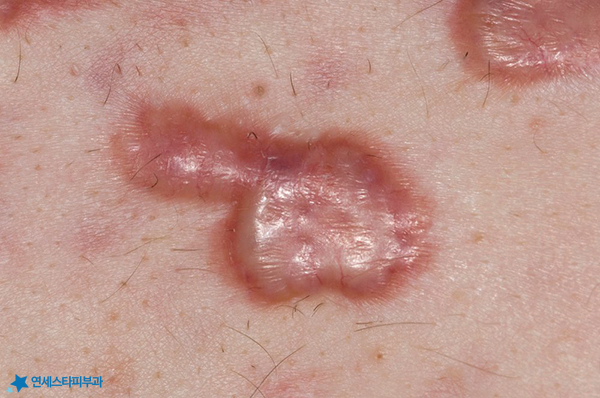
Keloids have a somewhat special characteristic. Initially, they may appear similar to hypertrophic scars, but over time, they tend to expand beyond the original wound area. They do not naturally shrink, making them noticeable, and depending on their location, their raised shape can cause discomfort in daily life.
In the clinic, even with the same "raised scar," the management approach differs depending on whether it stays within its boundaries or grows beyond them. The characteristics of the two types of scars are summarized in the table below:
| Classification | Hypertrophic Scar | Keloid Scar |
|---|---|---|
| Extent | Stays within the original wound area | Expands beyond the wound area |
| Time Course | Tends to gradually shrink or lighten | Tends not to shrink on its own |
| Perception | Relatively less prominent | Distinctly raised and noticeable |
If you are concerned about such scars, reviewing the explanations on Characteristics and Management of Keloid Scars and Triamcinolone Scar Injection for Hypertrophic Scars may help you understand better.
How does injection treatment work?

Steroid injection treatment is a method that helps reduce scar size by suppressing inflammation and collagen production. It offers the advantage of relatively quick changes and ease of procedure.
However, many people find the pain during the injection process daunting.
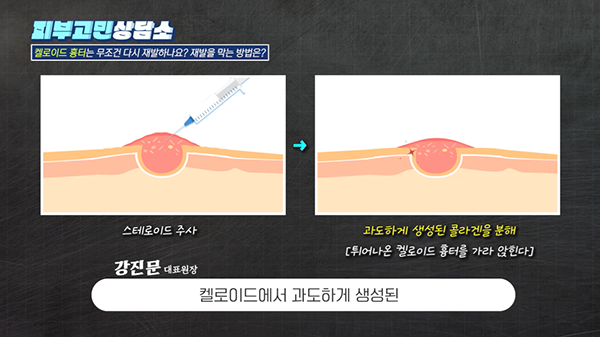


Some clinics offer low-pain injection methods to reduce discomfort during treatment, so it's good to check this before proceeding. However, for keloid scars, it is reported that combining injections with laser treatment, depending on the condition, can help prevent recurrence and maintain the effect longer, rather than using injections alone.
Before considering treatment, it's good to check the following items:
- Is the scar growing beyond the original wound area?
- Does the redness persist for a long time?
- Does the clinic apply pain-reducing methods during injections?
- Is your condition suitable for combined injection and laser treatment?
- Is there a family history of keloids?
If you are concerned about the type of scar or pain, you can easily ask any questions you have through chat consultation regarding scar treatment direction.
If redness persists for a long time
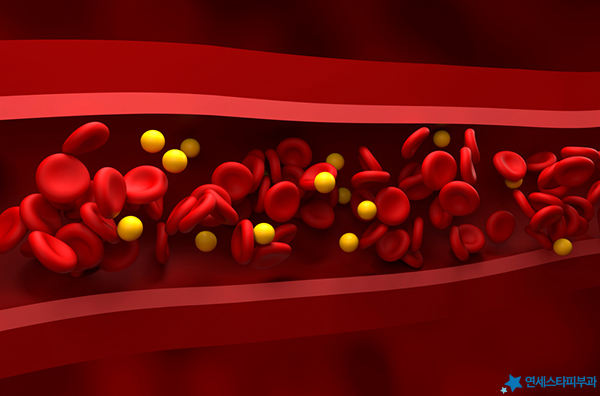
Upon close observation of the problematic lesion, you may notice persistent redness. This redness is due to excessive vascular development.
Vbeam Prima, known as a vascular laser, is considered helpful in improving such red marks. If you are concerned about redness accompanying scars, the explanation on Redness Management for Red Acne Scars may also be helpful.
Why combined management is recommended over single treatment

For raised scars, better results can be expected when various methods are combined, depending on the type, size, and location. If treatment is difficult and the scar quickly returns to its original state, the disappointment can be significant.
We generally recommend a comprehensive approach that combines various methods tailored to the condition, rather than a single treatment. If the scar also involves depth or indentation, an approach that refines the structure, such as Surgical Scar Revision, may also be considered.
Why you don't have to give up prematurely

In this article, we've summarized the characteristics of raised scars and methods to address them. While the treatment period may vary depending on the individual and condition, since it is an area that can be improved, by proceeding step-by-step without giving up prematurely, raised scars can be made significantly smoother.

Scars are an area that is refined through staged management tailored to the condition, rather than disappearing all at once. If you want to confirm whether your scar is hypertrophic or keloid, and which method is right for you, we recommend consulting us comfortably below.
💬 Consult NowChief Director Lee Sang-ju (MD, PhD, Yonsei University College of Medicine and Graduate School, completed dermatology residency at Severance Hospital, President of the Korean Dermatological Association) Chief Director Lee Sang-ju's Profile First published 2025-04-18 / Last reviewed 2026-06-16
This content is for general information purposes only, and results may vary depending on individual skin conditions. Accurate diagnosis and treatment direction should be determined through consultation with medical staff.