

Anyone who experiences trauma that tears the skin or undergoes surgery involving an incision goes through a suturing process. But why do red, raised scars remain even after careful suturing? To get straight to the point, suture scars are affected by excessive regeneration and skin tension during the healing process, and it is reported that timely management can reduce the prominence of the scar.
Hello. This is Yonsei Star Dermatology Sinchon. Even if suturing is done well, it is not uncommon for the sutured area to open up, leaving prominent marks like hypertrophic scars or keloid scars. Today, based on the explanation from Dr. Kang Jin-moon, a dermatologist, we will summarize how to manage scars after suture surgery to reduce them and what treatments can help with already established surgical scars.
Why is early management important for suture scars?
For those sensitive to scars, early management to reduce scars is important. The same applies to suture scars.

After an injury and suturing, stitches are usually removed within 1 to 2 weeks. At this point, the sutured area may appear to have finished regenerating, but skin cells actually continue to regenerate for several months, or even up to a year.

The problem arises when this regeneration occurs more than necessary. If regeneration is excessive, the scar is more likely to become prominent. Therefore, appropriately managing excessive skin regeneration becomes the basic principle of early scar management.
How to manage blood vessels that create red marks

Unnecessary blood vessels that promote excessive regeneration can be constricted or reduced with vascular lasers like Vbeam Prima. It is reported that this type of management can significantly reduce the extent of excessive scarring. Preventive management for suture scars can begin immediately after stitch removal, and even if the start time is somewhat delayed, it does not pose a major problem, but it is better to start as early as possible.
The key to suture scar management is to address red marks early and minimize skin tension.
Why suture scars differ in size even with the same suturing

The most important cause of scars after suture surgery is skin tension. Areas with strong tension tend to regenerate excessively, so areas with high tension like the arms, legs, and torso are prone to scars widening and becoming large. Conversely, areas with thin skin like the face have weaker tension, so scars tend to be less prominent.

In particular, the eyelids, which are the thinnest part of our body, are considered the area where scars are least likely to remain due to weak tension. Understanding the differences by area is easier when organized in a table.
| Area | Skin Tension | Scar Tendency |
|---|---|---|
| Eyelids | Weak | Least likely to remain |
| Face | Weak | Relatively less prominent |
| Arms, Legs, Torso | Strong | Prone to widening and becoming large |
In the clinic, the recovery patterns for the same suturing can be quite different depending on the area, and areas with strong tension require more active management.
Things to consider before re-operating on a scar
Another case where significant skin tension occurs is scar reconstruction or tissue expansion, which involves removing an existing scar and re-suturing. Surgical removal and suturing of scars can potentially create larger scars, so it is advisable to choose this method carefully. If considering Surgical Scar Revision, it is important to thoroughly examine the condition and location of the mark first.
If you have any questions, inquire via chat consultation for suture scar management
Four things to remember in suture scar management

To achieve satisfactory results in suture scar management, it is good to remember the following four points:
- Use a vascular laser to reduce red marks in the sutured area as early as possible.
- Avoid strenuous exercise or excessive movements that put tension on the skin.
- Using scar ointments or patches together can aid in management.
- If the mark is still bothersome after the redness subsides, continue with stage 2 management using a regenerative laser.
If vascular marks were managed in the first stage, the second stage focuses on refining the texture of the remaining marks to be as close to normal skin as possible.
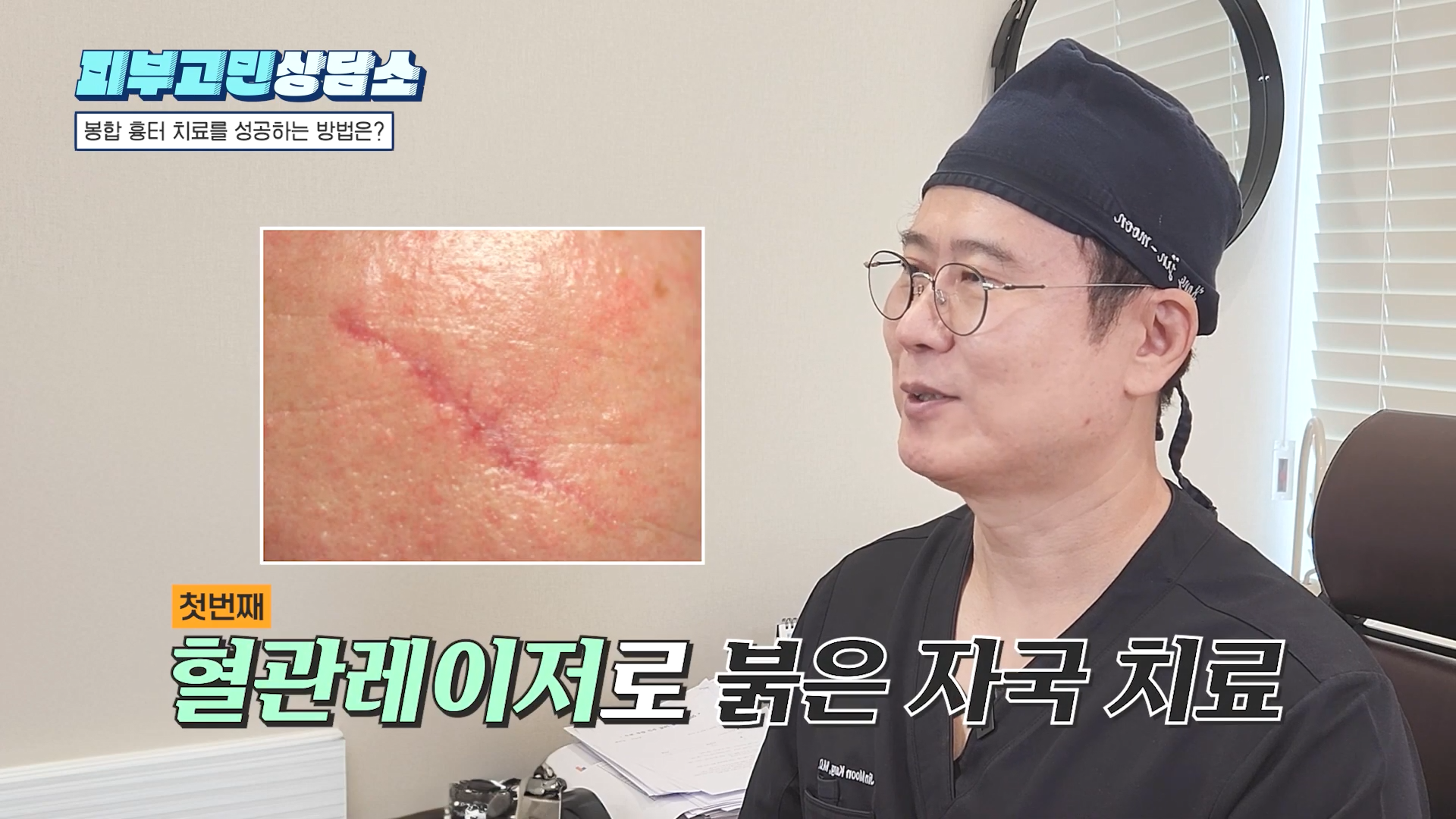
Ointments and patches are auxiliary means that are easy to continue in daily life, and lifestyle habits that reduce excessive movement help manage tension.
Consistent long-term management

If the scar is still noticeable after the redness has disappeared and it is a concern, there is a method of performing stage 2 management with skin regeneration lasers such as Ultrapulse Encore or StarLux. While it is difficult to return a scar to exactly the same as normal skin, it is reported that consistent management with the goal of making it as similar as possible to normal skin can improve it to the point where it is not a major concern in daily life. The degree of improvement may vary from person to person.
Marks involving incision and suturing, such as cosmetic surgery scars, are approached with the same principle. If you are concerned about suture scars affecting your confidence or weighing on your mind, please feel free to contact Yonsei Star Dermatology Sinchon. We will provide sincere consultation.
If you have any questions, inquire via chat consultation for scar treatment
Chief Director Lee Sang-joo (MD, PhD, Yonsei University College of Medicine and Graduate School, completed dermatology residency at Severance Hospital, President of the Korean Dermatological Association) Chief Director Lee Sang-joo Profile First published 2024-05-09 / Last reviewed 2026-06-16 This article provides general information, and the condition and recovery pattern of scars may vary from person to person. Please consult with medical staff for an accurate diagnosis and treatment plan.