
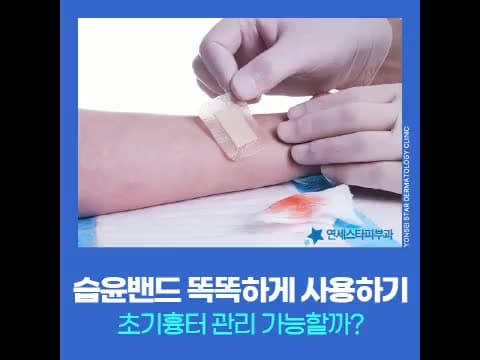
It's easy to think that forming a scab quickly after an injury is better, but from the perspective of skin regeneration, this isn't always the case.
Faster Scab Formation Can Lead to Scars
When a wound dries out and a scab forms, the rate at which new cells grow slows down. After healing, pigmentation or scar marks often remain more distinct. Therefore, how the wound environment is maintained in the early stages determines the subsequent scarring.
How Do Hydrocolloid Dressings Help?
Hydrocolloid dressings are based on the principle of moist wound healing, which maintains a moist environment at the wound site while preventing external bacterial invasion. In a moist environment, cell regeneration is faster, and growth factors in the exudate help skin recovery.
Proper use of hydrocolloid dressings in the early stages of a wound can help reduce scab formation and allow the skin to heal naturally, which may have a positive impact on early scar prevention.
If marks remain after the wound has healed and are a concern, management at the early scar stage is important. Early approaches, such as PreScar Golden-Time Triple Care, which addresses the golden time before a scar hardens, can also be considered. If you are worried about scarring, it is a good idea to consult about early management directions.
Proper Use Starts with Disinfection
Proper use of hydrocolloid dressings begins with thoroughly disinfecting the wound. If the dressing is applied while contaminants or bacteria remain, the moist environment can become a breeding ground for bacteria, leading to secondary infection. The appropriate product varies depending on the nature of the wound and the amount of exudate (wound fluid), so the choice also affects the healing speed.
Change Time Is Determined by Condition, Not Date
For hydrocolloid dressings, the key is to determine the change cycle based on the condition of the dressing, not a fixed schedule. We often receive questions in the clinic like, "How often should I change it?" We recommend changing it when the following signs appear:
- When the inside of the dressing is bulging with exudate and seems about to leak out
- When the edges lift or wrinkle, weakening the waterproof function
- When there are signs of infection, such as redness, pain, warmth, or foul odor at the application site
Conversely, removing it too often is also not good. Frequent changes can cause newly growing skin tissue to be pulled off, hindering recovery.
| Situation | Judgment |
|---|---|
| Bulging or leaking with exudate | Change |
| Edges lifting, waterproof weakened | Change |
| Suspected infection (redness, warmth, foul odor) | Change immediately and check |
| Normal reaction of white bulging after Laser Lesion Removal | Generally can be maintained for about a week |
Especially after Laser Lesion Removal for lesions like moles, syringomas, or warts, it is normal for the hydrocolloid dressing to bulge white, so there is no need to be overly anxious; it will gradually subside over time.
If a Reaction Occurs to the Adhesive Component
In some cases, contact dermatitis, or what is known as hydrocolloid dressing allergy, may occur due to the adhesive components or material of the dressing. If hives, redness, or blisters appear, or if severe itching, rash spreading to the surrounding area, or persistent pain and warmth occur, remove the dressing immediately. After removal, clean the area thoroughly, and if symptoms persist or worsen, it is safe to receive medication treatment from a dermatologist. For surgical scar areas that have been sutured, extra caution is needed in early management.
In Summary
When used correctly, hydrocolloid dressings are useful products that can help prevent early scars and promote wound healing. The key is to choose a product appropriate for the type of wound and amount of exudate, and to adhere to the change schedule and precautions. If the wound does not improve or adverse reactions persist after use, we recommend checking your condition through consultation and receiving medical attention.
Author · Dr. Sang-Joo Lee — Dermatologist Dr. Sang-Joo Lee is the chief director of Yonsei Star Dermatology Sinchon, who has long treated early wound and scar management, as well as pigment and scar treatments. He is the president of the Korean Dermatological Association (2026) and an adjunct professor at the Department of Dermatology, Yonsei University College of Medicine. His career can be viewed on his profile page. · Last reviewed on July 23, 2026
This article provides general medical information, and the healing process and management methods may vary depending on the wound condition and individual skin characteristics. If adverse reactions or infection are suspected, do not make arbitrary judgments; please consult a dermatologist for diagnosis.