
![How to Effectively Remove Sutured Surgical Scars with Laser | [Yonsei Star Dermatology Sinchon]](/_next/image?url=https%3A%2F%2Fagqdgbuateknhwpocrgu.supabase.co%2Fstorage%2Fv1%2Fobject%2Fpublic%2Fsources%2Fbbf3bebe-45b6-4415-bd04-bda18b2cac0f%2Fblog-images%2F223916837565_00_e924f37b5b09.jpg%3Ftype%3Dw966&w=3840&q=75)
Sutured scars left on the skin after surgery or an accident can weigh heavily on your mind every time you look in the mirror. The first question that usually comes to mind is, "Can I lighten this scar without another surgery?" To answer directly, sutured scars are an area where significant improvement can be reported with non-surgical laser and injection treatments alone, when tailored to their shape and timing.
Especially when a sutured mark from an accident or surgery protrudes above the skin, many people wish to conceal it. However, choosing another surgery to remove the scar carries the risk of creating a new scar. Therefore, today we will focus on non-surgical treatments for sutured surgical scars, particularly laser treatments.
Sutured Surgical Scars Are Not All the Same Shape
Many people think that "surgical scars are always raised scars," but in clinical practice, sutured scars come in various forms. Common types include:
- Raised scars (hypertrophic)
- Whitened linear scars
- Depressed (atrophic) scars
- Red scars
- Keloid scars
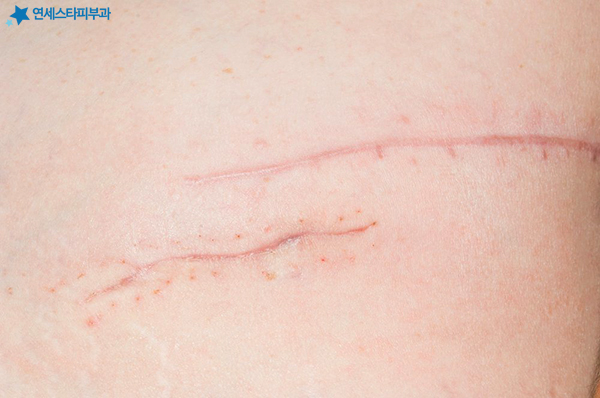
Since the treatment approach varies completely depending on the shape, a customized approach based on accurate diagnosis is paramount. Even if scars appear similar, different depths, colors, and tissue properties will lead to different equipment choices and combination treatments.
It can be said that the completeness of scar treatment depends more on the accuracy of the diagnosis and the timing of treatment than on the type of equipment.

For Depressed Scars, Combine with Subcision
Scars where the skin is deeply indented usually occur because fibrous tissue beneath the dermis pulls the skin inward. In such cases, Subcision may be combined with laser treatment.
By using a medical needle to sever the pulling fibrous tissue, the depressed skin's height can be restored, and the indented area can fill in, which is reported to be effective in reducing scar depth. However, this procedure requires skilled manual technique, so the number of clinics that can perform it is limited. If the depressed form is prominent, considering Surgical Scar Revision for Depressed Scars may also be an option.
If you are new to sutured scar treatment and unsure where to start, we recommend checking your current condition first through Chat Consultation for Scar Type Treatment Direction.
For White, Raised Scars, Ultrapulse Encore Laser
It is not uncommon for scar areas to turn white and rise in a linear fashion over time. In such cases, Ultrapulse Encore, a high-output fractional CO₂ laser, is utilized. The operating principle is as follows:
- It creates microscopic holes in the scar area to induce skin regeneration.
- It stimulates the dermal layer to gently soften hardened scar tissue.
- It refines the scar to a color closer to normal skin and smooths out uneven scar texture.

Typically, treatment is continued for about 10 sessions at one-month intervals, observing changes. The number of sessions and intervals may vary depending on the scar's depth and recovery speed, so it's good to keep in mind that there can be individual differences.
For Red Scars, Vbeam Prima Laser
Newly formed scars often appear as red lines due to dilated blood vessels. For such sutured scars, early intervention is important as the skin texture can become rough and the marks can harden over time.
As a vascular laser, Vbeam Prima selectively reacts to red pigment, addressing excessively dilated blood vessels. It can be used on sensitive areas like the face, and is reported to cause less irritation, leading to relatively faster recovery. If you are concerned about Red Scars of a similar nature, an approach that targets the underlying blood vessels can be helpful.
For Keloid Scars, Combination Treatment is Key
Depending on an individual's constitution or the body area, the skin may overgrow, forming keloids. In such cases, the mark is likely to extend beyond the original wound, and the possibility of recurrence must also be considered.

To maintain the improvement effect for a long time, a combination treatment is necessary, involving Triamcinolone Scar Injection tailored for Keloid Scars alongside laser treatment, rather than laser alone. Even at the stage where only redness remains, laser treatment plays a role in preventing the scar from developing further, so starting before the scar grows larger is advantageous.

How to Approach Facial Sutured Scars
Since the face is the first area people notice, scars can significantly impact one's impression. Beyond simple cosmetic concerns, they can lead to decreased self-esteem or psychological burden. In the consultation room, many patients express more difficulty with the stress of constantly being aware of the scar itself, rather than its size.
Therefore, a thorough diagnosis based on the type and condition of the scar, and treatment at the appropriate time, are crucial. However, laser scar treatment can only begin after a certain degree of recovery from surgery and removal of stitches.
- Combining laser treatment within 1-2 weeks after stitch removal can help manage scars before they become deeply established.
- Linear, depressed, red, and white scars each require different treatments.
- As the face is a sensitive area, priority is given to selecting equipment that causes minimal irritation.
- The timing of treatment and accurate diagnosis determine the completeness of the results.
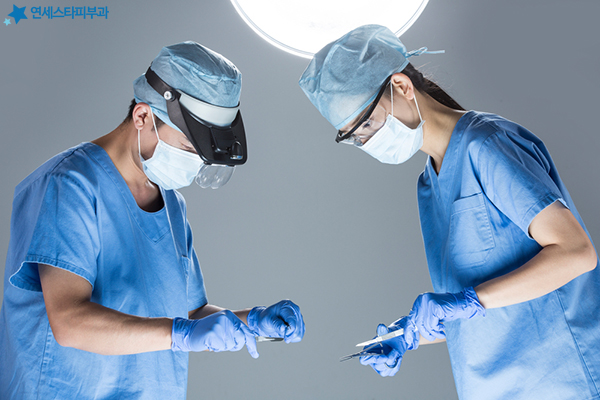
| Scar Type | Key Characteristics | Treatment Approach |
|---|---|---|
| Depressed | Dermal fibrous tissue pulls skin | Combine laser and Subcision |
| White Linear | Loss of color, raised line | Fractional CO₂ (Ultrapulse Encore) |
| Red Scar | Appears red due to vascular proliferation | Vascular laser (Vbeam Prima) |
| Keloid | Overgrowth beyond wound area | Combined laser and injection treatment |
What to Check Before Treatment
Sutured scars vary in appearance, depth, and color, and improvement can be reported with non-surgical laser and injection therapies alone. However, it is more realistic to approach treatment with the goal of consistently refining the scar to make it less noticeable, rather than aiming to completely erase it from the outset.

Most importantly, it is crucial to receive treatment tailored to your skin condition. This is because complex scar forms require experience in combining various equipment and treatments. If you are new to Surgical Scar Treatment, we recommend first checking which type of scar yours is closest to.
If you are concerned about sutured scars, we recommend having your condition checked before the scar becomes more established. If you let us know the shape and timing of your current scar, we will help you explore suitable options.
💬 Consult Now
Chief Director Lee Sang-ju (MD, PhD, Yonsei University College of Medicine and Graduate School, Completed Dermatology Residency at Severance Hospital, President of the Korean Dermatological Association) Chief Director Lee Sang-ju's Profile First Published 2025-06-30 / Last Reviewed 2026-06-16
This article provides general information on scar treatment, and the form and recovery pattern of scars may vary for each individual. Please consult with medical staff for an accurate diagnosis and treatment plan.