
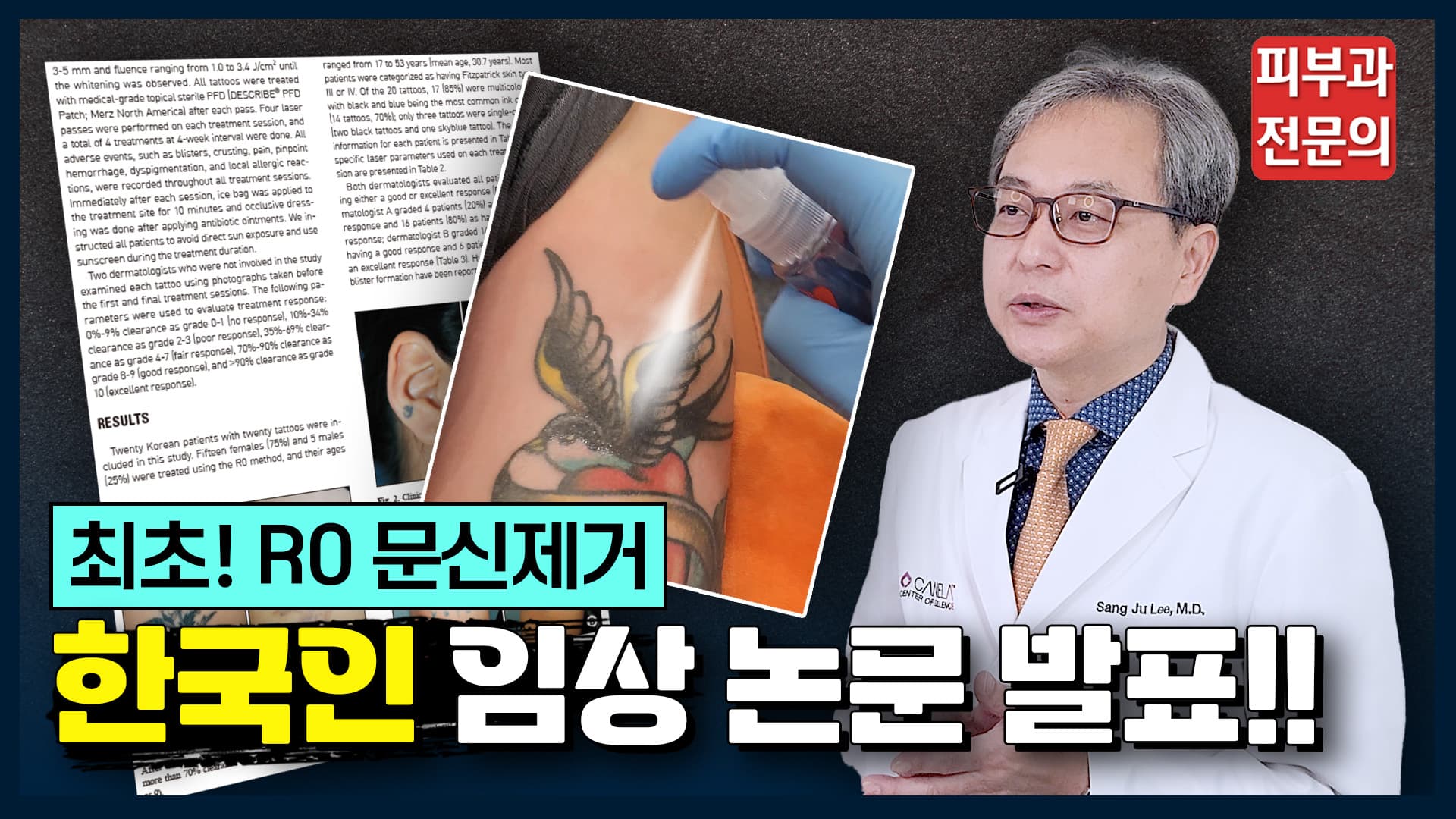
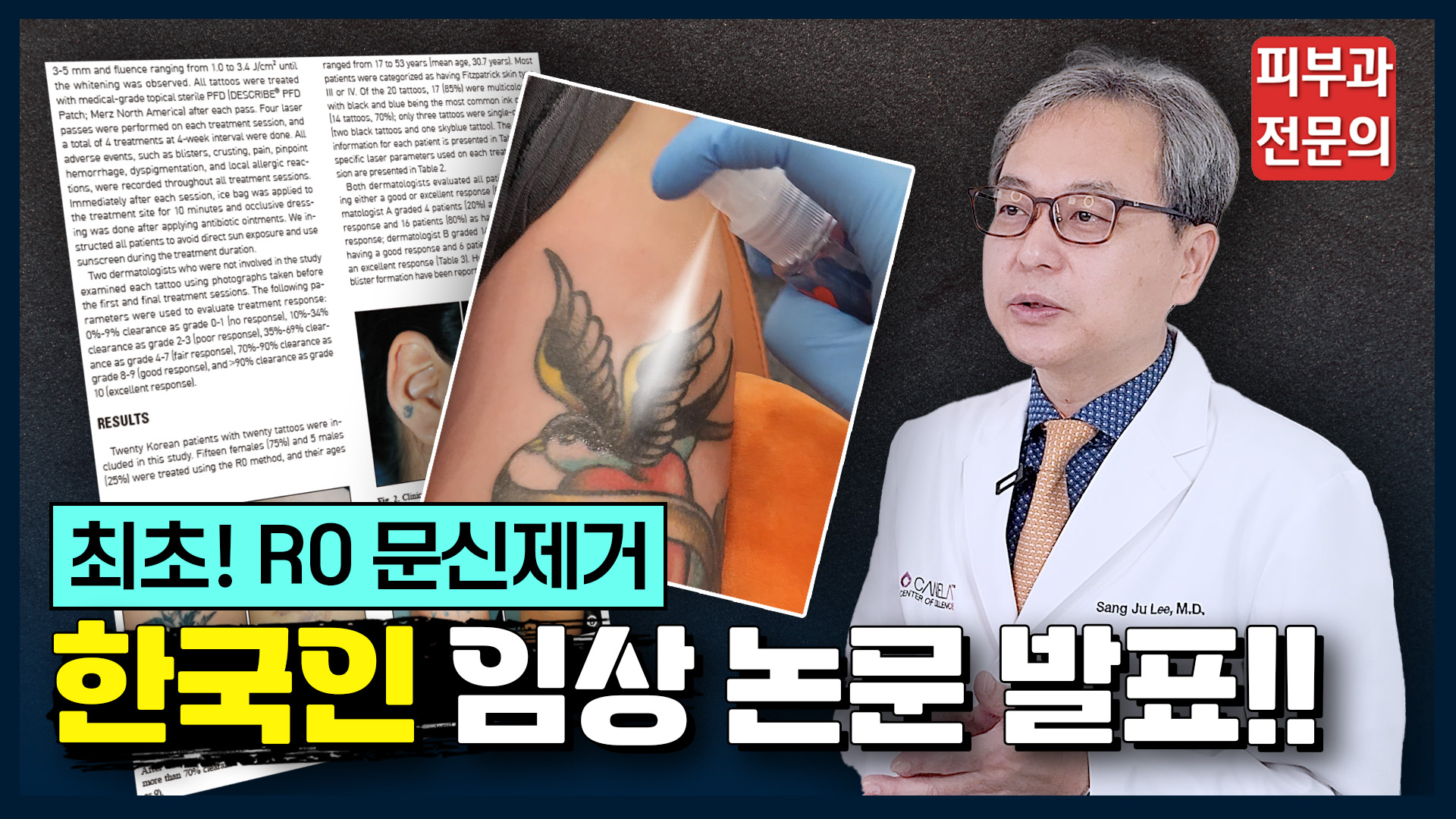
Our clinic is a dermatology clinic that removes tattoos using the R-Zero Technique. Dr. Lee Sang-joo, the head director, published a clinical paper on the R-Zero Technique for Koreans, and we would like to summarize why this clinical trial was necessary and how it was conducted.
The R-Zero Technique, first introduced in the United States in 2013, is a removal method that allows for four laser irradiations per session.
Three Stages of Tattoo Removal
First, let's look at the principle.
- The laser breaks down tattoo pigments into tiny fragments.
- Macrophages engulf the fragmented pigment particles.
- The macrophages, having engulfed the particles, move out of the body, removing the tattoo.
During the procedure, as the laser passes over the tattooed area, the pigment beneath the skin breaks, and white bubbles rise to the surface of the treated area. These bubbles obstruct laser penetration, preventing further irradiation.
The Resulting Extended Period
| Tattoo Size | Required Laser Sessions |
|---|---|
| Small size | At least 5 sessions |
| As size increases | Often 20 or more sessions |
Consequently, the treatment period can range from a short 6 months to over a year. This is why people say tattoo removal is more difficult than getting a tattoo.
The Path Opened in the US, Blocked in Korea
When the R-Zero Technique was first announced in the United States, a PFD medication was applied to quickly eliminate the bubbles, allowing for up to four repeated treatments in a single session. This opened a new chapter in removal methods.
However, obtaining the specialized PFD medication was not easy in Korea. Even though the R-Zero was known to be effective, there were many practical difficulties in implementing it domestically.
As a result, there were almost no clinical studies on R-Zero Tattoo Removal for Koreans. This is the background against which Dr. Lee Sang-joo, the head director, decided to conduct a clinical trial to confirm its efficacy and safety for Koreans.
How the Clinical Trial Was Conducted
- The study involved 20 Korean individuals with tattoos.
- Four wavelengths of a pico laser, which breaks down pigments in one trillionth of a second, were used.
- A total of 4 tattoo removal treatments were performed at 4-week intervals.
- Upon completion of the treatments, two dermatologists unrelated to this study evaluated the results by comparing before-and-after photos only.
The results were reported in the Journal of the Korean Society for Laser Medicine and Surgery, a domestic academic journal. Individual results and recovery progress may vary.
What Was Confirmed in the Safety Assessment
Although temporary blisters or pigmentation appeared immediately after the procedure, long-term reactions such as scars did not remain.
Some people worry that multiple treatments at once might cause skin damage and scarring. The causes of scarring are not the number of treatments, but rather the laser intensity and congenital skin type. If the intensity is excessively increased to achieve high efficacy even with a single shot, scarring can occur.
Continuing Forward
Given the lack of domestic research, this clinical trial has become a meaningful record. Yonsei Star Dermatology Sinchon will continue to strive to be a tattoo removal dermatology clinic that grows through continuous research.
The treatment composition is detailed in R-Zero Pico-Frectat Tattoo Removal Guide and Pinhole for Burn & Surgical Scar Guide, and the overall treatment flow is summarized in Tattoo Removal Treatment Guide. If you have any questions, please leave them in Chat with us now.

Authored and Medically Reviewed by Dr. Lee Sang-joo, Head Director (Dermatologist) Graduated from Yonsei University College of Medicine · Resident in Dermatology at Severance Hospital Ph.D. in Medicine from Yonsei University Graduate School · Former Professor of Dermatology at Youngdong Severance Hospital View Medical Staff Profile
First Published 2023-09-22 · Last Reviewed 2026-07-29
This article contains general medical information and does not substitute for individual diagnosis and treatment. Results and recovery progress may vary from person to person.