

We often get asked why a small piece of lettering takes so long to remove.
In terms of area, it's smaller than a palm, but the number of sessions can be as many as, or sometimes more than, for a design-type tattoo.
There are four main reasons:

First, the pigment is concentrated in a small area
Lettering is made to look clear and sharp by densely filling fine lines with ink.
Even if the area is small, the pigment density per unit area is high. The amount of pigment the laser needs to process at once increases, naturally leading to more sessions.
This is why small, dark lettering takes longer than a widely spread design.
Second, the pigment is often deeply embedded
Lettering primarily uses dark black inks. While black generally responds well to lasers, it's common for the pigment to have penetrated deep into the dermis, depending on the practitioner's technique.
If the pigment is deep, it cannot be accessed all at once, requiring a gradual approach. Depth contributes to the number of sessions.
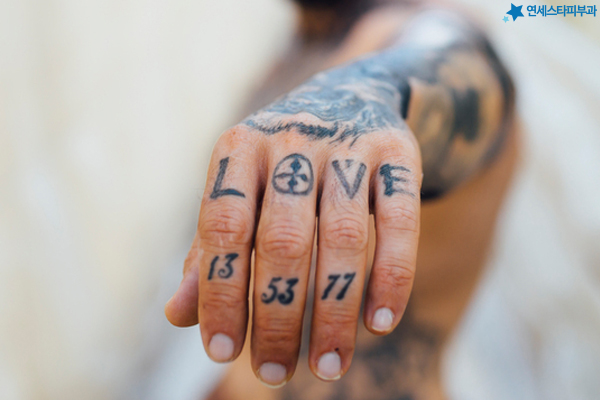
Third, because it's text, even a small amount remaining is visible
With design-type tattoos, if the pigment fades, the entire image becomes blurry. However, with lettering, the shape of the lines is still recognizable.
Even if only a small amount of pigment remains, the outline of the letters can be read, giving a strong impression that "it's still there."
Achieving a completely erased look requires repeating uniform treatments multiple times, which extends the perceived duration.
Fourth, the area is tricky
Lettering is often tattooed on areas where the skin is thin and nerves are concentrated, such as the wrist, collarbone, ankle, or behind the ear.
In these areas, pain can be felt more intensely even with the same output, and frequent movement can slow down recovery after treatment compared to other areas.
| Factor | Characteristics in Lettering |
|---|---|
| Pigment Density | Dense in a small area |
| Pigment Depth | Up to the deep dermal layer |
| Residual Perception | Read as text even with a small amount remaining |
| Area | Thin skin, concentrated nerves, frequent movement |
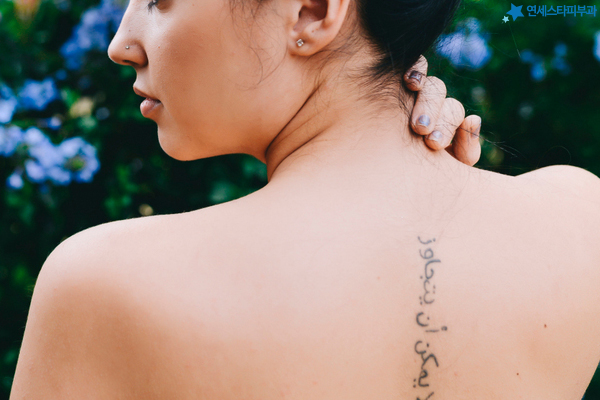
An approach that changes the method instead of increasing intensity
Increasing laser intensity to reduce the duration also increases the burden on the skin. Therefore, we look for methods that increase efficiency at the same intensity.
With typical tattoo removal lasers, a white bubble forms on the skin surface after a single shot. While this bubble remains, light cannot properly penetrate the skin, making it difficult to re-treat in the same session.
The R-Zero Technique is an approach that addresses this limitation. It utilizes PicoWay Laser systems, which are advantageous for breaking down pigment into smaller particles, to expand the scope that can be treated in a single session.
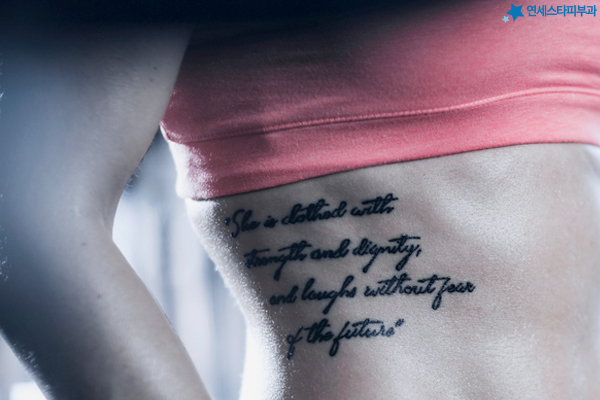
In summary
The reason why lettering tattoo removal takes a long time is not due to incorrect treatment, but rather a combination of pigment density and depth, the form of text, and the characteristics of the area. To reduce the duration, it is safer to consider methods that increase the efficiency of a single session rather than increasing intensity.
To estimate which conditions your tattoo falls under and the expected number of sessions, we need to see its condition directly. Please use Consult about the removal direction for my tattoo via chat.
This article was reviewed by Dr. Lee Sang-joo (Dermatologist), the chief director. He leads Yonsei Star Dermatology Sinchon and will serve as the president of the Korean Academy of Dermatology in 2026. First published 2026-08-11 · Last reviewed August 16, 2026
This content provides general medical information, and individual differences in condition and treatment response may occur. Please consult with a doctor to determine treatment eligibility and methods.