

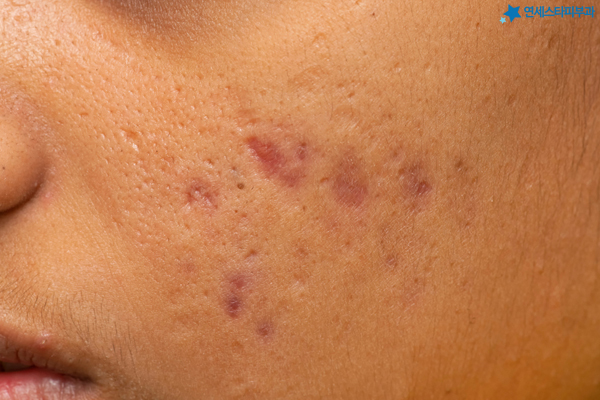
Facial scars are highly visible due to their location, making even a small mark a cause for concern. The first question that usually comes to mind is, "When and how should I start treatment?" However, since the approach differs depending on the scar's color, texture, and whether it is flat or depressed, identifying the type first is the starting point.
Why are facial scars so bothersome?
There are many situations in daily life that can leave marks on the face. Bumps or sudden accidents, necessary surgeries, and even seemingly minor fingernail scratches can lead to long-lasting scars for some people. The face, in particular, can cause significant stress even with small marks, making it a part of the body where early management and prompt treatment are desired.

Scars can naturally fade over time. However, the outcome varies greatly depending on the type (e.g., keloid, hypertrophic, atrophic), so the process of determining the appropriate device and management direction based on the type will dictate the results. Even similar-looking scars, such as surgical scars and burn scars, differ in thickness and color tone, leading to different recommended treatments.
When is the best time to start laser scar treatment?
Laser treatment is often gradually combined starting 2-4 weeks after surgery or suturing, or when the epidermis around the wound is considered stable. There are important points to consider when determining this timing:
- If the wound is still open, or if infection or inflammation remains, sufficient rest and treatment are needed first.
- Confirm epidermal regeneration first to ensure no bleeding occurs and the situation does not worsen due to laser stimulation.
- Follow the sequence of calming infection and regenerating the epidermis, then starting under a specialist's diagnosis.
- The appropriate timing varies depending on the type, depth, cause, and skin type of the scar.

It is reported that treating facial scars as early as possible is advantageous. However, ensuring the conditions are met to prevent the wound from worsening due to stimulation is more important than simply starting quickly.
The timing for scar laser treatment varies depending on the type, depth, cause, and skin type of the problem, so it must be decided after confirming the condition at the clinic.

If you have any questions, please feel free to ask via chat consultation regarding scar treatment timing.
Laser Devices by Scar Type
Scars target different layers depending on whether they are pigmented, vascular, or deeply fibrotic. In the examination room, even with the same "facial scar," the choice of device often varies depending on which layer and what is being targeted. Let's summarize this in the table below.
| Device | Main Indications | Mechanism of Action |
|---|---|---|
| Ultrapulse Alpha | Deep and fibrotic scars, stubborn scars | An upgraded CO₂ fractional laser that induces regeneration deep into the dermis with precise high-power pulses and various modes |
| Vbeam Prima | Erythema, red scars, vascular (hypertrophic) scars | Targets blood vessels (hemoglobin) to reduce vascular lesions |
| PicoWay | Pigmented scars, depressed scars, collagen regeneration | Uses picosecond technology to destroy pigment and promote dermal regeneration with micro-shockwaves |
| StarLux | Pore, scar, and skin texture improvement | Non-ablative fractional method that induces collagen regeneration by creating micro-thermal damage in the dermis |
Ultrapulse Alpha is highly utilized for structurally fibrotic scars such as stubborn surgical scars, burn scars, and thick keloid changes. It is considered for cases where the texture is deeply embedded, such as thickened keloid scars.
Vbeam Prima is used for red and prominent vascular scars, early erythematous scars after surgery, hypertrophic or keloid-prone red scars, and scars accompanied by pigment and vascular redness.
PicoWay helps improve scars accompanied by pigmentation. It works by simultaneously addressing pigment and stimulating dermal regeneration, making it useful for scars with mixed pigmented changes.
StarLux is used for improving scars, pores, and elasticity, and has similar indications to existing fractional devices. It is reported to have a relatively fast recovery and a low risk of pigmentation issues during treatment, making it less burdensome.

Can scars be completely removed?
This is the most common question from people with facial scars. Realistically, complete removal is difficult. However, significant improvement is possible to the extent that the shape, color, and texture are similar to the previous state, without causing inconvenience in daily life. Individual results may vary.

At this point, the results differ depending on the appropriate laser and treatment combination, as well as experience. Therefore, it is necessary to choose a clinic that has various devices, making it easier to select the right laser for the condition, and that can apply complex treatments tailored to the characteristics. For deep or structurally complex scars, Surgical Scar Revision may also be considered.


A tailored approach yields results
The causes of facial scars are diverse, ranging from abrasions to burns, surgeries, and diseases like acne or chickenpox, and there are many types. The more tailored the treatment to the situation, the closer one gets to a complete recovery. Therefore, carefully identifying the problem and choosing the appropriate laser for each situation is paramount.
Going a step further, if methods that can create synergy, such as Subcision or Cell Regeneration Injection, can be applied together, even facial scars can be expected to show positive progress to a less noticeable level. Cosmetic Surgery Scars remaining immediately after suturing can also be managed within a controllable range by matching the timing and equipment.
Yonsei Star Dermatology Sinchon will continue to provide information about scars, helping you take another step towards clearer skin.
If you have any remaining questions, please feel free to connect via chat consultation regarding scar laser device selection.

Dr. Sang-Joo Lee, Chief Director (MD, PhD, Yonsei University College of Medicine and Graduate School; completed dermatology residency at Severance Hospital; President of the Korean Dermatological Association) Dr. Sang-Joo Lee's Profile First published 2025-12-08 / Last reviewed 2026-06-16
This content is for general information purposes only, and individual results for scar shape and progress may vary. Please consult with medical staff for an accurate diagnosis and treatment timing.