

Deeply depressed scars on the skin do not fade easily over time, making them a constant concern when looking in the mirror. The first question that usually comes to mind is this: "Can depressed scars be filled with laser alone?" To answer directly, scars formed deep in the dermis have limitations with laser treatment alone, and improvement is reported when combined with procedural approaches tailored to the depth and shape.
Why are deeply depressed scars difficult to treat?
Deep scars are formed in the lower layers of the dermis and are often adhered to the underlying tissue. Therefore, treating only the skin surface makes it difficult to achieve sufficient results.
Laser treatment is often used for depressed scars, and a laser promotes a certain amount of new tissue growth with each treatment. The problem is that the deeper the depressed scar, the infinitely more treatment sessions are required. Deep scars often do not respond well to conventional laser treatment, and if there is adhesion underneath, treatment must reach deep areas, making it a challenging condition to treat.
Since scars vary in shape, size, and depth, choosing the appropriate treatment method for each is paramount.
Deep Scars like Nail Marks and Chickenpox Scars
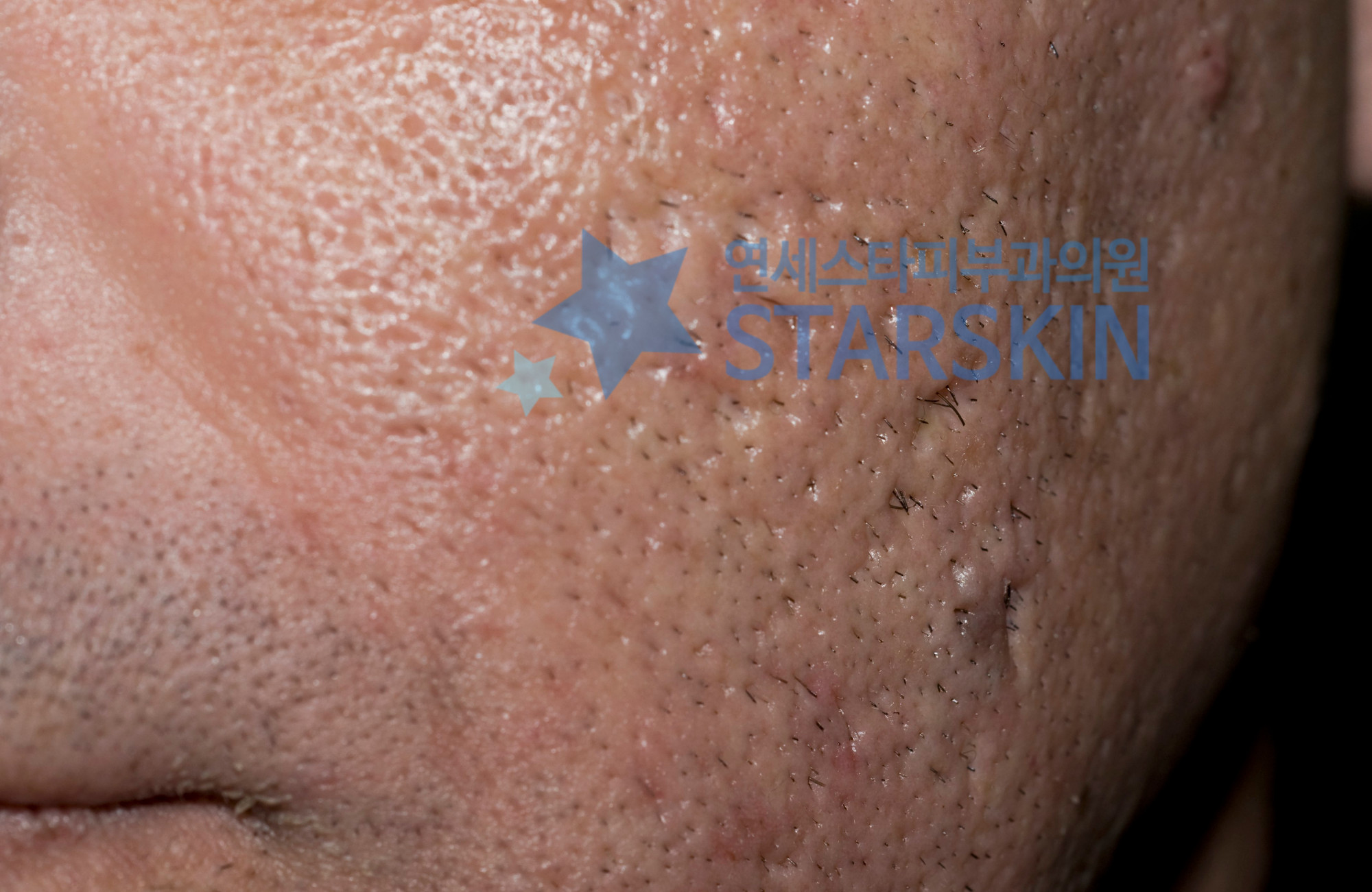
Typical examples of deep scars encountered in dermatology outpatients are nail marks and chickenpox scars. The depth of scars that improve with general laser treatment is approximately up to 1mm; deeper than that, laser alone has limited effectiveness.
In such cases, a procedure is needed to break the fibrotic scar tissue underneath to lift the deep scar. This is called Subcision, a treatment method that breaks the fibrotic scar underneath the skin, and the blood accumulated in that area pushes the scar up like a pocket, improving the scar overall.
For deep scars like chickenpox scars, approaches like Subcision are reported to be more effective than initial laser treatment.
Acne Scars: Treatment Varies by Shape
Acne scars can be broadly divided into atrophic, boxcar, and rolling scars. Even for the same acne scar, the treatment direction changes depending on its shape. Especially for boxcar scars or depressed acne scars called ice pick scars, which have narrow and deep openings, laser treatment alone has limitations.
| Scar Type | Shape Characteristics | Considered Approach |
|---|---|---|
| Atrophic Scars | Small, shallow pore-like shape | Laser-centric |
| Boxcar Scars | Deep, cylindrical depression | Combined procedures like Suture-Free Punch |
| Rolling Scars | Wide, undulating depressions | Combined procedures like Subcision |
For deep, cylindrical boxcar scars, Suture-Free Punch can be helpful. Suture-Free Punch is a procedure that uses a punch tool to cut the underlying scar and lift it to match the skin surface. It is considered advantageous because it does not require suturing after the procedure, leading to faster recovery and less disruption to daily life, and changes can be observed relatively quickly.
If you have any questions, please feel free to contact us for depressed scar treatment consultation.
Advantages of Procedural Treatments

Laser is a useful method for treating shallow scars. For deep scars, however, procedural treatments are also considered, and their advantages are summarized as follows:
- Localized approach to the scar minimizes disruption to daily life.
- Reported to be more effective for deep scars compared to laser.
- Synergy can be expected when combined with other laser treatments.
- For deeper scars, the proportion of procedural treatment tends to increase.
Similarly, for deep surgical scars or traumatic scars, a strategy combining procedures and lasers is used depending on the scar's depth and location. Depending on the scar shape, Surgical Scar Revision may also be considered.
Important Points for Post-Procedure Care

Procedural treatment is a relatively simple yet effective scar treatment method, where the practitioner's experience and know-how play a crucial role. Since scars vary in shape, size, and depth, choosing the appropriate treatment method for each is most important. Therefore, it is advisable to undergo treatment at a medical institution with sufficient experience.
Key points to remember for post-procedure care are as follows:
- Generally, daily life is possible immediately after the procedure.
- Avoid washing your face on the day of the procedure.
- Apply the prescribed regenerative ointment as instructed.
- Scar changes vary individually, so monitor the progress over time.
In the clinic, even for what appear to be similar scars, the recommended method often differs depending on the depth and degree of adhesion. Therefore, rather than judging solely from photos, a plan is made after directly examining the scar's condition.
Where to Start with Scar Treatment
For deeply depressed scars, a realistic approach is to first identify the scar's shape and depth, then appropriately combine laser and procedural treatments, rather than using a single method. For deep scars like nail marks, chickenpox scars, or boxcar acne scars, procedural methods such as Subcision or Suture-Free Punch can be considered.
Yonsei Star Dermatology Sinchon assists with facial scar treatment through one-on-one consultations and personalized treatment plans.

Chief Director Lee Sang-joo (MD, PhD, Yonsei University College of Medicine and Graduate School, Completed Dermatology Residency at Severance Hospital, President of the Korean Dermatological Association) Chief Director Lee Sang-joo's Profile First Published 2023-08-14 / Last Reviewed 2026-06-16
This content provides general information about scar treatment, and treatment response and recovery may vary from person to person. Please consult with medical staff for an accurate diagnosis and treatment plan.