

Eyebrow tattooing is a semi-permanent procedure that reduces daily makeup time, but over time, many people wish to remove them due to thickened lines, discoloration, or changes in eyebrow shape. The first question people often ask is, "When can I start removing it, and how many sessions will it take to get clean?" To answer directly, the recovery process varies from person to person depending on the timing, number of sessions, and post-procedure care.
Yonsei Star Dermatology Sinchon offers tattoo removal procedures, including eyebrow tattoos. Today, we will systematically address the most common questions from patients in the consultation room, from the optimal timing for removal to the number of sessions and aftercare during the recovery period.
When can eyebrow tattoos be removed?
Removal is possible immediately after receiving semi-permanent makeup. After tattooing, tiny holes form on the skin's surface, which gradually close as the skin heals. Once these holes close, the pigment is absorbed into the skin, extending the time required for removal.
Immediately after the procedure, the holes are open, so receiving treatment at this time can help reduce the number of removal sessions as the tattoo particles can exit through the open holes. However, if there are scabs, swelling, inflammation, or dead skin cells on the tattooed area, immediate treatment may be difficult.
It is less strenuous on recovery to proceed with removal after swelling and inflammation have subsided.

Can it be removed in one session? How many sessions are needed?
Semi-permanent tattoos generally have a shorter removal period than regular tattoos. While typical tattoos are etched deep into the dermis, semi-permanent makeup is applied shallowly between the epidermis and dermis, allowing for relatively faster removal. However, it cannot be removed in a single session.
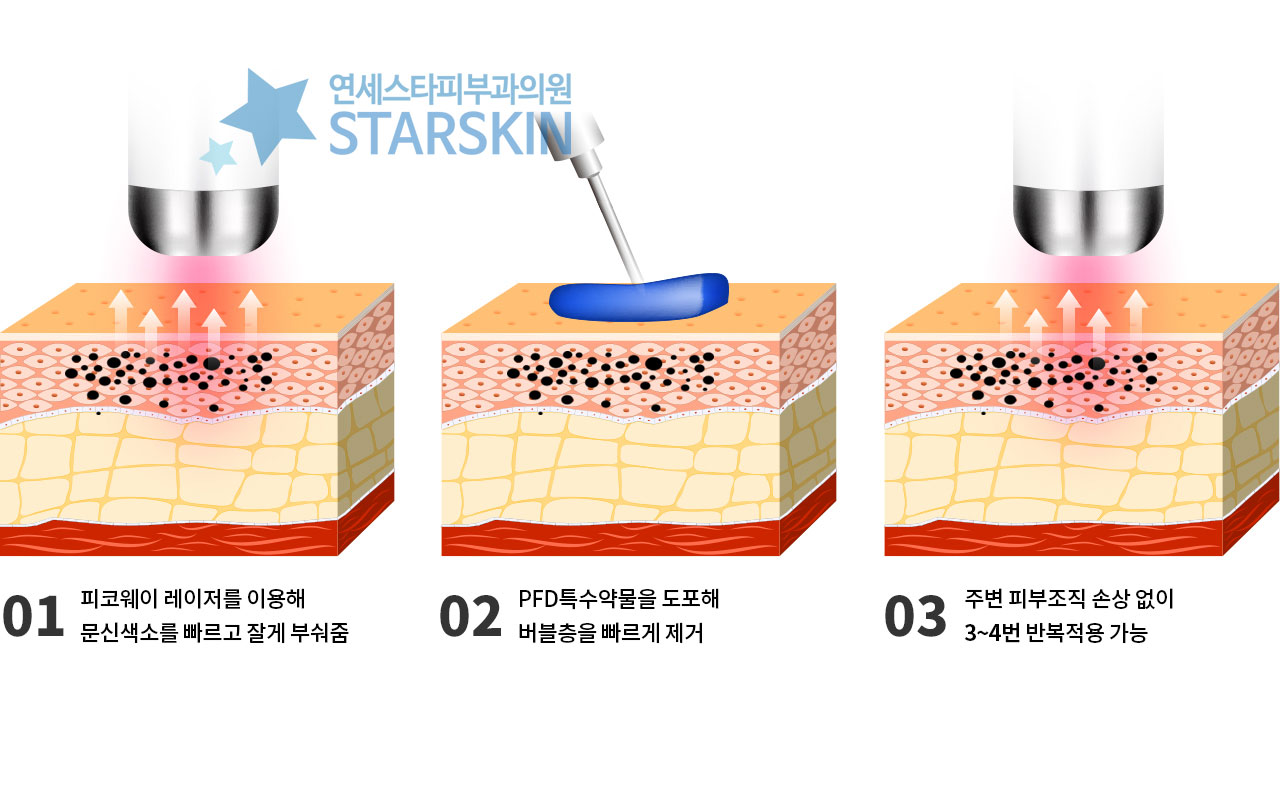
This is because, unlike what it may seem, eyebrow tattoos use mixed pigments, not just one color. When removing eyebrow tattoos with the R-Zero Technique, up to 4 laser irradiations are possible in one session. Most people can visually confirm removal after about 3 to 5 sessions, spaced one month apart, but the number of sessions needed varies from person to person depending on the pigment concentration and depth.
Are eyeliner or lip semi-permanent tattoos removed in the same way?
The R-Zero Technique with specialized medication is only available for eyebrows. When a picosecond laser is applied to the tattooed area, a white bubble layer appears, and a typical tattoo removal session usually concludes here.
As mentioned earlier, the process involves repeating the procedure up to 4 times using the PFD specialized medication. However, eyeliner and lip semi-permanent tattoos have a small area, making it difficult to use specialized medication. Therefore, for semi-permanent tattoos other than eyebrows, we assist with removal using a picosecond laser.

Here's a simple summary of the differences in removal methods by area:
| Area | Main Method | Features |
|---|---|---|
| Eyebrows | R-Zero Technique (PFD specialized medication) | Up to 4 irradiations in one session |
| Eyeliner | Picosecond Laser | Limited use of medication due to small area |
| Lips | Picosecond Laser | Limited use of medication due to small area |
The laser tattoo removal method varies depending on the area and pigment condition, so it is best to consult with us to determine the appropriate method for you.
If you have any questions, feel free to ask via chat consultation regarding eyebrow tattoo removal methods.
When can I wash my face and apply makeup after the procedure?
Washing your face and showering are possible immediately after the procedure, but it is best to avoid strong irritation to the treated area. Makeup is possible after 2 to 3 days, and when removing makeup, be careful not to irritate the treated area.
Here are some aftercare tips to follow during the recovery period:
- If oozing or scabs form, apply Fucidin to protect the area.
- Avoid exercise, saunas, jjimjilbangs (Korean bathhouses), and swimming for one week after the procedure.
- During the same period, refrain from smoking and drinking, as they can affect recovery.
- Do not forcibly touch scabs or blisters until they fall off naturally.
- Continue to apply sunscreen even after scabs have fallen off.

My eyebrows look darker immediately after the procedure.
Immediately after the procedure, the color may appear darker, but it will naturally lighten over time, so there's no need to worry too much. If you experience itching or swelling, applying a cold compress can help reduce the symptoms.

If you experience these symptoms, a visit is necessary.
Most reactions subside over time, but in the following cases, it is safer to visit the clinic where you received the procedure for a check-up rather than managing it yourself:
If swelling, itching, or heat sensation persists without subsiding, or if new symptoms appear that are different from those described above. In the consultation room, we find that the sooner patients come in for a check-up, the smoother the progress management tends to be.

Eyebrow tattoo removal results are determined by the timing and number of sessions, as well as post-procedure care. It is recommended to undergo a direct consultation to determine the method suitable for your eyebrow's pigment condition and design.
If you have any questions, please leave them via chat consultation regarding tattoo removal timing and aftercare.
Sang-Joo Lee, Chief Director (MD, PhD, Yonsei University College of Medicine and Graduate School; Dermatology Resident, Severance Hospital; President, Korean Society for Dermatology) Chief Director Sang-Joo Lee's Profile First Published 2023-07-20 / Last Reviewed 2026-06-16
This content is for general information purposes only. Recovery progress and suitable treatment methods vary from person to person, so please consult with medical staff for an accurate diagnosis and plan.