

If, after acne subsides, the area remains hard and swollen for a long time, it may not be a simple acne mark. If it doesn't hurt much to touch but doesn't seem to shrink, the first question to ask is, "Is this acne, or a scar?"
If it started small like a millet seed but doesn't get smaller over time, and instead hardens, you might suspect the presence of acne keloids.
What's the Difference Between Acne Marks and Acne Keloids?
Typical acne, when accompanied by inflammation, causes pain when pressed and feels soft or as if something is inside. Many cases naturally subside over time.
In contrast, cases that have progressed to keloids feel very firm and hard to the touch. There is no significant pain, but during the active growth phase, mild discomfort or itching may occasionally appear.

To help distinguish between the two, their characteristics are summarized as follows:
| Category | General Acne | Acne Keloid |
|---|---|---|
| Touch | Soft or yielding | Firm and hard |
| Pain | Pain when pressed | No significant pain, accompanied by itching |
| Course | May subside over time | Does not shrink naturally |
| Size Change | Resolves relatively quickly | Tends to grow larger |
Why Do Keloid Scars Occur?
Keloid scars are scars where tissue proliferates excessively during the healing process of damaged skin, swelling much more than the original wound area. If your skin easily swells from small injuries or irritations, you likely have this predisposition.
Keloids can also develop during the healing process after skin damage from acne. While the exact causes are not yet fully understood, it is known to be influenced by constitution and hormones.
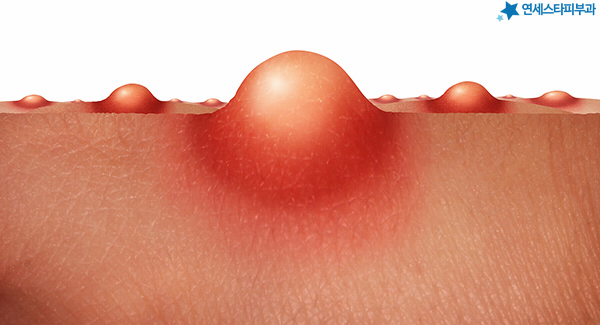
Therefore, it is not easy to accurately predict keloid formation in advance. However, if any of the following apply, it is advisable to check your condition:
- If a raised mark does not shrink for a long time.
- If it is located in areas where keloids commonly form, such as the chest, shoulders, back, or jawline.
- If it started as small as a millet seed but grows larger over time.
- If a family member also experiences scars that tend to swell similarly.
If It Has Firmly Settled, Natural Recovery is Difficult to Expect
In the clinic, we often see people who initially thought it was general acne and squeezed it or left it alone, only to visit us after a hard lump remained.

Once a keloid has grown, it is known not to disappear or shrink naturally. Even if it feels slightly better temporarily, there is a possibility of recurrence, so appropriate treatment tailored to the condition is necessary for recovery.
It is reported that rather than waiting for keloids to shrink on their own, it is important to accurately diagnose them at the suspected stage and begin appropriate treatment.
It often appears on the jaw area, so if your condition feels similar to the characteristics described above, the first step is to accurately determine whether it is an acne keloid or not.
Treatment directions may vary depending on the extent and location, so if you have any questions, you can check in advance by contacting us via chat for keloid ambiguity.
Reasons for Combining Injections and Lasers
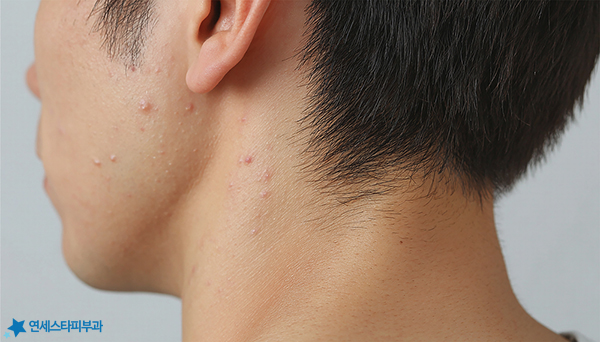
If it has keloid characteristics, general care often has limitations. In such cases, a combined approach of injections and lasers can be considered to enhance treatment effectiveness.
Triamcinolone Scar Injection is a method used to reduce the height of keloid scars and decrease recurrence. Lasers are sometimes applied together to maintain the treatment state longer and increase satisfaction.

Injections used for scar treatment are relatively simple, but the significant pain during the procedure has often been a drawback. Some clinics also apply a low-pain injection method to reduce this discomfort and pain burden, so it can be helpful to check this when planning your treatment.
Acne keloids, like acne scar management, often involve a phased approach rather than a single procedure, observing the condition as it progresses.
Points to Consider for Post-Treatment Care

Given that it combines two problems—frequent recurrence and difficult treatment—the judgment of the medical staff performing the treatment plays a crucial role. Thoroughly analyzing the condition and proceeding with customized treatment, rather than simply overlooking it, helps reduce recurrence.
Here are some points to keep in mind for home care after treatment:
- Do not forcefully squeeze or irritate with your hands.
- Protect the affected area to prevent injury.
- Consistently maintain cleanliness.
- If you notice changes, do not make arbitrary judgments; consult with medical staff.

In Summary
If a lump you thought was acne remains hard for a long time, you might suspect acne keloids. Rather than waiting for it to shrink naturally, it is helpful for recovery to check the condition at the suspected stage and, if necessary, consider a combined approach of injections and lasers.
If you need to confirm which case applies to you, feel free to inquire below.
💬 Chat Now
Dr. Sang-Joo Lee, Chief Director (MD, PhD, Yonsei University College of Medicine and Graduate School; Completed Dermatology Residency at Severance Hospital; President of the Korean Dermatological Association) Dr. Sang-Joo Lee's Profile First Published 2025-09-22 / Last Reviewed 2026-06-16
This content is for general information purposes only. Results may vary depending on individual skin condition and constitution. Accurate diagnosis and treatment direction must be determined through consultation with medical staff.