

Many people are upset every time they look in the mirror because their skin remains uneven after severe acne has subsided. Depressed scars are difficult to fill with moisturizers or cosmetics, and once they form, natural recovery is typically slow. So, what methods can be added when lasers alone are not enough? For deep and firm depressed scars, procedural treatments such as Subcision, Suture-Free Punch, and Dot Peeling are considered in addition to laser treatment.
Why Do Acne Scars Become Depressed?
After severe acne, skin cells are destroyed due to inflammation. In this process, fibrous tissues inside the dermis become entangled and pull the epidermis downwards like a string. This continuous pulling results in depressed scars with a sunken surface.
For mild scars, improvement can be expected by using lasers to induce the depressed areas to fill in. However, if the fibrous cords pulling down the base are firm or the scars are deep, lasers alone may have limitations, so a procedural approach that releases the pulling itself is often combined.

Subcision: A Method to Cut the Pulling Fibrous Cords
Subcision is a procedure that uses a medical needle to cut the tangled fibrous tissue that is pulling the skin downwards. When the cords are cut, blood collects in the depressed scar area, creating a bruise, which is called a hematoma. The principle is that this collected blood supports the sunken area from within, leveling its height.
About a month after the procedure, the depressed area is filled with new skin cells. Subcision is often applied to wide and deep rolling acne scars.
If the fundamental cause of a scar is the pulling of fibrous cords at the base, we believe that releasing that pulling should be the first approach before refining the surface.

Suture-Free Punch: Lifting Boxcar Scars
Suture-Free Punch is often used for distinct boxcar-shaped depressed scars among various acne scars. This method involves lifting the depressed area with a medical punch device to match the surrounding skin's height. Since the skin might sink again if left as is, a special medication is used to fix the lifted height.
New skin regenerates beneath the punched area, and after about a week, the height becomes similar to the surrounding skin, and the redness can be observed to subside. Individual recovery patterns may vary.
In the clinic, even with the same depressed scars, their shape and depth vary, so choosing the right tool for the scar type greatly influences the outcome.
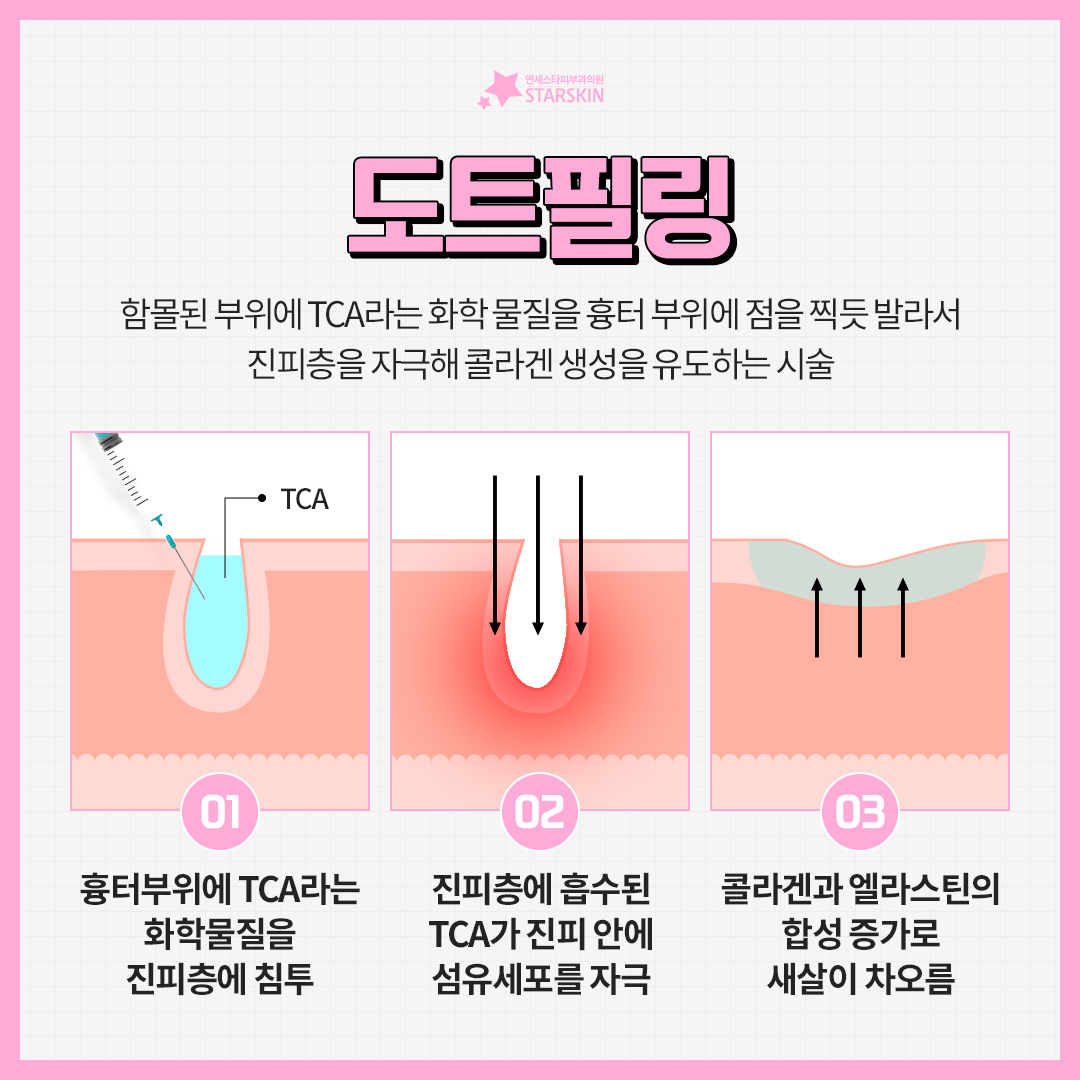
Dot Peeling: A Method to Fill Deep and Narrow Scars
Dot Peeling is often performed for deep and narrow depressed scars. Dot Peeling is a type of localized chemical peel, where TCA (Trichloroacetic Acid) is precisely applied to the depressed scar area, penetrating the dermal layer.
The principle is that the stimulated dermal fibrous cells produce collagen and elastin, causing new skin to fill in. Like other procedures, significant changes are usually not seen in a single session. Gradual improvement is typically expected with 3 to 5 repetitions at intervals of 4 to 6 weeks. The effects and number of sessions may vary individually.
For questions, inquire via chat consultation regarding acne scar treatment

Post-Procedure Care Checklist
Managing the recovery period well is also part of the outcome. While it varies by procedure type, here are some common points to keep in mind:
- Scabs formed after Dot Peeling usually fall off naturally within 10 days, so do not forcibly remove them.
- Bruises formed after Subcision are part of the healing process, so do not over-stimulate them.
- Moisturize the treated area sufficiently and apply sunscreen diligently.
- Avoid saunas or excessive friction while new skin is regenerating.
- If swelling or redness persists for a long time, consult with medical staff instead of making arbitrary judgments.
Which Procedure is Right for Me?
The three procedures have different uses depending on the scar shape. They are summarized at a glance in the table below.
| Procedure | Best Suited Scar Type | Mechanism of Action |
|---|---|---|
| Subcision | Wide and deep rolling type | Cuts fibrous cords at the base to restore height |
| Suture-Free Punch | Distinct boxcar type | Lifts and fixes the depressed area |
| Dot Peeling | Deep and narrow type | Stimulates dermis to induce new skin formation |
The procedures introduced above are often performed in combination with laser treatment, tailored to the condition of acne scars, rather than alone. Even within the same face, depressed acne scars and red acne scars may be mixed, so it is advisable to approach each type differently. It is also important to manage acne itself at the stage before it develops into scars.
Since the appropriate method varies depending on the symptoms and scar depth, we recommend getting a diagnosis from a dermatologist with extensive treatment experience and then creating a customized plan.
For questions, inquire via chat consultation for customized scar treatment

Dr. Sang-Joo Lee, Chief Director (MD, PhD, Yonsei University College of Medicine and Graduate School; Completed Dermatology Residency at Severance Hospital; President of the Korean Dermatological Association) Dr. Sang-Joo Lee Profile First published 2023-10-30 / Last reviewed 2026-06-16
This content is for general information purposes only. Treatment effects and recovery patterns may vary by individual. Accurate diagnosis and treatment plans should be determined through consultation with medical staff.