

Living with pets, it's surprisingly common to get scratched by a cat's claws. It's fortunate if it ends with just a minor scratch, but if red marks or indented scars remain on the back of the hand and wrist after the wound heals, it's bound to be a concern. We often receive the question, "Can scars lighten even after they've healed?" To answer directly, there is potential to subtly improve the marks by selecting laser equipment that matches the scar's color, shape, and the time it appeared.
In this article, we will explain how cat scratches and nail scars form, and outline management strategies using Vbeam Prima and Ultrapulse Alpha devices.
Cat Scratches and Nail Scars: Why Do Marks Remain?
Cat scratches begin when the skin is torn or scraped by claws or teeth. Scars can remain as the surrounding tissue undergoes inflammation during the healing process, and frequently exposed areas like the face or wrist are prone to pigmentation or red marks.
Nail scars follow a similar principle. Marks from being scratched by a fingernail or a sharp object, or marks caused by a fingernail piercing or scraping the skin, often result in uneven skin texture or lingering marks even after the wound has healed.
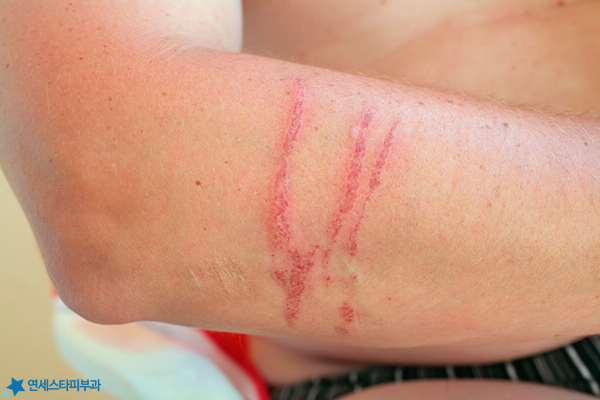
Even after a wound has healed, scars are likely to solidify if the following conditions overlap:
- If the inflammatory response continued for a long time during the wound healing process
- If the wound is deep or wide
- If it's an area frequently stimulated, such as the hand or arm
- If proper wound care was not provided during the recovery period
This means that the conditions for cat scratches to easily leave nail scars are sufficiently met. If you own a cat, developing a habit of checking wounds from the beginning in preparation for sudden scratches can be helpful.
First, Distinguish the Types of Scars
Scars vary in form depending on their color, shape, and texture. The forms that can appear after cat scratches or nail scars are summarized in the table below:
| Form | Characteristics |
|---|---|
| Red vascular marks | When blood vessels remain after wound healing, appearing red |
| Pigmented marks | When melanin deposits in the wound area, leaving a dark mark |
| Uneven tissue changes | When scar tissue is thicker or sunken compared to the surrounding skin |
| Fine scar lines, indented scars | When fine marks remain, like nail scars, making the skin texture not smooth |
If the form is indented, the approach is similar to management of depressed acne scars, and if the line is distinct like a surgical scar, reviewing surgical scar revision together can be helpful for understanding.
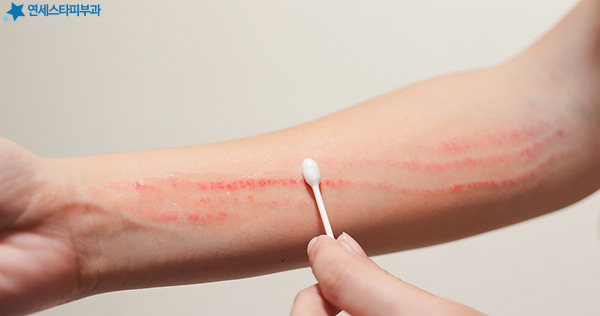
Things to Check Before Treatment
Even with the same cat scratch, scars can remain differently for each person. Before deciding on a treatment direction, we examine the following items:
- Whether the scar's color is red, black, or white
- Whether the scar's shape and texture are flat, thick, or indented
- How long ago the scar appeared
- The skin condition and frequency of irritation in the scar area
- Skin type and healing ability
Even if the cause of nail scars is similar, the appropriate laser equipment varies depending on skin type, shape, color, and treatment timing. Therefore, it is better to receive a thorough check from medical staff rather than self-diagnosing.
If you are curious about scar management, you can easily inquire through chat consultation for scar conditions.
How Does Laser Work on Scars?
Lasers work by delivering energy to the internal skin tissue, thermally stimulating scar tissue, and inducing regeneration. A key feature is that they can simultaneously correct various factors such as pigment, vascular changes, and tissue changes in the scar area.

Treatment tailored to the condition is possible by adjusting the device's intensity, density, and wavelength settings. For marks caused by cat scratches or nail scars, the process of selecting equipment, considering "when and in what state it was," is important.
It is reported that scar treatment leads to more natural results when equipment is divided according to color and depth, rather than using a single device to treat all marks.
Vbeam Prima, a Choice for Red Marks
Vbeam Prima is a device used for vascular marks, i.e., red mark treatment. It is used to selectively improve red blood vessels when the scar is in its early stages or when blood vessels are prominent. If red marks are distinct immediately after a cat scratch or nail scar, Vbeam Prima can be a good option.
Ultrapulse Alpha, Regeneration for Established Scars
Ultrapulse Alpha is a fractional CO₂ laser from Lumenis, specialized for scar treatment. It is notable for reaching up to approximately 4mm deep into the dermis, stimulating scar tissue, and inducing regeneration.
It is suitable for aiding regeneration from deeply established scars with fixed shapes to fine marks like nail scars. Even if a significant amount of time has passed since a cat scratch and the scar has set in, there is potential to subtly improve the mark through devices that activate the skin's regenerative power.
When to Start and How Many Sessions?
Scar treatment is reported to yield better results when started early, and it is particularly advantageous to manage immediately after the wound has healed. In the consultation room, those who visit when the marks are faint often have a wider range of options. However, even for scars that have been present for a while, there are devices like Ultrapulse Alpha that can be applied to deep scars, so we recommend consulting a specialist first rather than giving up.
The number of treatments varies depending on the scar's shape, depth, and location, and usually involves 5 or more repeated sessions. There can be individual differences, so the number and interval will be adjusted based on the condition.
Post-laser treatment care tips are as follows:
- Reduce physical irritation to the treated area
- Consistently maintain UV protection
- Protect the skin barrier with moisturizing
- Monitor progress while combining with regenerative care
If the scar is distinct or deep, methods such as Surgical Scar Revision or Triamcinolone Scar Injection may also be considered in addition to laser treatment.

For a Long and Happy Life with Your Cat
Cat scratches and nail scars are common occurrences in daily life, making them a frequent concern for those with pets. By using appropriate laser equipment tailored to the condition at the right time, marks can be naturally lightened.
Rather than dismissing it as "unavoidable because I have a cat," if the marks bother you, we recommend getting them checked. If you're curious about methods suitable for your scar condition, you can consult immediately below.
💬 Consult NowChief Director Lee Sang-joo (MD, PhD, Yonsei University College of Medicine and Graduate School, completed dermatology residency at Severance Hospital, President of the Korean Dermatological Association) Chief Director Lee Sang-joo's Profile First published 2025-10-27 / Last reviewed 2026-06-16
This content is for general information purposes only, and as scar conditions and recovery patterns can vary from person to person, please confirm an accurate diagnosis and treatment plan through consultation with medical staff.