

If a pierced ear doesn't heal and swells into a hard lump, you might suspect a keloid. The first questions that usually come to mind are, "Is this just a scar, or is it a keloid? And should I go to the hospital now?" To answer directly, ear keloids can grow or recur over time, so it's best to identify them early and establish a management plan.
The phenomenon of traces remaining after a wound heals is called a scar. In cases of minor healing, the traces fade over time, but if the healing process is not smooth, the skin may remain uneven. Among these, keloids are considered a challenging type.
What's the Difference Between Keloids and Regular Scars?
Keloid scars can appear anywhere on the body, especially on the chest, back, ears, and jaw. Many people inquire specifically about ear keloids after piercing. They are often called 'ear bumps' and appear as an abnormal swelling of the scar tissue with inflammation in the pierced area.
Typical scars stop changing and become fixed after a certain period, and the approach is to gradually erase the marks. However, keloids have a slightly different nature. They are reported to be challenging to manage because they tend to grow in size or recur after treatment.

Even if they start as small palpable lumps, they can grow into kidney bean-sized or tumor-like masses over time. Discomfort such as itching or pain may accompany the scar area, and if severe, it can cause inconvenience in daily life.
Why Do Ear Keloids Occur?
The clear reasons for ear keloid formation are not yet fully understood. However, it is known that when the skin is damaged by earrings or piercings, excessive collagen is produced during the healing process, causing the scar to abnormally protrude.
Constitutional factors are also reported to play a role, but it is not easy to confirm in advance whether one has a keloid constitution. If you have the following tendencies, it is advisable to be mindful of the possibility of occurrence and take precautions:
- If your skin easily swells even from small injuries
- If scars tend to remain and last for a long time
- If scars were prominent in previous piercing or surgical areas
- If a family member had keloids or hypertrophic scars
Keloids rarely disappear on their own over time and can even grow or recur, so early identification and management are reported to be important.
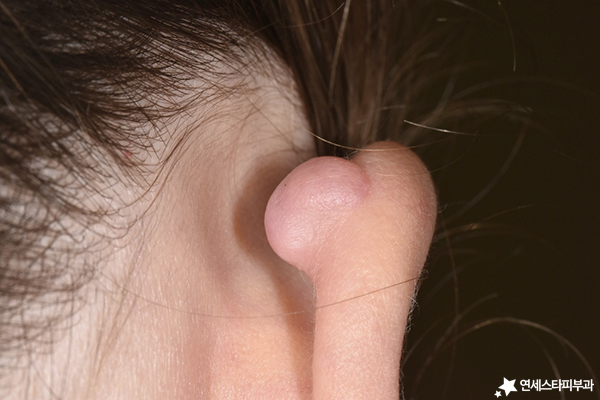
These Signs May Indicate Early Symptoms
In the examination room, the changes patients first notice are usually similar. If several of the following items overlap, it's time to check for the possibility of a keloid scar:
- A hard lump is felt around the time the piercing site heals
- The lump feels like it's gradually getting bigger over time
- Itching or throbbing pain accompanies the affected area
- The scar spreads beyond the original pierced hole
If you notice these changes, it's advisable to visit a dermatologist to check your condition before it gets larger. You can comfortably ask any questions you have through chat consultation regarding ear keloid symptoms.

How is Treatment Performed with Lasers and Injections?
In cases of keloid scars on the ear, satisfactory removal effects can often be expected with laser treatment alone, without surgical methods. Therefore, it is recommended to start treatment relatively early rather than neglecting it until it grows larger.
When treating scars with lasers, there is a perception that it takes a long time due to repeated treatments. However, ear keloids, which have grown into tumor-like masses, can be excised relatively quickly using laser methods such as Laser Lesion Removal.
It may feel similar to surgery, but its characteristic is that it can be completed quickly without a long recovery period after the procedure. The advantage is that it can be excised at once with a laser, allowing for a relatively quick return to daily life.

Post-Excision Management Determines the Outcome
Excising a tumor-like ear keloid is not the end. Maintaining a good state for a long time is paramount. A representative method to reduce the size and height of the scar is Triamcinolone Scar Injection.
| Treatment Method | Main Role | Features |
|---|---|---|
| Laser Excision | Removes raised scars | Relatively short recovery period |
| Injection Treatment | Reduces scar size and height | Used for recurrence suppression and maintenance |
| Combined Treatment | Balances removal and management | Reported to have higher satisfaction than single treatment |
Combining laser and injections allows for both removal and maintenance. The period of intensive treatment and preventive treatment may vary depending on the individual's condition. However, it is worth considering as it can increase satisfaction compared to performing injections or lasers alone.

Habits to Protect Scars in Daily Life
Even after treatment, management should continue to maintain a good state. Treatment is performed considering various conditions such as scar size, shape, onset time, and skin characteristics, and thereafter, it is advisable to adopt the following habits:
- Avoid creating new injuries or irritation in the affected area
- Do not touch or scratch excessively
- If itching or pain is felt again, do not leave it to chance and seek medical attention
- If you plan to get another piercing, consult with medical staff in advance
If you notice signs that could be early symptoms of an ear keloid, such as pain, itching, or a small lump that is gradually growing, we recommend visiting a dermatologist to check your condition without delay. If you have similar concerns, you can comfortably ask through chat consultation regarding scar treatment.

Sang-Joo Lee, Chief Director (MD, PhD, Yonsei University College of Medicine and Graduate School, completed dermatology residency at Severance Hospital, President of the Korean Society for Dermatology) Chief Director Sang-Joo Lee's Profile First published 2025-04-03 / Last reviewed 2026-06-16
This article provides general information, and symptoms and treatment responses may vary by individual. Accurate diagnosis and treatment should be determined through consultation with medical staff.