

Many people inquire about color tattoos after hearing they are harder to remove than traditional black tattoos, and hesitate to proceed with removal.
We've compiled information on how color tattoos are removed and what to check for.

Why Color is Tricky
Color tattoo removal is often more challenging to erase cleanly compared to black and white tattoos. The removal period tends to be longer and is considered more difficult.
We apply methods discovered through numerous clinical trials, and there are three key points to keep in mind when removing color tattoos.

First, is the equipment short-pulsed?
You may have heard that PicoWay Laser is effective for tattoo removal. Picosecond lasers work by emitting pulses in trillionths of a second to break down pigment into tiny particles.
However, not all picosecond lasers have the same performance. Even among picosecond lasers, a shorter pulse width can break down tattoo particles more effectively, leading to better results. Among picosecond lasers, PicoWay is known for its short pulse width.
Therefore, we recommend PicoWay Laser for difficult-to-remove color tattoos. You can see the equipment configuration in the R-Zero Pico-Frectat Tattoo Removal guide.

Second, does it use different wavelengths for each color?
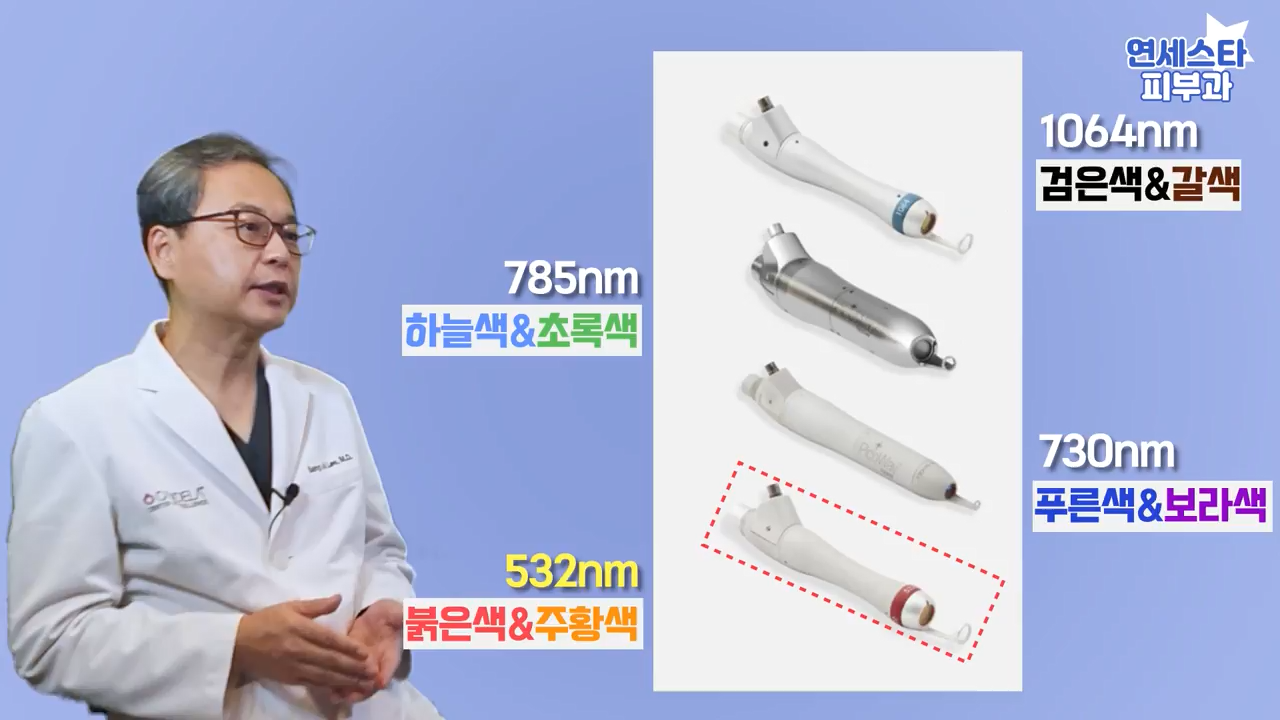
The next crucial factor is whether the practitioner applies appropriate wavelengths for each color. Lasers equipped with various handpieces can handle color tattoos more effectively. The PicoWay Laser used at our clinic has four handpieces for different wavelengths, allowing for color-specific removal.
| Tattoo Color | Wavelength Used |
|---|---|
| Black, Brown | 1064nm |
| Sky Blue, Green | 785nm |
| Blue, Purple | 730nm |
| Red, Orange | 532nm |
It is known that pigments are most effectively removed when using the appropriate handpiece for each color. You can find information on single-wavelength methods separately in Nd:YAG Tattoo Removal.
Third, can the number of sessions be reduced?
The outcome of color tattoo removal depends on how much the number of sessions can be shortened. This can vary depending on the following conditions:
- How deeply the pigment was injected
- Which colors were mixed and used
- How much pigment was used
Color tattoos, in addition to variations by color, generally require more treatment sessions compared to black and white tattoos. Since sessions are typically held once every one to two months, it can take several months to several years if the pigment does not fade easily.
As the duration lengthens, the probability of giving up midway also increases. Therefore, it is necessary to aim for a shorter treatment period with a procedure that allows up to 4 irradiations per session.
The R-Zero Technique addresses the drawback of conventional methods, where immediate re-treatment was difficult due to bubbles formed during laser irradiation, by applying a special PFD medication to allow for 3 to 4 additional irradiations.

Colors that fade well and those that don't
While color tattoo removal itself is not easy, some colors are particularly challenging. Blue and black tend to fade better than other colors, while white, skin tone, and yellow do not fade easily.
This is why cover-up tattoos are discouraged, especially for color tattoos. If a tattoo is covered with yellow, skin tone, or white due to a mistake, the treatment becomes very difficult.
Immediately after a cover-up, satisfaction is often high because it's hidden in one go. However, as this tattoo does not last permanently and its color changes over time, the discrepancy with the actual skin tone increases, often leading to visits for removal.
Skin-colored tattoos are difficult to remove, and the treatment period that might have ended in a few sessions could double, so it's advisable to be especially cautious.

You don't need to worry that color tattoo removal will be more painful just because it's more difficult.
Our clinic has adopted a low-pain air cooling system to alleviate pain and discomfort. Even those who have a fear or burden of pain can proceed without much difficulty.

What determines the final outcome
When removing color tattoos, it's also important to choose a laser that can handle various pigments to reduce the possibility of post-treatment pigmentation.
Color tattoos can be removed with patience and multiple sessions. However, please remember that in this long battle, how effectively the practitioner shortens the time with effective methods and know-how makes the difference in the final outcome.
The treatment flow is summarized in the Tattoo Removal Treatment Guide. If you are curious about the color composition of your tattoo, please let us know via chat now. The number of sessions required may vary for each individual.


Authored and Medically Reviewed by Chief Director Kang Jin-moon (Dermatologist) Graduated from Yonsei University College of Medicine · Severance Hospital Dermatology Resident Currently Adjunct Professor, Department of Dermatology, Yonsei University College of Medicine · Member, Korean Society for Laser Medicine and Surgery View Medical Staff Profile
First Published 2024-04-22 · Last Reviewed 2026-07-29
This article contains general medical information and is not a substitute for individual diagnosis and treatment. Results and recovery progress may vary for each individual.