
![Double Eyelid Scar Removal: Causes, Laser Selection Factors | [Yonsei Star Dermatology Sinchon]](/_next/image?url=https%3A%2F%2Fagqdgbuateknhwpocrgu.supabase.co%2Fstorage%2Fv1%2Fobject%2Fpublic%2Fsources%2Fbbf3bebe-45b6-4415-bd04-bda18b2cac0f%2Fblog-images%2F224050196720_00_c4153b00f5f4.jpg%3Ftype%3Dw966&w=3840&q=75)
Double eyelid surgery is a common cosmetic procedure that makes the eyes appear clearer. However, if the surgical site does not heal well, forms hard lumps, or a red line persists for a long time, the line can become uneven, altering the overall impression of the eyes. Many people wonder why double eyelid scars form and if they disappear on their own once established. The conclusion is that scar tissue formed in the dermal layer often does not easily resolve over time, requiring treatment tailored to its form and symptoms.
What exactly are double eyelid scars?
Double eyelid scars refer to fibrous scar tissue formed at the double eyelid surgical site. This occurs when the dermal layer of the incised and sutured area recovers during surgery, and tissue overgrows, resulting in hard lumps.

Sometimes it appears only as a red line on the surface, but it can also manifest as a broken line when the eyes are open or one side appearing thicker. Since it's not merely a surface skin problem but a structural change deep within the dermis, moisturizers or general ointments have limitations.

What causes scar tissue to form?
Several conditions often overlap in the formation of scar tissue. The following are typical contributing factors:
- High tissue tension during incision and suturing
- Delayed wound healing due to bleeding, inflammation, or infection
- Constitutional tendency towards hypertrophic scars or keloids
- Frequent rubbing of the eyes or irritation during swelling management after surgery

Especially if you are constitutionally prone to scarring, scar tissue may be more prominent even after the same surgery. If you have a tendency towards keloid scars or hypertrophic scars, it may be helpful to discuss this beforehand with your doctor.

How are scar tissue types classified?
Double eyelid scars do not appear in just one form. They vary in type, such as those with prominent redness, those that feel firm, or those where the line is sunken or raised. Since the approach differs depending on the form, it's easier to understand by classifying them as follows:

| Scar Type | Main Characteristics | Considered Approach |
|---|---|---|
| Predominantly Redness | Vascular dilation, persistent residual redness | Vascular laser types |
| Firm Fibrosis | Lumps when touched, thickness | Dermal regeneration-inducing laser types |
| Complex Type | Both redness and thickness | Multi-stage combined approach |
These forms often do not easily improve over time, and active judgment for double eyelid scar removal is reported to be necessary.

If you have any questions, inquire via chat consultation about double eyelid scars

How is laser treatment approached?
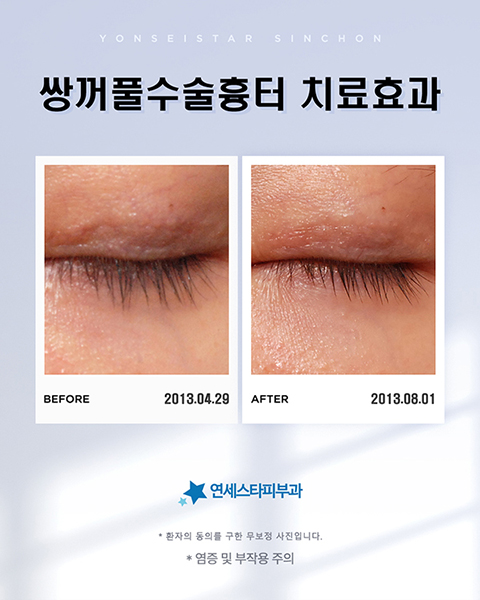
Double eyelid scars are not just a surface skin problem but a fibrous tissue issue formed deep within the dermis, so a combined approach with laser treatment is considered.
Since red scar tissue and firm fibrous tissue have different characteristics, combining lasers tailored to the symptoms rather than trying to solve everything with one device can help restore a natural line.
Vbeam Prima is a vascular laser used for redness and inflammatory scars, utilized to alleviate red scar tissue, vascular dilation, and residual redness in the double eyelid area. It causes relatively little skin irritation, allowing for precise treatment even in the delicate area around the eyes. Similar principles are applied in managing facial redness or red acne scars.

Ultrapulse Alpha and StarLux are used to selectively treat fibrous scar tissue in the dermal layer while inducing new collagen regeneration. They can be precisely controlled even on the thin skin around the eyes, helping the skin texture recover smoothly after double eyelid scar removal.
By selecting and treating with lasers according to the shape and symptoms of the scar, both red scar tissue and firm scar tissue can be addressed, resulting in a more natural recovery of the double eyelid line. This principle of equipment selection is also applied in treating similar cosmetic surgery scars.
Post-treatment care to reduce scar tissue
In clinical practice, post-operative care habits often determine the extent of scar tissue as much as the surgery itself. Paying attention to the following can help reduce the likelihood of occurrence:
- Avoid rubbing your eyes or pressing the area excessively during recovery
- Do not arbitrarily change prescribed ointments or care methods
- If redness or lumps persist for a long time, seek medical attention instead of self-diagnosing
- Reduce sun exposure and follow recommended protection guidelines
Above all, if scar tissue is felt or redness persists for a long time, it is safer to seek consultation with dermatology medical staff to determine the timing of laser treatment rather than managing it yourself.
Summary
Double eyelid scars remaining after surgery can become a factor that changes the impression of the eyes, beyond simple cosmetic discomfort. Precise laser treatments such as Vbeam Prima, StarLux, and Ultrapulse Alpha can help restore a natural double eyelid line by addressing redness and scar tissue, and the degree of recovery may vary from person to person.
We recommend finding a hospital and medical staff who can carefully select and perform the laser equipment necessary for you.
Feel free to ask any questions below.
💬 Consult Now

Chief Director Lee Sang-ju (MD, PhD, Yonsei University College of Medicine and Graduate School, completed dermatology residency at Severance Hospital, President of the Korean Dermatological Association) Chief Director Lee Sang-ju's Profile First published 2025-10-22 / Last reviewed 2026-06-16
This content is for general information purposes only, and since the form and recovery pattern of scars can vary from person to person, please confirm an accurate diagnosis and treatment plan through face-to-face consultation with medical staff.