
![Curling Iron Burn Scars: Treatment is Possible Even After a Long Time | [Yonsei Star Dermatology Sinchon]](/_next/image?url=https%3A%2F%2Fagqdgbuateknhwpocrgu.supabase.co%2Fstorage%2Fv1%2Fobject%2Fpublic%2Fsources%2Fbbf3bebe-45b6-4415-bd04-bda18b2cac0f%2Fblog-images%2F223323235793_00_9f2bd147e366.jpg%3Ftype%3Dw966&w=3840&q=75)
Curling irons are an indispensable tool for styling hair, but it's not uncommon for the high-temperature surface to touch the face, neck, or shoulders, leading to burns. We often receive questions like, "It's been a long time, can my scar still fade now?" To answer directly, improvement has been reported even for old burn scars when approached step-by-step, tailored to the scar's shape and pigment condition.
Immediately After a Burn: Emergency Response to Reduce Scarring
Treatment immediately after a burn determines the depth of the subsequent scar. The first thing to do is to cool the burn.
- Cool the burned area sufficiently under running cold water for 20-30 minutes.
- After the heat subsides, disinfect the area.
- Apply a moist dressing to keep the wound from drying out.
- Do not intentionally burst blisters; leave them as they are.
If this initial response is well-executed, the likelihood of scarring can be reduced. However, if the response is delayed or the burn depth was significant, burn scars may form.
What Do Curling Iron Burn Scars Look Like?
Burn scars do not appear in just one form. In the clinic, pigment changes are the most common accompanying feature.

They are broadly divided into two types of pigment changes:
| Category | Appearance | Main Cause |
|---|---|---|
| Hyperpigmentation | Skin appears dark or dark brown | Pigment darkens due to inflammation after a burn |
| Hypopigmentation | Burned area appears white | Destruction of melanin cells (mainly 2nd-3rd degree burns or higher) |
Even for the same burn, hyperpigmentation and hypopigmentation have different recovery pathways. Scars that have darkened and scars that have turned white require different treatment principles, so distinguishing the scar's condition is the first step.
Hyperpigmentation: An Approach to Matching Color
For hyperpigmentation that remains as dark brown or black, laser treatment is performed. At our clinic, we utilize Pico Toning treatment. This method involves repeatedly irradiating the mottled areas with Pico Toning to match them to the surrounding skin color.
It's best to understand this as a gradual evening out of tone with repeated irradiations, rather than all color disappearing at once. The number of sessions required may vary individually depending on the depth and amount of pigment.
For inquiries, please contact us via chat for burn scar treatment
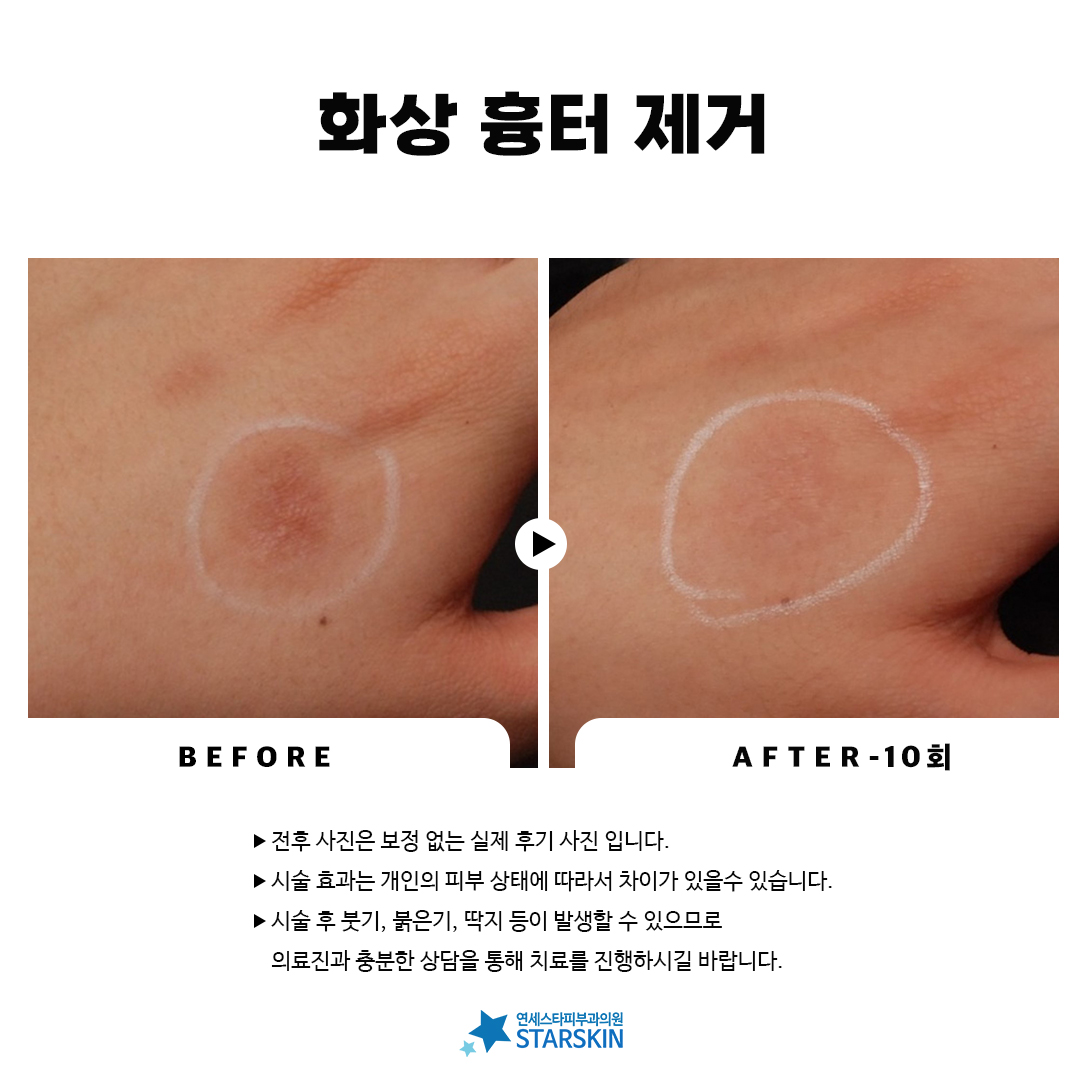
Hypopigmentation: Revitalizing Melanin Cells
As mentioned earlier, hypopigmentation is a condition where melanin cells in the skin are destroyed due to 2nd or 3rd-degree burns or higher. Therefore, for the skin to recover naturally, an environment must be created for melanin cells to regenerate.

At this time, treatment is performed with fractional laser and Pinhole Technique. Fractional laser aims to create a wound healing response in the skin, inducing melanin cells to recover naturally and the skin color to return to its original state.
The Pinhole Technique uses the Ultrapulse Encore laser to create tiny holes in the burn scar area. The laser reaches deep into the skin, inducing regeneration, and in that process, helps the skin color recover to resemble the surrounding skin. Depending on the thickness and extent of the scar, methods with adjusted intensity, such as Pinhole Alpha or Mild Pinhole, may be applied.
The Pinhole Technique is also applicable to severe burns that have resulted in thickened, hardened scars, and it is a procedure that Yonsei Star Dermatology Sinchon has been applying since the early 2000s (it can be called the originator of the Pinhole Technique).
When Scars Are Deep or Tissue Damage Is Extensive
If the skin tissue itself is deeply damaged beyond pigment issues, resulting in an uneven or hardened surface, laser treatment alone may have limitations. For such scars, Surgical Scar Revision may be considered. The appropriate method varies depending on the depth and location of the scar, so a medical consultation is necessary for diagnosis.
Things to Know Before Treatment
- Older scars require a step-by-step approach rather than a single treatment.
- Hyperpigmentation and hypopigmentation have different treatment principles, so accurate differentiation is paramount.
- After treatment, consistent UV protection is necessary to prevent pigment from darkening again.
- Recovery speed and results may vary individually depending on the burn depth, area, and skin condition.

It's easy to assume that old curling iron burn scars cannot be resolved, but by continuing treatment tailored to the scar's condition, improvement is possible. Rather than constantly worrying about covering scars, we recommend assessing which method might be right for you.
💬 Consult NowDr. Lee Sang-joo, Chief Director (MD, PhD, Yonsei University College of Medicine and Graduate School; completed dermatology residency at Severance Hospital; President of the Korean Dermatological Association) Dr. Lee Sang-joo's Profile First Published 2024-01-15 / Last Reviewed 2026-06-16
This content is for general informational purposes only, and recovery patterns and results may vary individually. Please consult with medical staff for an accurate diagnosis and treatment plan.