


Today's 20s and 30s generations are full of individuality. Many people are getting tattoos to express themselves.
There's a variety, from celebrity tattoos to semi-permanent makeup tattoos for eyebrows or eyeliners, tattoos to cover scars, and fashion tattoos to express individuality. However, the majority of those who get tattoos often make impulsive decisions.
Two Cases Encountered in the Clinic
Our clinic has performed thousands of laser tattoo removal procedures over 20 years.
One of the most memorable patients was a young lawyer who had studied abroad. She had her ex-lover's initials tattooed on her buttocks.
Another patient was a man who had his girlfriend's name tattooed on his arm. When asked why he didn't want to erase all the letters, he explained that his ex-girlfriend's name and his new girlfriend's name were similar, so he only wanted to erase part of the letters.

The Delicacy Created by Location
Couple tattoos are often placed in intimate areas not visible to others, such as the buttocks. This naturally requires more careful treatment.
We meticulously remove them to ensure that those who come with such concerns can proceed comfortably.
What Cover-Up Tattoos for Stretch Marks Leave Behind
Surprisingly, some people get cover-up tattoos to hide stretch marks or scars. The problem is that our skin color constantly changes with the seasons.
Over time, there will inevitably be a difference between skin color and the cover-up color. As a result, many people visit us to remove flesh-toned cover-up tattoos that are more noticeable than the stretch marks themselves.
Skin-toned tattoos are difficult to remove, so it can be like adding a bigger problem while trying to solve a smaller one.
Simply Increasing Intensity is Not the Answer
Most people who come for removal want to erase their tattoos cleanly in a short period. To remove them quickly, strong intensity and multiple treatments at once are often desired, but strong laser application can lead to scars or side effects.
Therefore, our clinic sets the irradiation intensity at an appropriate level to avoid leaving scars and combines it with preventive treatments to prevent scarring. Related procedures can be found in the Pinhole for Burn & Surgical Scar guide.
A Method of Irradiating Four Times at Once
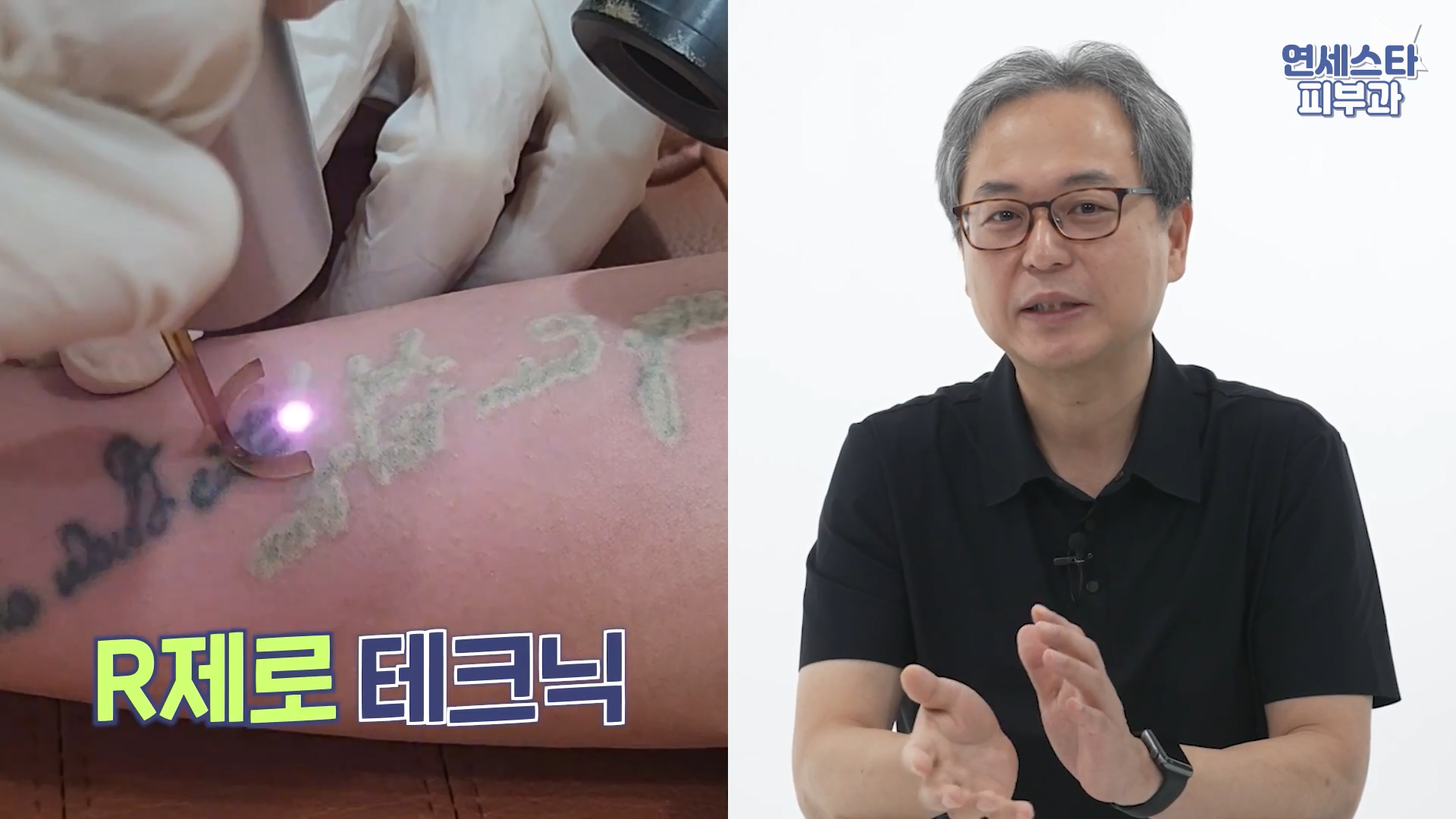
Conventional laser tattoo removal is usually limited to one treatment due to the bubbling phenomenon. Our clinic's R-Zero Technique applies a special PFD medication over the bubbles to make them disappear.
This allows for up to four repeated treatments at once, which can shorten the overall treatment period.
| Removal Method | Features |
|---|---|
| Chemical Removal | One of the known methods |
| Surgical Removal | One of the known methods |
| Laser Removal | Currently the most widely used method |
Even with laser removal, you should expect about 10 or more sessions, and for color tattoos, 14 or more sessions. The R-Zero Technique works to reduce this number of sessions. The equipment configuration is detailed in the R-Zero Pico-Frectat Tattoo Removal guide.
About Equipment and Pain
Our clinic uses PicoWay Laser equipment. This device has a short pulse width, and the shorter the pulse width, the more finely it can break down tattoos for removal.
- Good equipment and good treatment techniques must go hand in hand for successful treatment results.
- Pain is reduced using cooling-based pain control methods.

Between Before and After Tattooing
Tattoo removal costs significantly more and takes much longer than getting a tattoo. Therefore, please consider carefully before getting a tattoo.
If you are considering removal due to a couple tattoo in an intimate area, please first refer to the Tattoo Removal Treatment Guide and feel free to inquire via chat now. Individual results and recovery progress may vary.


Authored · Medically Reviewed by Chief Director Kang Jin-moon (Dermatologist) Graduated from Yonsei University College of Medicine · Severance Hospital Dermatology Resident Currently Adjunct Professor, Department of Dermatology, Yonsei University College of Medicine · Member of the Korean Dermatological Association View Medical Staff Introduction
First Published 2024-04-30 · Last Reviewed 2026-07-29
This article contains general medical information and does not substitute for individual diagnosis and treatment. Results and recovery progress may vary by individual.