

If a firm, raised mark on your chin persists long after acne has subsided, it may not be a simple acne scar. The first question that usually comes to mind is, "Is this just a scar, or is it a keloid that needs treatment?" If the mark doesn't subside for more than 6 months and feels like it's growing, you might suspect the possibility of it progressing into a keloid scar.
Why Do Acne Marks Become Chin Keloids?
When skin tissue proliferates excessively during the healing process of acne, the area may not heal flat but instead remain as a firm, raised scar. Keloids are often thought of as something that "only occurs in people with a certain constitution," but in reality, it's not that simple.
Changes in hormones due to various daily life situations can lead to an acquired change in constitution, or some individuals may have always had a tendency to develop keloids but didn't realize it due to a lack of clear triggers before. Therefore, if a raised mark on your chin persists for a long time, it's better to visit a dermatologist to carefully examine its condition rather than trying to self-diagnose.
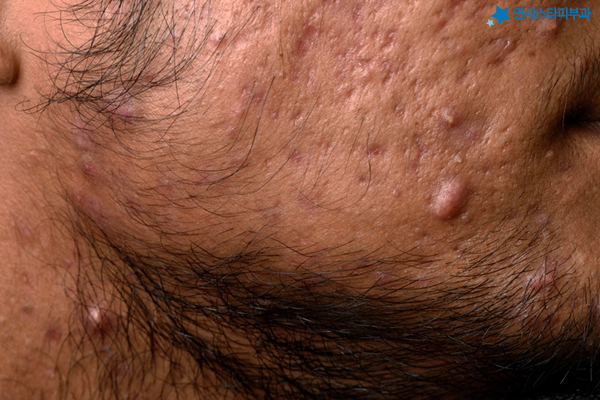
How Do Keloids Differ from Regular Scars?
Most scars gradually fade over time, but keloids have the opposite characteristic. They tend to become more raised and larger over time, often spreading beyond the original area of the injury to the surrounding skin.
In the consultation room, many patients find the "why does it keep getting bigger?" aspect more distressing than the raised shape itself. Sometimes, pain or itching may accompany it, and in severe cases, it can become a bothersome scar that affects daily life.

Unlike regular scars that fade over time, keloids are reported to grow larger and extend beyond the original wound area.
Where Do They Commonly Occur?
Keloids tend to appear more frequently in specific areas. They are primarily observed in the following locations:
- Center of the chest (anterior chest)
- Shoulders and back
- Earlobes (e.g., piercing marks)
- Lower face, such as the chin

They often start as small, millet-sized bumps that are not easily noticeable, but since scars tend to grow, it's best to examine them as early as possible. However, they don't grow indefinitely or always cause pain, so it's not uncommon for people to mistake them for the process of severe acne subsiding.
How to Distinguish Between Acne and Chin Keloids
The two differ in how they feel to the touch. Let's summarize this in the table below.
| Category | Active Acne | Established Keloid |
|---|---|---|
| Touch | Relatively soft | Hardened to the surrounding area |
| Pain | Often accompanied by heat and pain | Less severe pain |
| Change | Improves as inflammation subsides | May grow over time |
| Accompanying Symptoms | Pustules, redness | May feel itchy when growing |
Acne is a state where inflammation remains in the skin, so pressing the lesion often causes a sensation of heat and pain, and it is relatively soft. In contrast, if a chin keloid has already established itself, the surrounding skin begins to feel firm and hardened.
However, it is difficult for a layperson to accurately distinguish between them based solely on these differences. If you have any questions, you can easily check by contacting us via chat for inquiries regarding chin keloid and acne differentiation.

Combined Injection and Laser Treatment
Triamcinolone Scar Injection is often used to treat keloids. It helps flatten raised areas and is relatively simple to administer, making it a widely used method. However, recurrence is frequent, and the injections can be quite painful, which can be a burden for some.
To reduce these discomforts and maintain the effect for a longer period, we recommend combining it with laser treatment rather than using a single treatment.

Adding laser scar treatment can help improve abnormal tissue proliferation, and it is reported to not only reduce the size but also lower the possibility of recurrence and maintain the effect for a relatively long time.
Recently, there has been a trend to reduce the burden of the treatment process by choosing clinics that use injection methods with reduced pain compared to traditional ones. The important thing is to carefully select medical professionals who have the knowledge and experience in treatment methods that consider both convenience and effectiveness.
Management Points to Pay Attention to at Home
Separate from treatment, if you want to prevent scars from worsening in daily life, it's good to remember the following:
- Avoid frequently touching or pressing the raised area with your hands.
- Avoid irritating exfoliation or excessive scrubbing.
- Pay attention to UV protection for the affected area.
- If it doesn't subside for more than 6 months, seek medical consultation rather than making an arbitrary judgment.
As this is a relatively tricky topic among scars, we recommend calmly managing the marks with medical treatment and care rather than leaving them unattended for a long time or excessively irritating the skin. If you are concerned about acne marks in general, you may find it helpful to also refer to information on acne scars.
If you still have questions, check them out below.
💬 Chat with us nowConclusion
In this article, we've summarized the differences between acne and chin keloids, the characteristics of keloids, and the approach of combining injection and laser treatment. We hope this has provided a small guide for those who have been bothered by persistent raised marks on their chin for a long time.
Chief Director Lee Sang-ju (Yonsei University College of Medicine, Ph.D. in Medicine, completed dermatology residency at Severance Hospital, President of the Korean Society for Dermatology) Chief Director Lee Sang-ju's Profile First published 2026-03-11 / Last reviewed 2026-06-16
Treatment response and recovery patterns may vary by individual, so please confirm an accurate diagnosis and treatment plan through an in-person consultation with medical staff.