
![Chickenpox Scar Treatment Timing: Laser Treatment Recommended Before Scars Worsen | [Yonsei Star Dermatology Sinchon]](/_next/image?url=https%3A%2F%2Fagqdgbuateknhwpocrgu.supabase.co%2Fstorage%2Fv1%2Fobject%2Fpublic%2Fsources%2Fbbf3bebe-45b6-4415-bd04-bda18b2cac0f%2Fblog-images%2F223874351195_00_8b6e3e3157c3.jpg%3Ftype%3Dw966&w=3840&q=75)
Childhood Chickenpox: Why Does It Leave Scars?
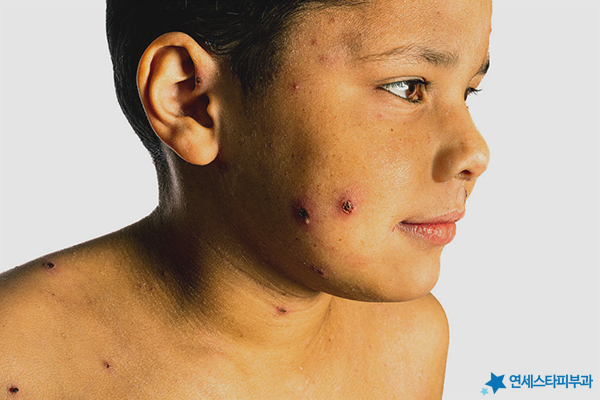
Chickenpox scars are marks left on the skin after suffering from chickenpox. Chickenpox is a highly contagious infectious disease commonly experienced in childhood, but many individuals are still bothered by the marks left on their faces into adulthood. One of the most frequent questions in the consultation room is, "Can old chickenpox scars be treated?" To answer directly, improvement can be expected with phased treatment, even if it takes time.
Especially when depressed scars remain on visible areas like the forehead or cheeks, they can't be covered with makeup, causing significant stress. Let's examine how chickenpox leaves scars.

Four Pathways for Chickenpox to Leave Scars
The process of chickenpox scarring can be broadly summarized as follows:
- Severe Inflammatory Response When infected with the chickenpox virus, blisters form. When these blisters burst, inflammation occurs. If the inflammation is deep, it can damage the dermal layer, leading to scarring.
- Scratching or Popping Blisters Chickenpox is accompanied by severe itching, making it easy to scratch or pop the blisters. This can lead to secondary infection or deep damage, often resulting in depressed, indented scars.
- Secondary Bacterial Infection If bacteria infect the blisters, the wound worsens. In children or individuals with weakened immune systems, wound management can be difficult, increasing the likelihood of scarring.
- Individual Constitution and Healing Capacity Individuals with reduced skin regeneration or a predisposition to scarring are more likely to develop marks. Even with the same illness, some may develop severe scars, while others recover with almost no trace.
Regarding the last point, individuals with a scar predisposition like keloids may have different healing patterns. Understanding the characteristics of keloid scars can help in determining the treatment direction.
The Limitations of Dermabrasion, and a Changed Approach
In the past, dermabrasion was often mentioned to remove such marks. However, it was reported to have drawbacks, such as severe redness in the treated area or even widening of the depressed area.
To compensate for the shortcomings of existing treatments, a combined treatment using Intracision (an application of subcision) and Er:YAG laser emerged. This allows for safer and more satisfactory results. Since most chickenpox scars are depressed, the approach aligns with the treatment principles for depressed acne scars, which are also a type of depressed scar.

Laser Treatment: When is the Best Time to Start?

So, when is the best time to start laser scar treatment to erase chickenpox marks? It's possible once the scabs have fallen off and there is no more oozing.
While there are individual differences depending on the person and the severity of the problem, recovery usually occurs to some extent within about 3 months. Starting treatment during this early stage is crucial to prevent it from developing into a larger scar.
When assessing the treatment timing, it's good to check the following:
- Have the scabs completely fallen off?
- Is there no more oozing from the affected area?
- Is it within the early stage, within 3 months of onset?
- Do you have no important appointments within a week?

If you have questions about chickenpox scars or are wondering about the right time to start treatment, you can easily inquire through chat consultation for chickenpox scar treatment timing.
Old Pockmarks: Can They Be Treated Now?
Scars from childhood sometimes remain as pockmark-like traces on the face into adulthood, and many people hesitate, wondering if such old chickenpox scars can be treated.
As more time has passed, treatment becomes a bit more complex and the process longer. However, it's not a problem that will never disappear. If you take your time and repeat the treatment multiple times, you can expect positive results, so don't give up. Similarly, for accumulated depressed scars, an approach combining multiple stages, such as Premium Customized Acne Scar Care, may be utilized.

Intracision and Er:YAG: Two Stages to Fill and Refine
You might be curious about how chickenpox scars are treated with lasers. As explained earlier, we combine Intracision, an application of the subcision method, with an Er:YAG laser.
First, the fibrous tissue causing the depressed scar is severed, helping the pulled-down skin to rise again. After this initial treatment and a recovery period, the depressed area naturally elevates.

Next, an Er:YAG laser is used to finely refine any raised or uneven edges of the scar. As the height matches the normal skin and the skin texture improves, the appearance of depressed chickenpox scars is naturally reduced. For deep or extensive scars, Surgical Scar Revision may also be considered.
| Stage | Method | Purpose |
|---|---|---|
| 1st | Intracision (Subcision application) | Severing pulled fibrous tissue to fill depressed areas |
| 2nd | Er:YAG Laser | Refining scar edges to smooth skin texture |

Treatment Sessions and Points to Note During Recovery
This method is widely used today as it reduces the burden of traditional chickenpox scar treatments. However, temporary bruising or erythema may appear immediately after the procedure.
If you have an important appointment within a week, it's advisable to postpone the treatment slightly. As it's not a one-time treatment, we recommend undergoing at least 5 sessions, spaced about a month apart. Individual results may vary.

One might think this method takes a long time. However, undergoing this process is reported to yield high satisfaction, as the treatment effect can be maintained under the premise that chickenpox scars do not reappear in the same spot. Similar to other types of acne scar treatment approaches, adjusting the plan according to the depth and shape of the scar is key.
Conclusion: The First Step to Reducing Scars
We hope this information has provided a small guide for those who have been burdened by noticeable chickenpox scars or stressed by old marks.

If you are an adult still bothered by chickenpox scars, examining the condition of your scars is the starting point.
💬 Chat for Consultation Now

Dr. Sang-Joo Lee, Chief Director (MD, PhD, Yonsei University College of Medicine and Graduate School; Completed Dermatology Residency at Severance Hospital; President of the Korean Dermatological Association)
First Published 2025-05-22 / Last Reviewed 2026-06-16
This article is for general information purposes only. Symptoms and recovery patterns may vary individually, and an accurate diagnosis and treatment plan should be determined through consultation with medical staff.