
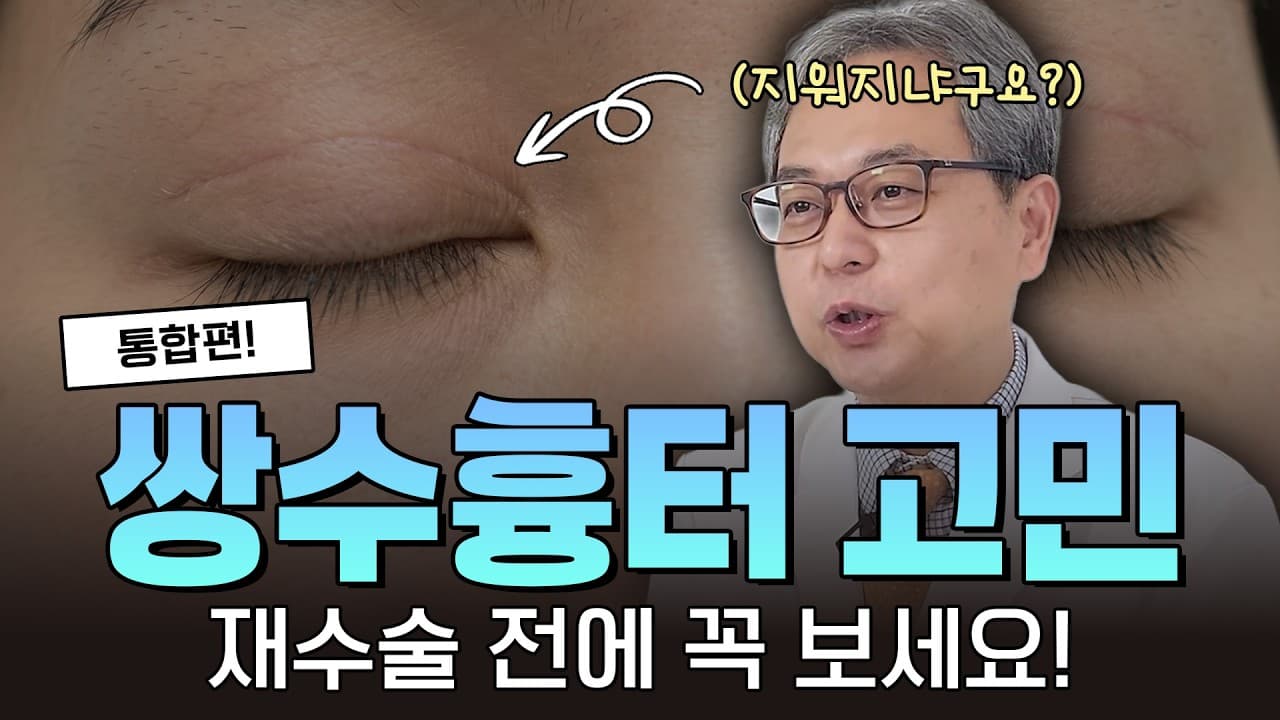
Unlike the saying that double eyelid surgery scars naturally get better over time, they can last a lifetime. It is not uncommon for red marks, indented lines, or raised tissue to persist for several months to several years or more. Therefore, scars are not just a matter of observing the progress, but an area where the approach must vary depending on the pattern and constitution. We have compiled and explained frequently asked questions.
Scars, once formed, can last a lifetime
While the shape may change in the early stages after double eyelid surgery, it is generally correct to assume that surgical scars remaining after 3 to 6 months will last almost a lifetime. Once a scar is established, it does not disappear on its own, so it is advisable to control it well in the early stages.
If you only believe that time is the best medicine and leave red lines untreated for a long time, you may miss scars that require treatment.
There is a golden time for scar treatment
Double eyelid scars, like general surgical scars, have a golden time. The earlier the treatment, the better the effect.
- Starting point: It is generally advisable to start treatment between 2 weeks and 6 months, or at the latest, within 6 months.
- Prevention purpose: Treatment can begin immediately 1 to 2 weeks after suture removal.
- If the timing is missed: If a white scar remains, you can receive treatment whenever you wish.
If a red line persists for a long time, it is highly likely to be a scar that requires treatment, not just a simple cosmetic issue.
The method varies depending on the nature of the scar
Double eyelid scar treatment varies depending on the size and color of the scar, the degree of unevenness, and the depth of indentation. It is difficult to definitively say whether laser or surgery is better.
- If the double eyelid line is completely crooked or asymmetrical, surgical revision is considered.
- If the scar is sunken, the line appears thick, or it is raised, laser is more effective for refining.
- If you have a constitution that tends to form scars easily, it is advisable to prioritize laser treatment over surgery.
Laser treatment is the concept of smoothing uneven areas like sandpaper and lifting indented areas. You can think of it as refining the surface while keeping the line shape as is.
The area around the eyes can be treated safely
Many people worry about corneal or nerve damage because it is an area close to the eyes. The laser used in this area is very precise and only treats the upper scar, so it does not affect the lower eye.
For those who are too worried, wearing protective lenses that the laser cannot penetrate during the procedure can reduce the burden on the eyes.
The pain during the procedure is also not significant, so you just need to keep your eyes closed.
More careful if you have a keloid constitution
Reports of keloids forming on double eyelid scars are rare, but some of my patients have developed them. In cases of keloid constitution, the indentation or protrusion of the surgical site is often more severe, and the line is frequently uneven. In such cases, injection treatment is combined with the procedure to loosen the scar. If the color remains dark, whitening lasers can also be helpful.
We approach with customization at the precise time
Double eyelid scars are not just a simple cosmetic issue. Receiving treatment tailored to the nature of the scar at the precise time is a way to accelerate recovery and naturally refine the double eyelid shape. For daily life, washing and showering are generally possible immediately, and fine exfoliation may occur for a few days.
Results may vary by individual, and accurate diagnosis and treatment are determined after consultation.
Written by. Dr. Sang-Joo Lee, Medical Director (Yonsei Star Dermatology) · Medical Staff Introduction · Last reviewed 2026-06-04