
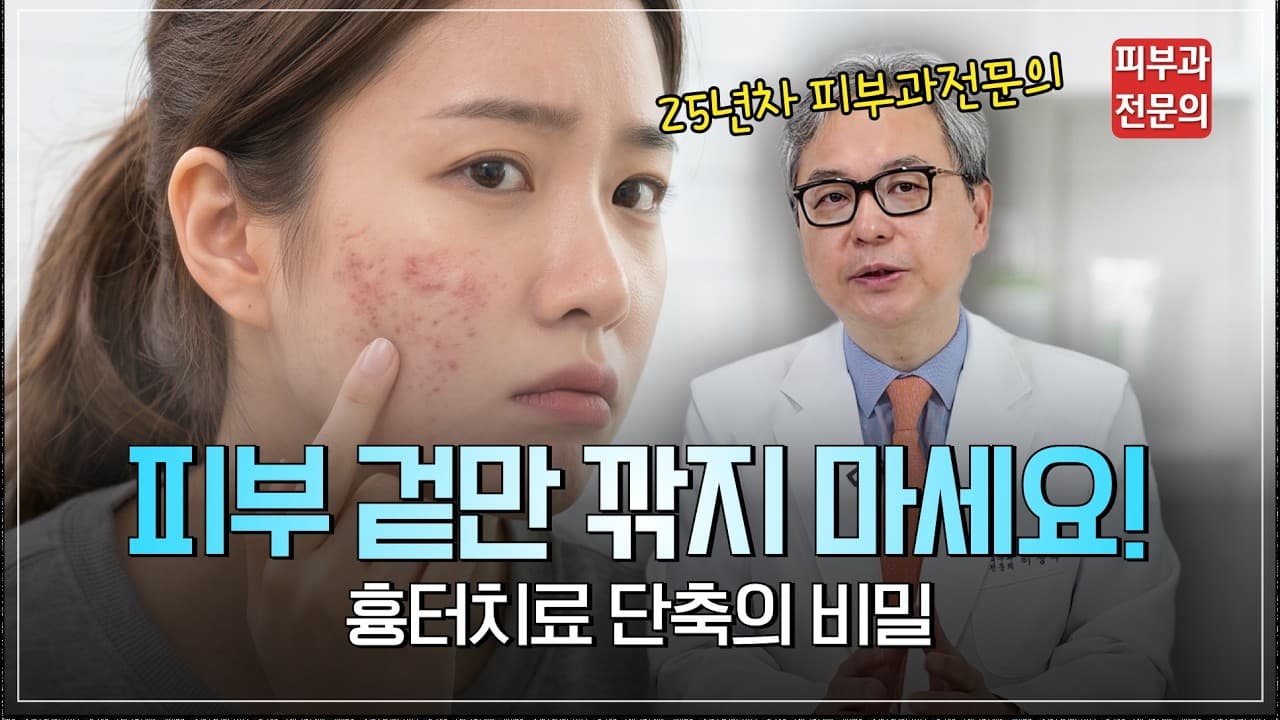
It must have been frustrating to see deep acne scars that couldn't be covered even with makeup. If you've tried scar ointments and laser treatments without improvement, the problem might be beneath the skin, not just on the surface. We've summarized Subcision and Suture-Free Punch, often called the ultimate treatments for acne scars.
Why surface-level treatments may not work
Depressed scars are not merely caused by thinning skin at that spot. Often, the surface is pulled down because scar tissue beneath the skin is firmly tugging on it.
In such cases, no matter how much the surface is refined, the pulling force remains. Even if the surface is regenerated with a laser, it gets pulled down again from below, making it feel like there's no progress despite repeated treatments.
If the cause is below, the solution must also address what's below.
What does Subcision cut?
"Sub-" means beneath the skin, and "incision" means to cut. Thus, it means to incise beneath the skin.
Subcision is a procedure where a special needle is inserted under the skin to sever the tough, fibrous scar tissue that is pulling the scar downwards.
Instead of shaving the surface, this method releases the pulling force, allowing the depressed skin to rise. You can understand it by a similar principle to a rubber band springing back when released.
The space created between the severed tissues is then filled through a regeneration process. This aims to both cut the tissue and encourage the skin to rise at the same time.
Scars well-suited for Subcision
It's difficult to expect the same effect for all acne scars. It is particularly effective for the following two types:
- Rolling scars — scars with gentle edges, broadly undulating depressions
- Boxcar scars — scars with distinct borders and square-shaped depressions
Both types are often caused by tissue pulling from below, so an approach that severs this force is well-suited.
When is Suture-Free Punch used?
This method uses a punch device to cut the skin according to the scar size, lift it upwards, and then adjust the height with a special medication without suturing.
If laser treatment is about stimulating the skin to slowly regenerate, Suture-Free Punch is closer to expecting significant change with a single procedure.
However, this method is also not suitable for all scars.
- Icepick scars (pore-like) — scars with narrow openings and deep depressions
- Boxcar scars with cylindrical depressions
It is primarily used for scars with clear and narrow borders, like those above.
Why one method is not enough
Acne scars vary in shape and depth even on a single person's face. It's common to have a mix of rolling and icepick scars.
Therefore, a complex approach is often needed, applying Subcision, Suture-Free Punch, and lasers differently depending on the scar type. Approaching them gradually and repeatedly, rather than trying to eliminate them all at once, tends to be safer and yield more stable results.
What makes a difference in post-procedure care
The treated area requires sufficient care to prevent secondary bacterial infections.
- If a special medication was applied at the clinic, about one week of caution is needed.
- For Subcision, it's advisable to avoid showering for one to two days.
- Adequate moisturizing and sun protection are fundamental and should continue throughout the recovery period.
- If redness persists, it's good to manage that aspect as well.
Insufficient care can delay recovery and leave pigmentation, making the days following the procedure as important as the procedure itself.
In summary
Acne scars do not improve on their own over time.
However, by distinguishing whether the scar's cause is on the surface or from tissue pulling from below, and by choosing the appropriate method for the type and consistently applying it, you can expect significantly smoother skin.
It is difficult to determine which type your scars are closest to by visual inspection alone, so a consultation is more accurate for confirmation.