
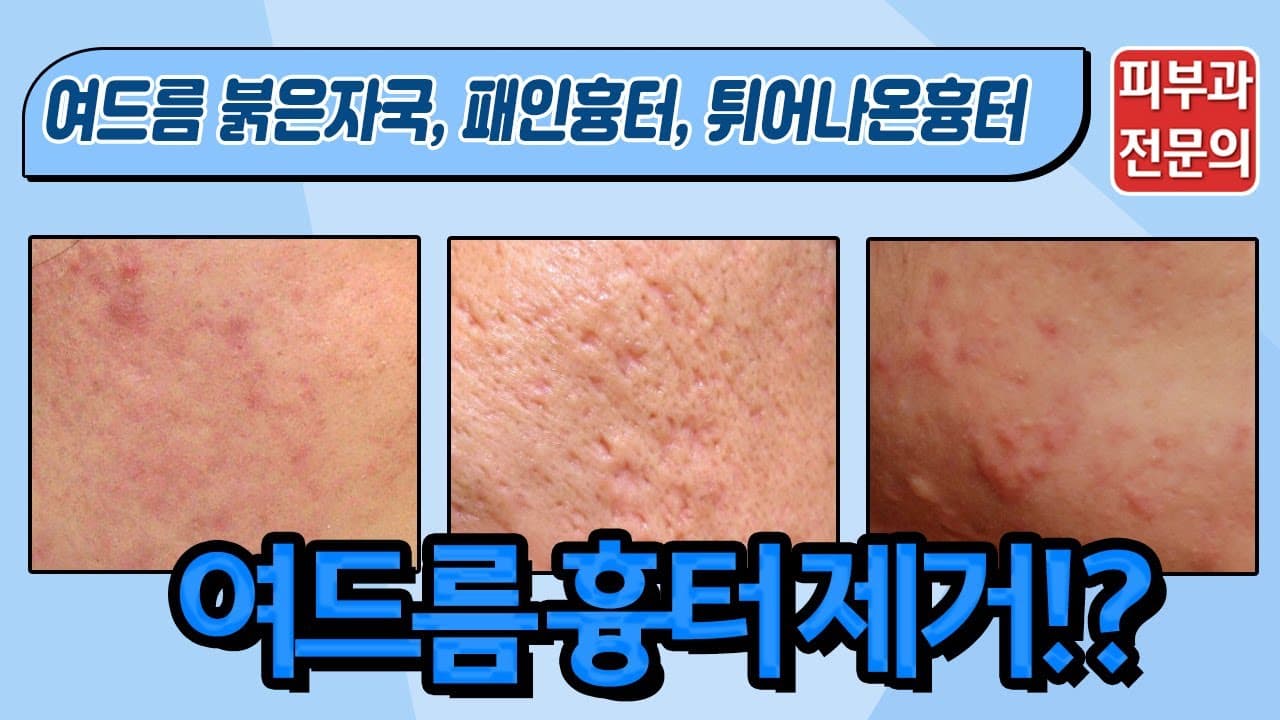
Hello. I am Lee Sang-ju, a dermatologist. Many people are concerned about acne, but while acne itself is a problem, many also experience difficulties due to the scars it leaves behind. Today, we will take a detailed look at acne scars.
Acne Scars: Not Just One Type
When we see acne scars on the face, it's easy to only think of 'depressed scars'. However, acne scars are diverse in shape and size, and can be broadly classified into three forms.
1. Scars with the same height as the skin surface (Pigmented Scars)
Among acne scars, there are cases where the height is the same as the skin surface, but only the color has changed. This area may appear red or brown. Red acne marks, in particular, can be seen as an early stage of scars that may progress to depressed scars.
2. Depressed Scars Where the Skin Sinks Down
The most common type of acne scar is a depressed scar, which appears as a sunk-in form after severe inflammation damages skin tissue. This can also be broadly divided into three types based on shape:
- Icepick Scar: Also known as a pore scar, it is narrow at the entrance and deeply pitted, as if pierced by an ice pick.
- Boxcar Scar: It has a round, cylindrical shape, appearing sunken within the skin.
- Rolling Scar: The skin surface itself is uneven, appearing as broad, shallow depressions, like rolling waves.
3. Raised Scars on the Skin
Many people only think of depressed scars when it comes to acne scars, but there are also raised scars on the skin. Particularly around the jawline or on the chest, large, raised keloid acne scars can occur.
Why is Customized Treatment Important for Various Acne Scars?
As acne scars come in various shapes and sizes, selecting treatment based on an accurate diagnosis of the scar is very important. Since treatment methods differ depending on the scar's shape, it is emphasized that treatment by experienced medical staff utilizing various techniques is paramount for acne scar treatment.
What are the Treatment Methods for Acne Scars?
There is a wide variety of treatment methods for acne scars. The appropriate treatment method is selected based on the type of scar.
- Flat Red Marks: Lasers that treat red acne marks are effective. Representative procedures include Vbeam Laser, which is used for vascular malformations or vascular treatments.
- Brown Marks: Brown acne marks are treated using pigment lasers.
- Depressed Scars: Since their shape, size, and depth vary, it is difficult to achieve results with a single method. Various methods are combined, broadly categorized into procedural methods and laser methods.
- Procedural Methods:
- Scar Filler: A procedure that fills in sunken areas.
- Subcision: A procedure that severs fibrous bands adhered beneath the skin.
- Punch Excision/Grafting: For cylindrical scars, this method uses a punch to remove or graft the scar area to match the height.
- Laser Treatment:
- Fractional Laser: While there are lasers that improve the skin overall, recently popular options include fractional lasers like Fraxel Laser, or ablative fractional lasers such as Deep FX or Active FX.
- Laser Dermabrasion: For severe acne scars, laser dermabrasion, which evens out the entire skin, is often performed.
- Procedural Methods:
- Raised Scars: Since raised scars often have many blood vessels, treatment often involves combining vascular lasers (Vbeam Laser) with Triamcinolone Scar Injection.
Considerations for Successful Acne Scar Treatment
When choosing an acne scar treatment method, it is important to consider various factors comprehensively.
"For laser treatment, it is crucial to select the appropriate laser for the scar's depth and width, and to choose the right treatment method and number of sessions, considering the patient's daily life."
Furthermore, the treatment intensity and frequency should be adjusted according to the patient's skin characteristics. If the skin tolerates laser well, it is advisable to achieve results in a short period with strong treatment. However, for sensitive skin, it is advisable to choose an appropriate laser and treat acne scars through repeated sessions.
No single laser can solve all acne scars. It is important to select the appropriate laser intensity based on the scar's shape and depth, and for this, it is crucial to receive treatment from an experienced practitioner. It is also important to choose a medical institution that can utilize various lasers.
Finally, and importantly, is the patient's consistent participation in treatment. Laser treatment does not completely eliminate scars in one go; rather, it is important to receive it consistently to gradually make the scar's height, depth, and color resemble the surrounding skin.